12 Simple Shoe Storage Ideas for Small Spaces That Work Fast
- Shoe Storage
 Ben
Ben- 0
- 39 minutes read
Living in a small space with a shoe collection is like trying to fit a gallon of milk into a shot glass—technically possible, but it’s gonna get messy. I know because I’ve spent years in apartments where my shoe situation was genuinely out of control.
At one point, I had shoes under my couch, behind my bathroom door, and in a sad pile near my bed that I just stepped over every morning like it was normal.
Small spaces force you to get creative, and honestly? Some of the best storage solutions I’ve found came from desperation and limited square footage.
You don’t need a walk-in closet or a massive entryway to keep your shoes organized. You just need smart solutions that maximize every inch you’ve got.
So let’s talk about 12 shoe storage ideas that’ll transform your cramped space from chaotic to functional—without requiring you to get rid of half your collection.
1. Vertical Shoe Rack Solutions
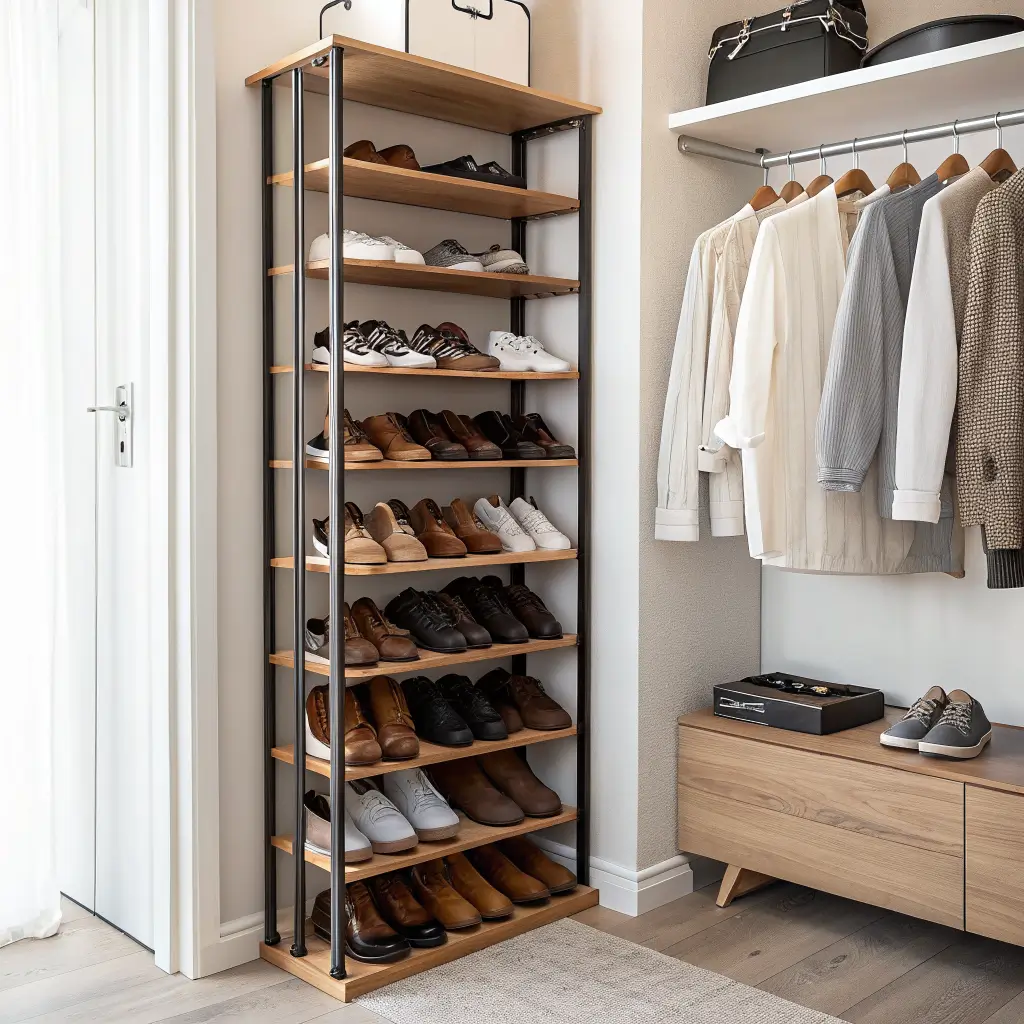
When you’re short on floor space, the only way to go is up. Vertical shoe racks are your best friend in small spaces because they maximize height instead of eating up precious square footage.
I installed a slim vertical rack in my tiny apartment entryway, and it holds 18 pairs of shoes in the same footprint as two shoe boxes side by side. The tower design stacks shelves on top of each other, creating multiple tiers of storage that climb toward the ceiling. It’s like a high-rise apartment building for your footwear.
Why vertical racks are perfect for small spaces:
- Minimal floor footprint: Takes up maybe 1-2 square feet
- High capacity: Most hold 15-30 pairs depending on height
- Easy to see everything: No digging through piles
- Fits in narrow spaces: Ideal for hallways and tight corners
The key is choosing a rack that’s actually stable when fully loaded. My first vertical rack was so wobbly that I genuinely feared for my safety every time I grabbed shoes from the top. I upgraded to one with a wider base and haven’t looked back. Stability matters when you’re stacking shoes six feet high.
Placement is crucial too. I keep mine right by my front door in a narrow space that couldn’t accommodate any other furniture. That spot was basically useless before, and now it’s the hardest-working storage in my apartment. Think about those awkward spaces in your home—vertical racks can turn dead zones into functional storage.
2. Under-Bed Shoe Storage Hacks
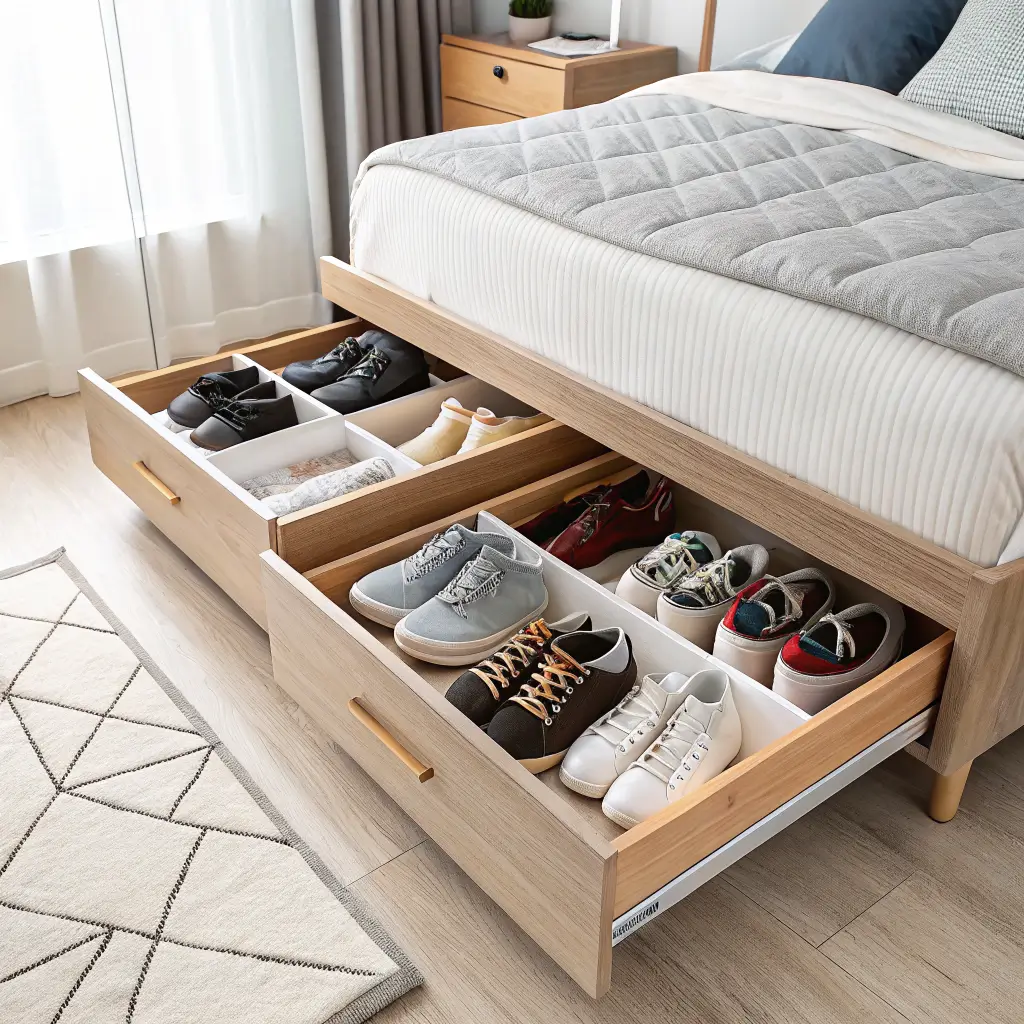
Your bed is sitting on top of prime real estate, and you’re probably not using it. Under-bed storage is the ultimate hidden solution for small spaces because it doesn’t require any visible footprint at all.
I use rolling containers under my bed for seasonal shoes I’m not currently wearing. Winter boots in summer? Under the bed. Sandals in winter? Same deal. This keeps my active shoe storage focused on what I actually need while still having everything accessible when seasons change.
Under-bed storage advantages:
- Completely hidden: Shoes stay out of sight
- Uses wasted space: That area was doing nothing anyway
- Protects from dust: Enclosed containers keep shoes clean
- Easy access: Rolling bins slide in and out smoothly
The trick is measuring your under-bed clearance first. I bought containers that were half an inch too tall and had to return them, which was annoying. Measure the height from floor to bed frame, then buy containers that leave at least an inch of clearance so they slide easily. Learn from my mistakes, people.
I recommend clear-top bins so you can see what’s inside without pulling everything out. Or at least label them clearly—”Summer Shoes,” “Winter Boots,” whatever makes sense. Future you will appreciate not having to play a guessing game at 7 AM when you’re already running late.
3. DIY Hanging Shoe Organizer Ideas
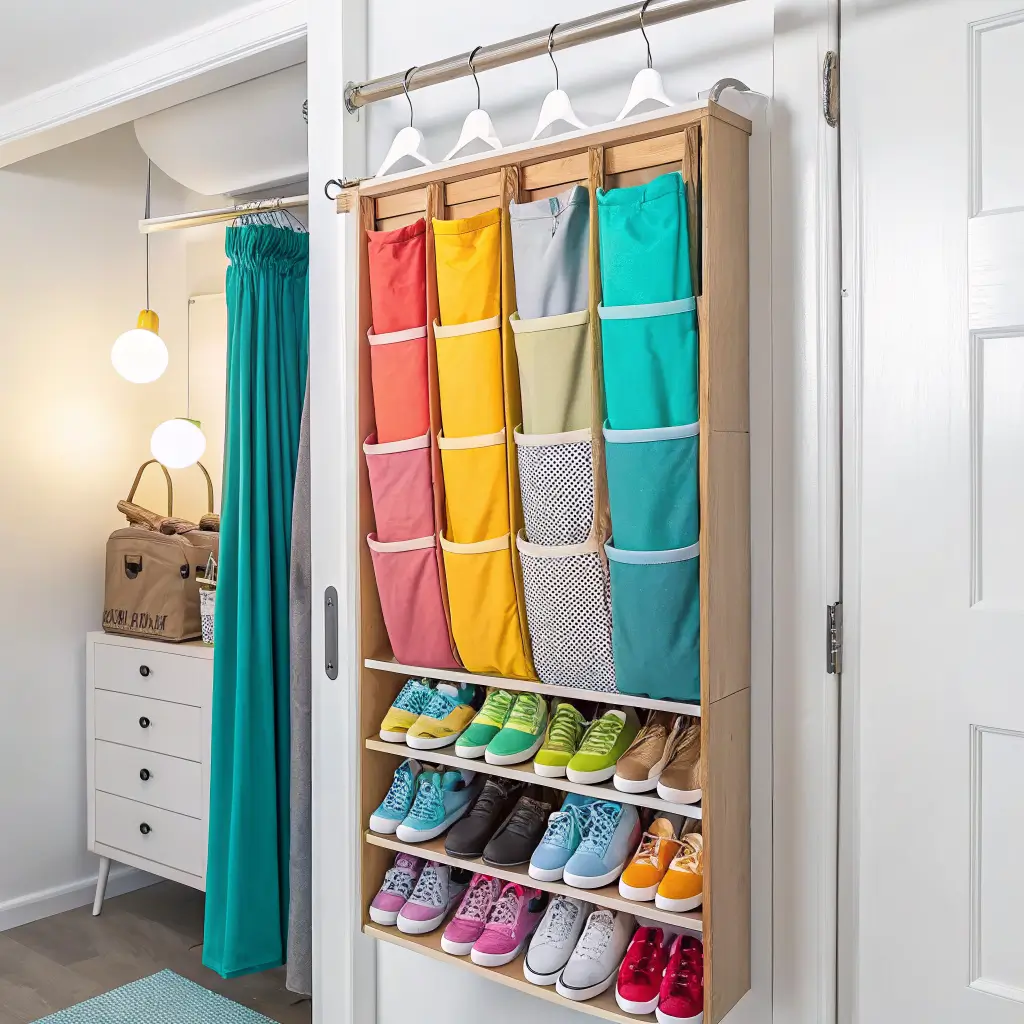
Sometimes the best solutions are the ones you make yourself. I created a hanging shoe organizer using fabric pockets and a tension rod, and it cost me maybe $20 total while holding about 12 pairs of shoes.
The beauty of DIY hanging organizers is that you customize them exactly to your space and needs. You can make them whatever size fits your closet, use whatever fabric matches your style, and create pockets sized for your actual shoes. Store-bought organizers never quite fit right, but when you make your own? Perfect fit every time.
Why DIY hanging storage works:
- Custom sizing: Make it fit your exact space
- Budget-friendly: Usually way cheaper than buying pre-made
- Personal style: Choose fabrics and colors you actually like
- Adjustable design: Modify it anytime you want
I used canvas fabric for durability and sewed pockets big enough for my largest sneakers. The whole thing hangs from a tension rod inside my closet, using vertical space that was previously just… air. The project took one afternoon and required basic sewing skills—if you can sew a straight line, you can do this.
If sewing isn’t your thing, you can also create hanging organizers using sturdy fabric and hot glue. I’ve seen people make them from old jeans, canvas tote bags, and even shower curtain material. Get creative with whatever materials you have. The goal is functional storage, not winning a craft competition.
Also Read: 10 Amazing Garage Shoe Storage Ideas to Declutter Fast
4. Over-the-Door Shoe Storage Tricks
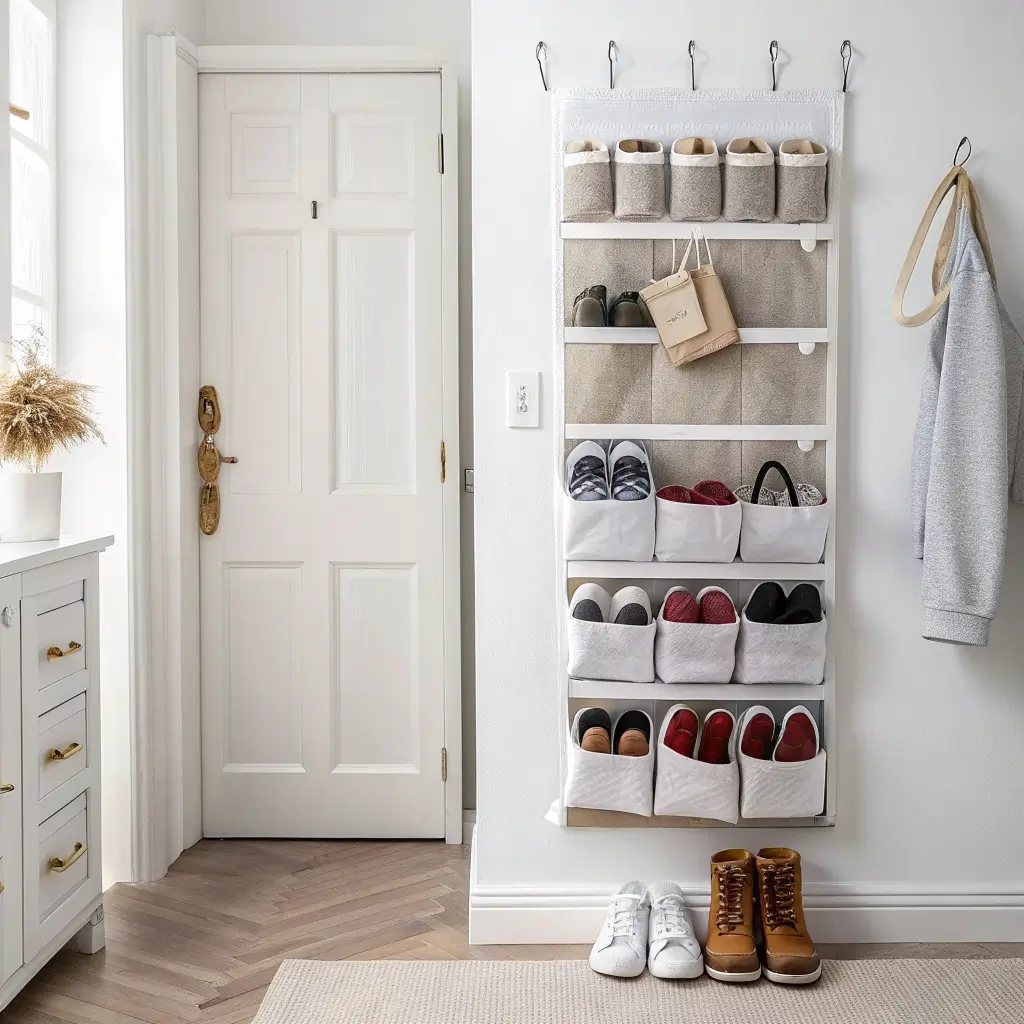
That door you walk through every day? It’s wasting valuable storage space. Over-the-door organizers are clutch for small spaces because they add storage capacity without using any floor or wall space.
I have one hanging on my bedroom door, and it holds 24 pairs of shoes. That’s 24 pairs that aren’t cluttering my floor, my closet, or my sanity. The door was just swinging open and closed anyway—now it’s pulling double duty as storage. Efficiency at its finest.
Over-the-door benefits for small spaces:
- Zero floor space: Doesn’t add to floor clutter at all
- Huge capacity: Most hold 20+ pairs easily
- No installation: Just hook it over and you’re done
- Renter-friendly: No holes, no permanent changes
The clear pocket versions are game-changers because you can see everything at once. I organized mine by category—flats at the top, sneakers in the middle, heels at the bottom. Now finding shoes takes five seconds instead of five minutes of frantic searching.
One important consideration: make sure your door can still close properly. I didn’t check this initially, and my door stuck out about 3 inches because of the organizer thickness. I had to get a slimmer version, which worked perfectly. Measure the gap between your door and frame before buying, or you’ll be making returns like I did :/
5. Compact Stackable Shoe Shelves
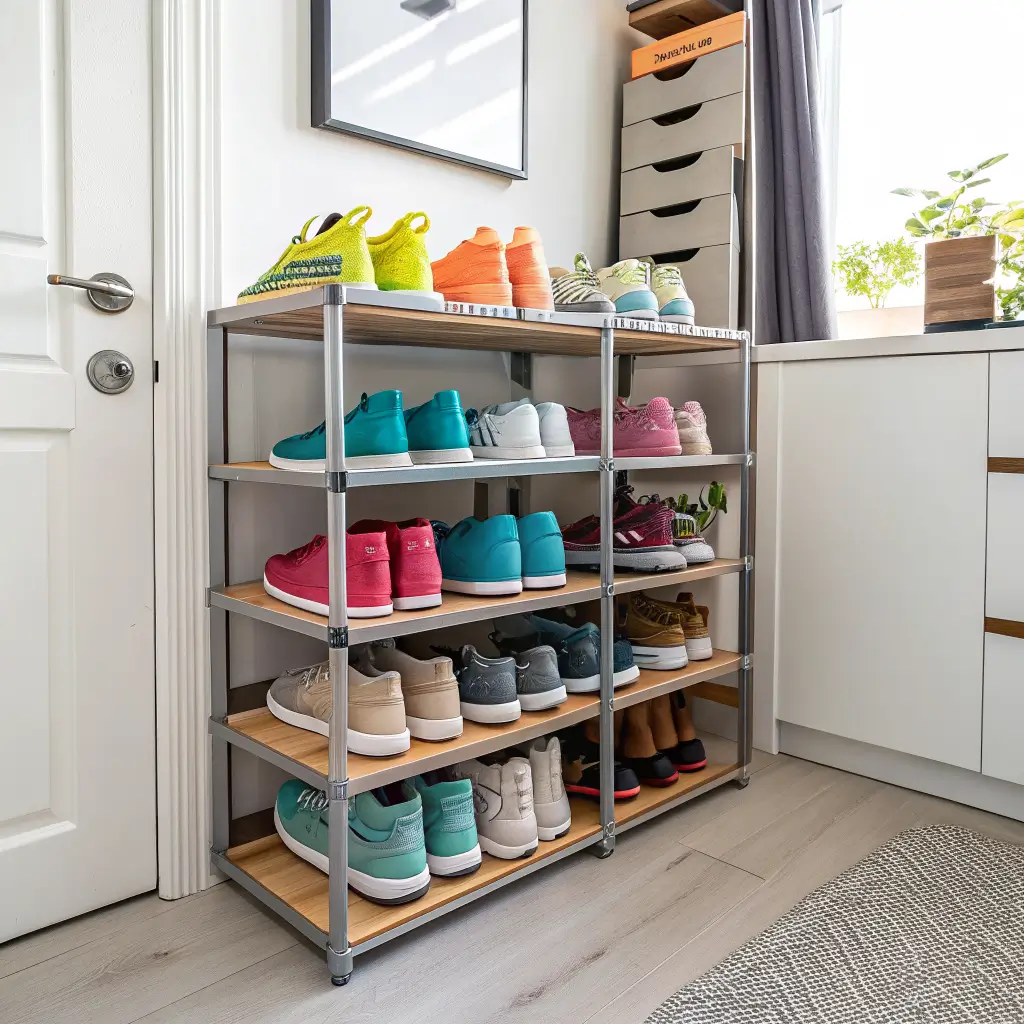
Stackable shelves are like building blocks for adults—endlessly configurable and surprisingly satisfying. These modular units let you build storage that fits your exact space, whether that’s a tiny corner or a narrow closet.
I started with a set of six stackable shelves and arranged them in my closet corner. Each shelf holds one pair of shoes, and I can stack them however makes sense. Need more storage? Add more shelves. Space requirements change? Rearrange them. It’s flexible storage that adapts to your needs instead of forcing you to adapt to it.
Why stackable shelves work in small spaces:
- Modular design: Start small and expand as needed
- Custom configurations: Stack them however fits your space
- Lightweight and portable: Easy to move and rearrange
- Affordable: Usually way cheaper than furniture
The individual shelf design means shoes don’t pile on top of each other, which prevents that annoying situation where you need the shoe at the bottom of the pile. Each pair lives on its own shelf, making everything accessible without disrupting the whole system.
I keep mine in a corner of my closet where nothing else would fit. The compact footprint works perfectly in that awkward space, and I can access every pair without moving anything else. FYI, look for shelves with ventilation holes or open designs—solid shelves can trap moisture and make shoes smell funky.
6. Hidden Shoe Storage Furniture
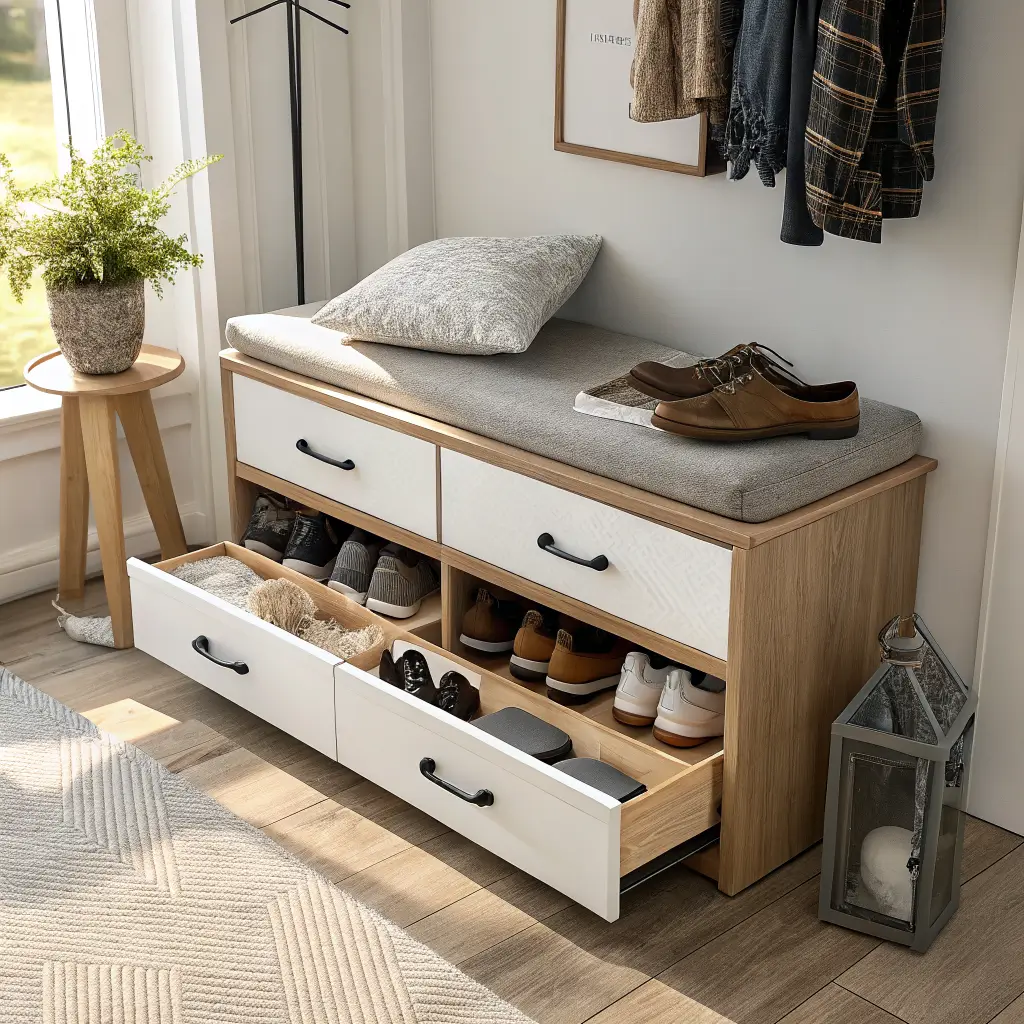
The best storage in small spaces is the kind you can’t see. Furniture with hidden shoe compartments gives you storage without the visual clutter, which makes small spaces feel bigger and less chaotic.
I bought an ottoman with internal storage that holds about 10 pairs of shoes. From the outside, it looks like a regular footrest in my living room. Open the top, and boom—organized shoe storage hiding in plain sight. Guests have no idea my living room furniture is secretly a shoe warehouse.
Hidden storage furniture advantages:
- Dual purpose: Furniture and storage in one piece
- No visual clutter: Keeps small spaces looking clean
- Discrete organization: Hides shoes completely
- Multi-functional: Often provides seating or surface space
Storage ottomans, benches with lift-up seats, and coffee tables with compartments all work for hiding shoes. The key is choosing furniture you actually need anyway—don’t buy a storage ottoman if you don’t need an ottoman. But if you’re already shopping for furniture, getting versions with storage is a no-brainer.
I also have a storage bench at the foot of my bed that holds seasonal shoes. It provides seating when I’m putting on shoes, storage for about 8 pairs, and looks like actual furniture instead of obvious storage. In a small space, every piece of furniture needs to earn its place by doing multiple jobs.
Also Read: 10 Creative Shoe Storage Ideas Closet Ideas for Busy Homes
7. Rotating Shoe Carousel Designs
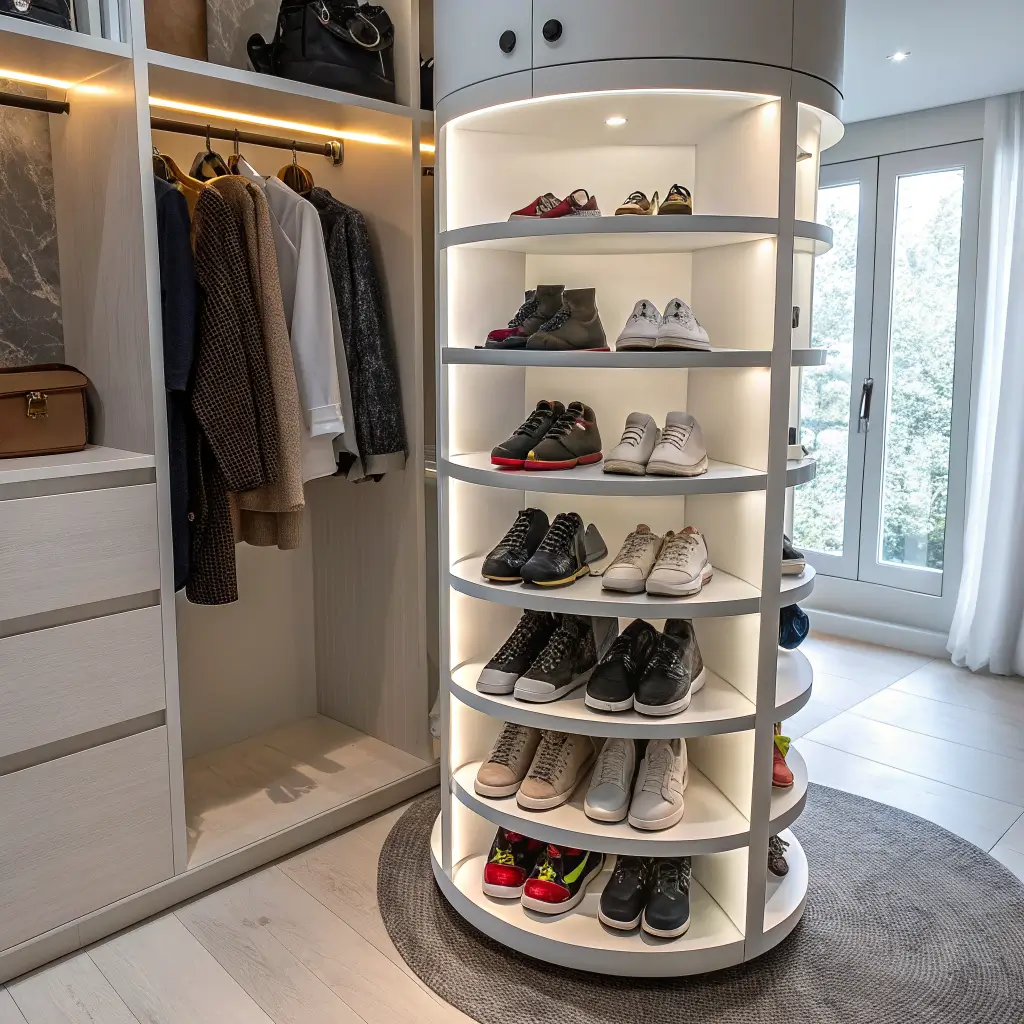
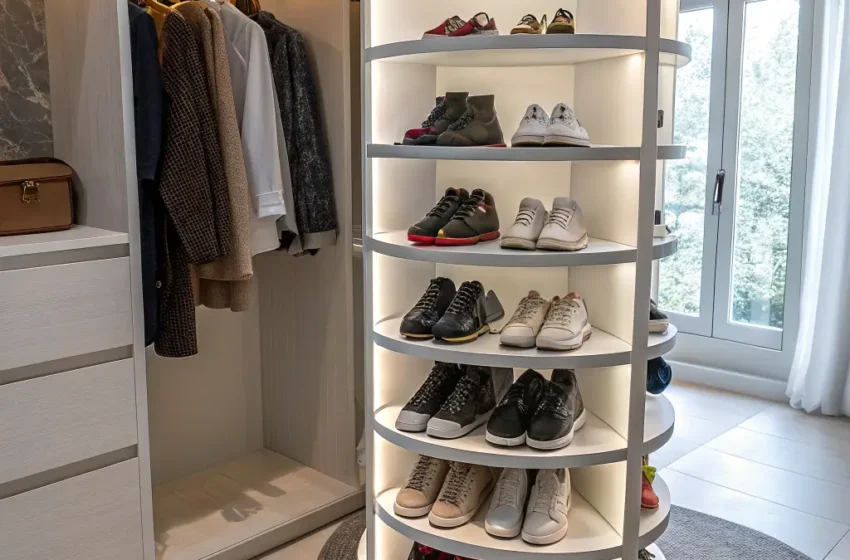
Rotating carousels are like lazy Susans for shoes, and they’re weirdly perfect for small spaces. I was skeptical until I tried one—now I’m convinced these things are underrated genius.
The carousel design lets you spin the rack to access different shoes, which means you can pack a lot of storage into a small footprint. Mine holds 24 pairs in a circular tower that takes up less than 2 square feet of floor space. I spin it to find what I need instead of shuffling through racks or digging in bins.
Why carousels work in tight spaces:
- Compact circular footprint: Small floor space usage
- High capacity: Surprising amount of storage
- Easy access: Spin to find what you need
- Kind of fun: Never gets old, honestly 🙂
The rotating mechanism makes every shoe accessible without moving anything else around. This is huge in small spaces where you can’t afford to have stuff blocking other stuff. Everything’s equally accessible with a quick spin.
I keep mine in a corner of my bedroom where a traditional shoe rack wouldn’t fit. The circular design works perfectly in corners because there’s no “back” that becomes inaccessible. Every side is equally functional, which maximizes the usefulness of awkward spaces.
8. Clear Shoe Box Organization System
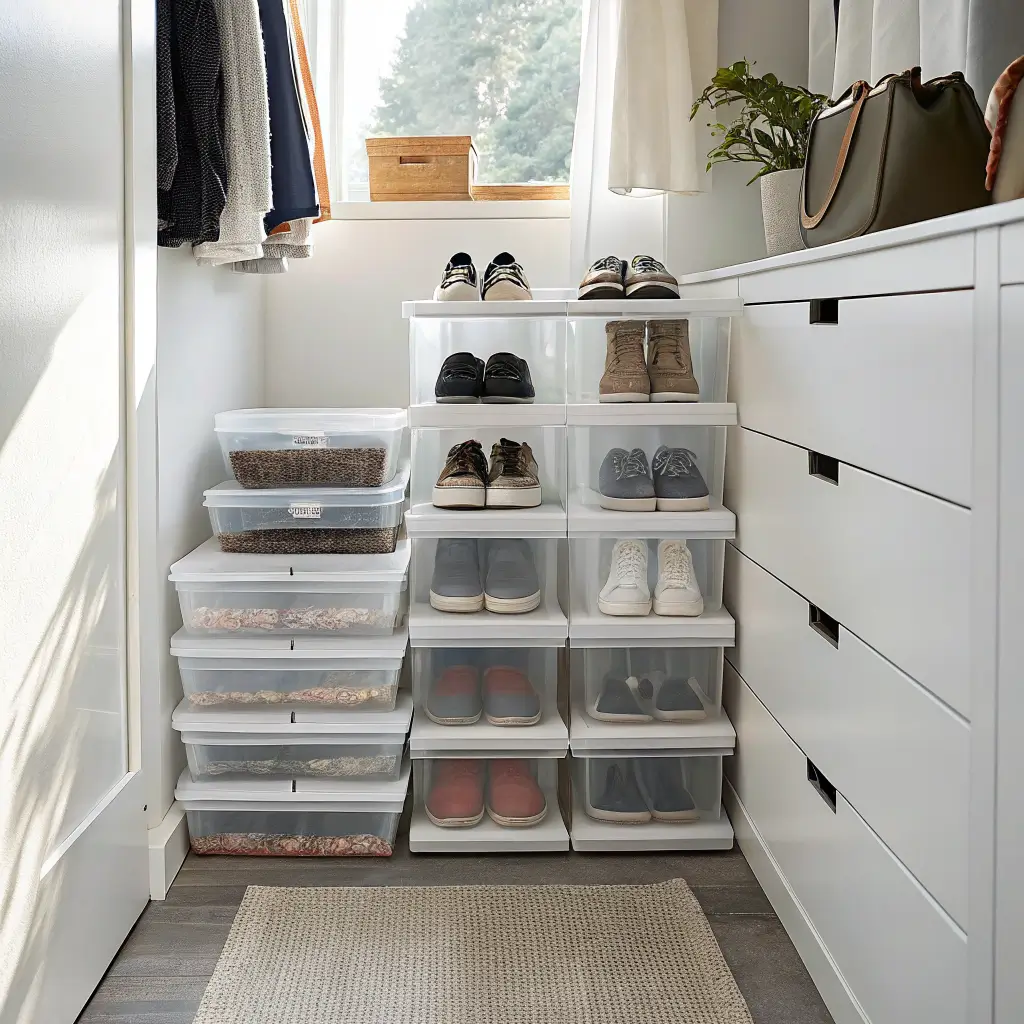
Clear boxes are the “I want to see everything without opening anything” solution. I switched to clear boxes for my entire collection last year, and the difference in functionality is night and day.
Each pair gets its own clear box that stacks with the others. You can see exactly what’s in every box without opening them, which eliminates the frustrating search through multiple containers. Stack them on shelves, in closets, or under beds—wherever you have vertical space to work with.
Clear box system benefits:
- Visual inventory: See every pair instantly
- Dust protection: Shoes stay clean and protected
- Stackable design: Build storage upward
- Uniform appearance: Everything looks organized and intentional
I labeled mine anyway because I’m that person, but honestly, the clear design makes labels kind of unnecessary. You can see what’s inside. The uniform stacking also makes my closet look way more organized than it did when I had random mismatched shoe boxes everywhere.
The investment is real though—clear boxes aren’t cheap if you’re outfitting an entire collection. I bought mine gradually, starting with my most-worn shoes and expanding over time. You don’t need to do everything at once. IMO, start with 5-10 boxes and see if the system works for you before committing to a full set.
9. Corner Shoe Rack Innovations
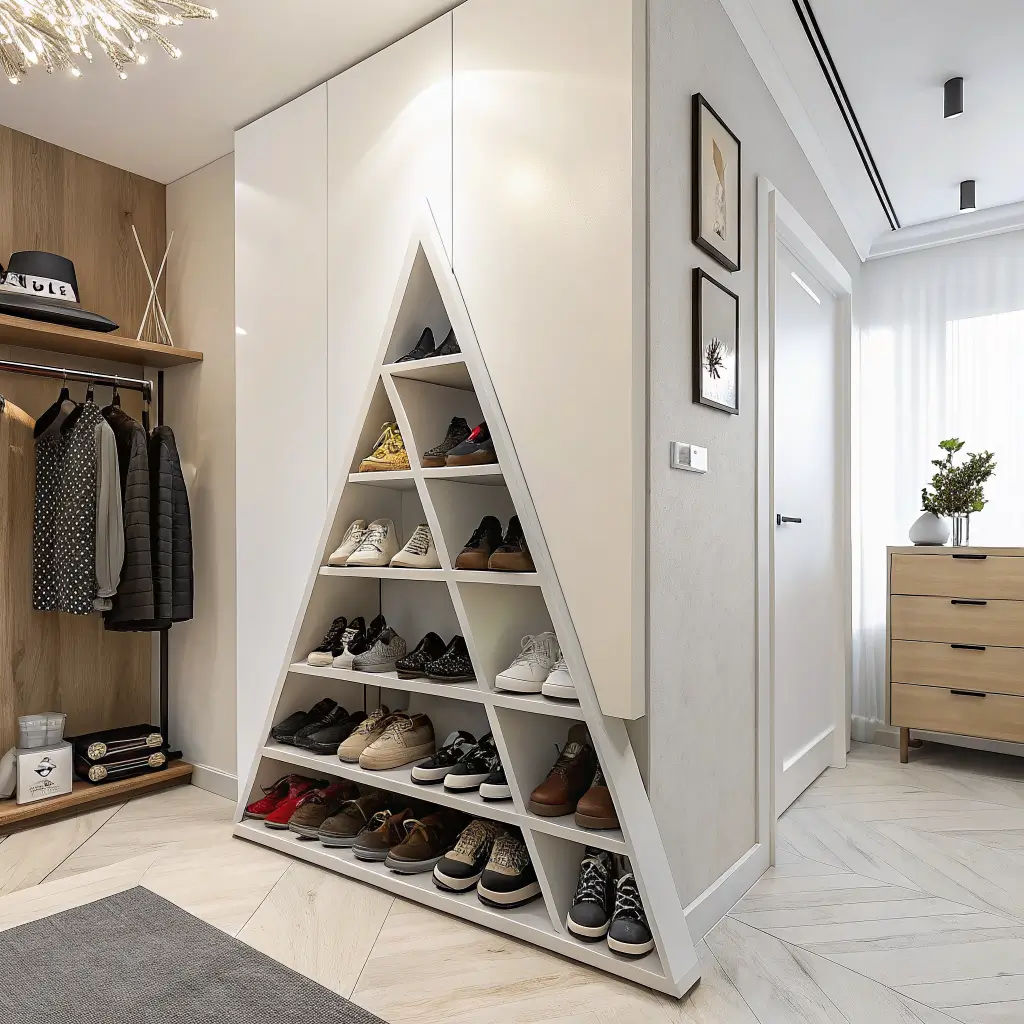
Corners are the most underutilized real estate in small spaces. A corner shoe rack is specifically designed to fit into those 90-degree angles where regular furniture just doesn’t work.
I installed a triangular corner rack in my entryway corner that was previously just collecting dust and random papers. Now it holds 15 pairs of shoes in a space that’s maybe 18 inches per wall. That corner went from useless to my most efficient storage spot basically overnight.
Corner rack advantages:
- Uses wasted space: Makes dead corners functional
- Compact footprint: Minimal space for decent capacity
- Stable triangular design: Naturally steady structure
- Fits where nothing else does: Purpose-built for awkward angles
The tiered design means shoes stack vertically, and the triangular shape is surprisingly stable. You’re not fighting physics like you are with rectangular racks shoved into corners. Everything just… works.
I keep my everyday shoes on the lower, more accessible tiers and special occasion shoes up higher. This way, the shoes I wear constantly are right at hand level, and the fancy heels I wear twice a year can live in the less convenient spots. Organizing by usage frequency makes way more sense than organizing by color or type.
Also Read: 12 Stylish Entryway Shoe Storage Ideas for Small Spaces
10. Multi-Purpose Bench with Shoe Storage
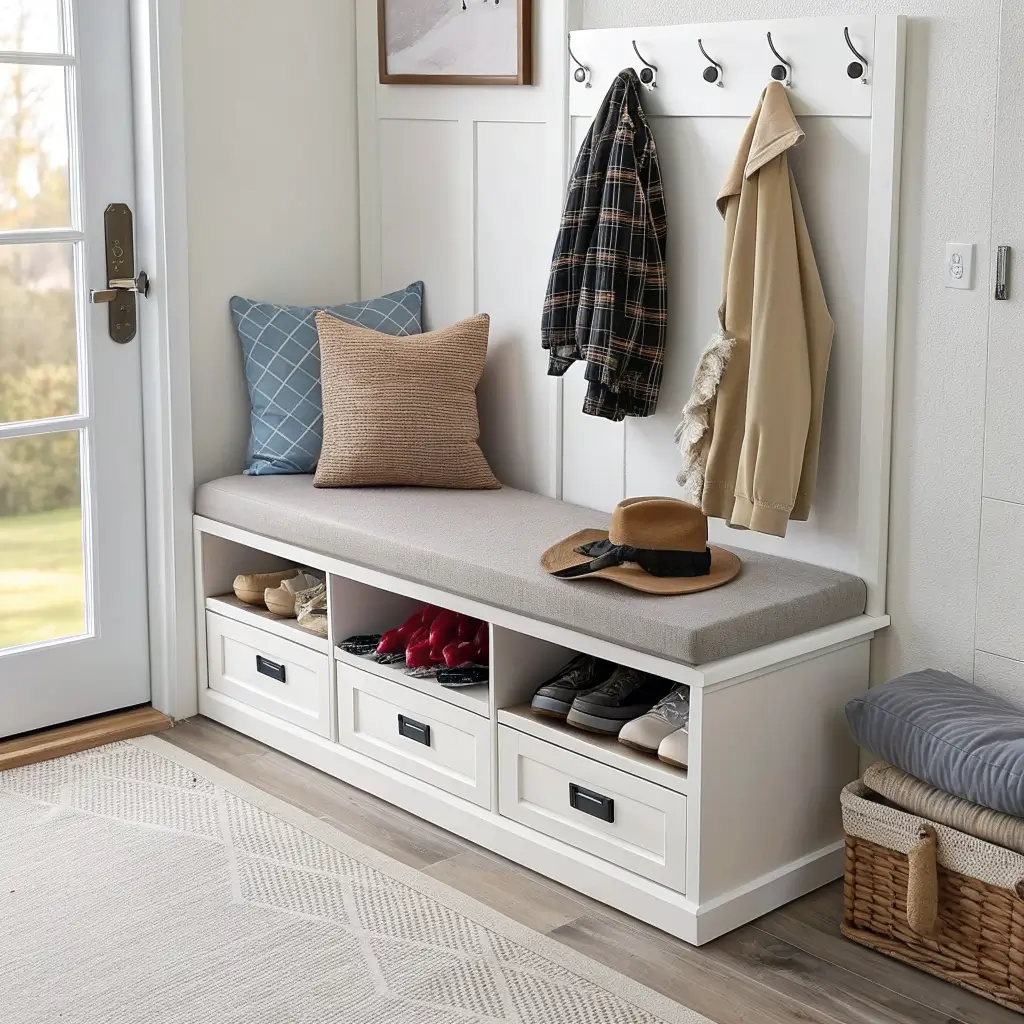
A bench with shoe storage underneath is the Swiss Army knife of small space solutions. You get seating and storage in one piece of furniture, which is exactly the kind of efficiency small spaces demand.
I have one in my entryway that provides a place to sit while putting on shoes and storage for about 12 pairs underneath. The top lifts up for additional hidden storage, and the open cubbies below keep everyday shoes accessible. It’s like three pieces of furniture merged into one, which is perfect when you don’t have room for three separate pieces.
Multi-purpose bench benefits:
- Seating and storage: Two functions, one footprint
- Entryway perfect: Exactly where you need both functions
- Hidden and visible storage: Options for different needs
- Makes small spaces functional: Efficiency is everything
The combination of seating and storage makes morning routines way easier. I sit down, grab shoes from the cubby, put them on, and leave. Before the bench, I was doing an awkward standing balance act while putting on shoes because I had nowhere to sit. Small quality-of-life improvements matter in tight spaces.
I built mine using basic lumber and cube storage inserts, but you can buy pre-made versions if DIY isn’t your thing. The key is getting dimensions that actually fit your space—measure carefully before buying or building. A bench that’s too big will dominate a small entryway instead of enhancing it.
11. Wall-Mounted Shoe Display Ideas
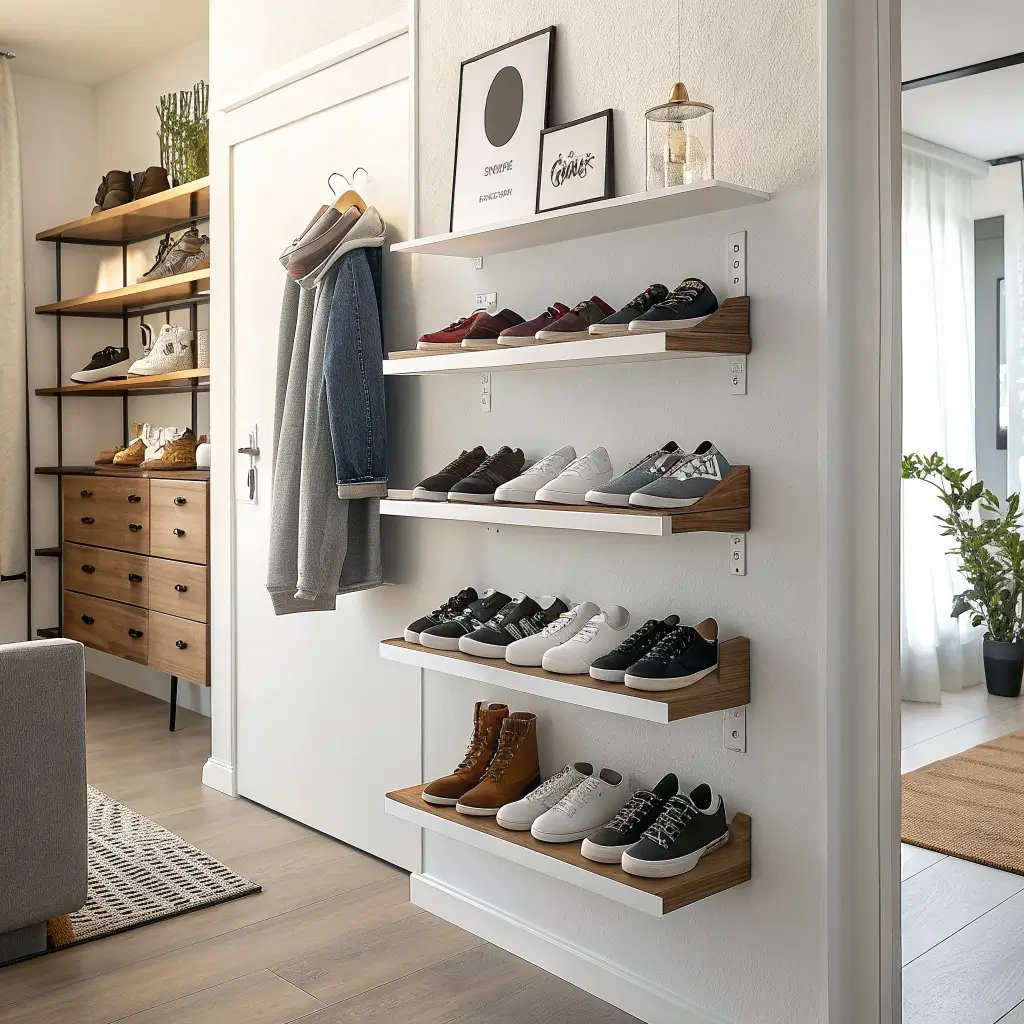
When floor space is nonexistent, walls become your storage solution. Wall-mounted shoe displays use vertical space and can actually look good, turning storage into decor.
I mounted floating shelves and crown molding shoe racks on my bedroom wall, creating a display for my favorite shoes. It’s functional storage that also showcases shoes I actually like looking at. In small spaces, you can’t afford to have ugly storage—everything needs to either look good or be hidden.
Wall-mounted storage advantages:
- Zero floor footprint: Keeps floor completely clear
- Customizable height: Mount wherever works best
- Shows off nice shoes: Display becomes decor
- Flexible arrangement: Add or remove as needed
The key is proper installation—use wall anchors or find studs, depending on your wall type. Shoes are heavier than you think, and wall-mounted storage needs to be secure. I over-engineered mine with extra anchors because I’m paranoid about things falling off walls at 3 AM.
I organized mine by color because it looks better displayed on a wall. Functional organization is important, but when storage is this visible, aesthetics matter too. The gradient effect from light to dark shoes makes my bedroom wall look intentional instead of like I just stuck storage wherever it fit.
12. Foldable Shoe Storage Solutions
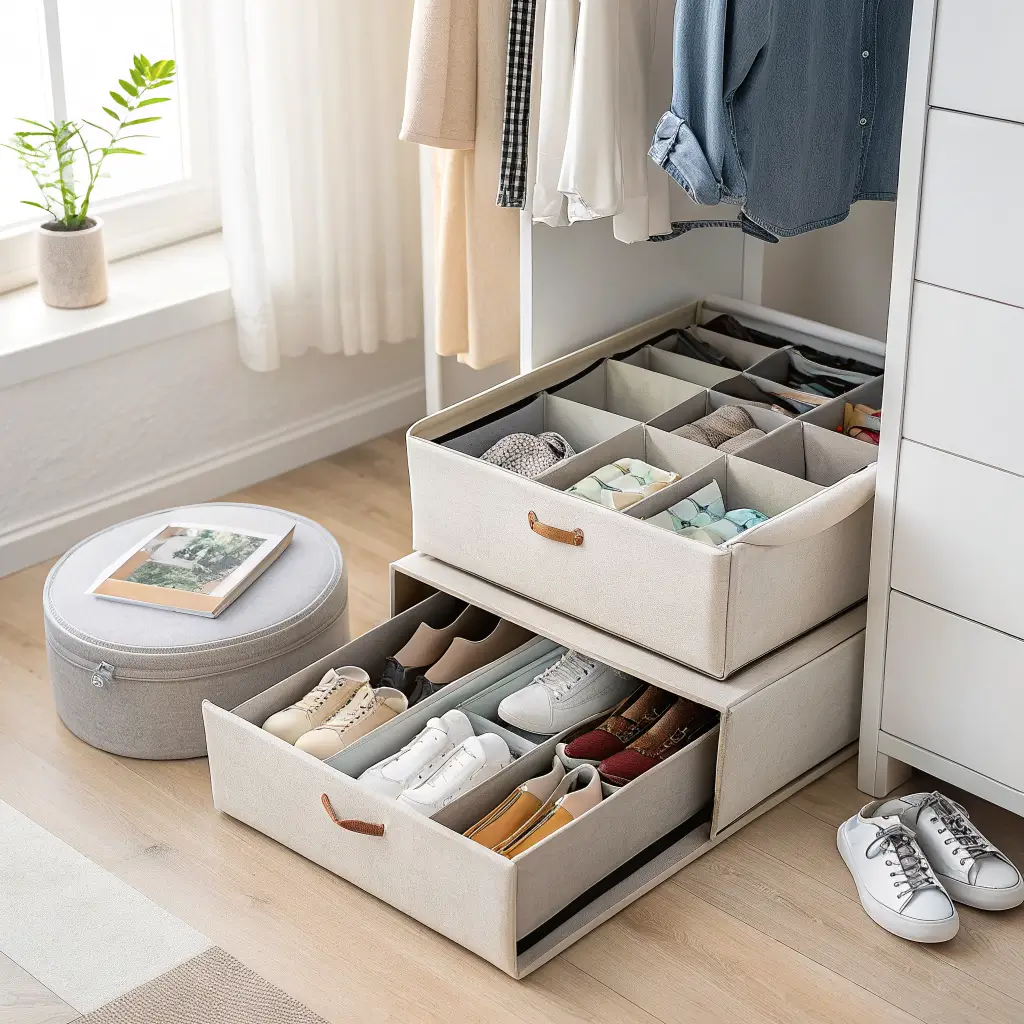
Foldable storage is perfect for small spaces because it adapts to your changing needs. I use collapsible fabric bins that fold flat when not in use, which is clutch when space requirements change seasonally.
In summer, I need less storage because I wear sandals constantly—maybe 5-6 pairs of active shoes. In winter, I need way more storage for boots, sneakers, and everything else. Foldable storage lets me expand and contract my shoe storage based on what I actually need at any given time.
Why foldable storage works:
- Adjustable capacity: Use it when needed, fold it away when not
- Seasonal flexibility: Expand for winter, contract for summer
- Easy to store: Folds flat for closet storage
- Lightweight and portable: Move it wherever you need it
I keep three foldable bins on a closet shelf. When I need them, I unfold them and load them with shoes. When I don’t, they fold flat and tuck behind other stuff. This flexibility is huge in small spaces where storage needs change but available space doesn’t.
The fabric design is important—get sturdy canvas or thick polyester, not flimsy cheap fabric that collapses under shoe weight. I learned this lesson with a set of cheap bins that lasted about two weeks before completely falling apart. Spend a few extra bucks on quality materials that’ll actually hold up.
Making Small Spaces Work
Living in a small space with a shoe collection requires strategy, but it’s absolutely doable. The key is using every available dimension—vertical space, hidden spaces, underutilized corners, and multi-functional furniture. You’re not just storing shoes; you’re playing three-dimensional Tetris with your home.
Start by counting your actual shoes. I know, groundbreaking advice, but seriously—you need to know what you’re dealing with. I thought I had maybe 30 pairs. Actual count? 47. That’s a significant difference that affects what storage solutions you need.
Think about frequency of use too. Shoes you wear every week should be easily accessible. Shoes you wear once a season can live in less convenient storage. I keep my top 10 most-worn pairs in my over-the-door organizer because it’s right by my bedroom door. Everything else lives in various spots based on how often I actually wear them.
Mix and match these solutions based on your specific space. I use a combination of under-bed storage, an over-the-door organizer, a storage bench, and wall-mounted shelves. No single solution handles everything, but together they create a system that actually works. Don’t feel like you need to pick one method and stick with it.
Vertical space is your best friend in small spaces. Floor space is limited, but walls and height usually aren’t. Any solution that builds upward instead of outward is probably a win. This is why vertical racks, stackable shelves, and wall-mounted displays work so well—they maximize dimensions you actually have instead of fighting for floor space you don’t.
And remember, small spaces require maintenance. Whatever system you set up only works if you actually use it and maintain it. I spent weeks organizing everything perfectly, then immediately reverted to kicking shoes off wherever they landed. It took real effort to build the habit of putting shoes back where they belong. But once that habit stuck? Total game-changer for keeping my small space functional.
Your Small Space Can Handle This
Having a shoe collection in a small space doesn’t mean living in chaos or getting rid of half your shoes. It means getting creative with storage and making smart use of every available inch.
The solutions exist—you just need to match them to your specific space and needs.
Start with your biggest pain point and solve that first. For me, it was shoes scattered across my bedroom floor. The over-the-door organizer solved that immediately.
Once your biggest problem is handled, you can tackle the secondary issues without feeling overwhelmed.
Your small space has more storage potential than you think. Those corners, that under-bed area, your doors, your walls—they’re all opportunities waiting to be used.
You just need to look at your space differently and get creative with solutions that maximize every dimension.
Now go measure your spaces, count your shoes, and start implementing solutions that’ll actually work for your life.
Your small space deserves better than shoe piles, and you deserve better than tripping over footwear every morning. You’ve got this—now go reclaim your floor space!