
Does a Gas Fireplace Need a Chimney? Guide to Venting Requirements


The short answer to the question “does a gas fireplace need a chimney?” is: it depends. While traditional wood-burning fireplaces always require a chimney to expel smoke and dangerous gases, modern gas fireplaces offer much more flexibility. The need for a chimney is not a simple yes or no but rather a crucial decision point that leads you to two distinct paths: vented or vent-free systems. Understanding the difference is essential for the safety, efficiency, and suitability of the fireplace for your home.
This comprehensive guide will demystify the world of gas fireplace venting. We will explore the intricate mechanics of how different fireplaces manage combustion, breaking down the pros and cons of each system in explicit detail. You will learn about the various venting technologies available, from direct vent systems that can be installed on almost any exterior wall to the controversial yet efficient vent-free models. Furthermore, we will delve into the critical topics of local building codes, installation requirements, long-term maintenance, and safety protocols. By the end of this guide, you will be equipped with the knowledge to confidently choose the right gas fireplace for your home, ensuring warmth and ambiance for years to come.
Section 1: Why Venting is the Core Consideration
At its heart, a gas fireplace is a combustion appliance. It burns fuel—either natural gas or propane—to produce heat and flames. This combustion process creates byproducts, including carbon monoxide, nitrogen dioxide, and water vapor. How these byproducts are handled is what defines the type of gas fireplace and determines its venting needs.
Chimney vs. Vent: Understanding the Terminology
Many people use the word “chimney” to refer to any structure that vents a fireplace. However, in modern gas fireplace terminology, there is an important distinction:
- Traditional Masonry Chimney: This is the classic brick or stone structure that runs from a fireplace up through the roof of a house. While some gas fireplaces can use an existing masonry chimney, it often requires a liner for safe and efficient operation .
- Vent or Flue System: This is a broader term for the pipes or channels that direct combustion gases to the outdoors. For gas fireplaces, this is often a specialized metal pipe system that can be routed through a wall or roof. It is a more flexible and often more efficient solution than a traditional chimney .
The key takeaway is that while a chimney is one type of venting system, modern gas fireplaces typically use more advanced and specialized venting technologies that may not resemble a chimney at all.
The Critical Role of Venting in Safety
The primary reason venting exists is safety. Carbon monoxide (CO) is an odorless, colorless gas produced during combustion that is potentially fatal at high concentrations. Proper venting ensures that CO and other harmful byproducts are safely expelled from the home . Beyond safety, venting also manages moisture levels. A vent-free fireplace, for example, releases water vapor into the room as a byproduct of its highly efficient combustion, which can increase indoor humidity and potentially lead to mold or mildew issues in tightly sealed homes if not managed properly .
Section 2: Vented Gas Fireplaces – Requiring an External Vent

Vented gas fireplaces are designed to expel 100% of the combustion byproducts to the outside of the home. They are the preferred choice for many homeowners due to their strong safety profile and realistic flame appearance. There are several types of vented systems, each with its own advantages.
Direct Vent Fireplaces: The Modern Standard
This is the most popular and versatile venting system for gas fireplaces today . A direct vent fireplace features a completely sealed combustion system.
- How It Works: It uses a coaxial venting pipe—a smaller pipe nestled inside a larger one. The inner pipe exhausts combustion gases to the outdoors, while the outer pipe simultaneously draws in fresh air for combustion from the outside . The firebox is sealed off from the home’s interior with a glass front, ensuring no indoor air is used for the fire and no byproducts can leak back in .
- Installation Flexibility: This system can be vented horizontally directly through an exterior wall, which is often easier and less expensive, or vertically through the roof . This flexibility allows a direct vent fireplace to be installed in almost any room with an outside wall, making it ideal for new construction and remodels where a traditional chimney does not exist.
- Advantages:
- Exceptional Safety: The sealed system completely isolates the combustion process from your home’s indoor air .
- High Efficiency: While not as thermally efficient as vent-free models, direct vent units are very efficient, with ratings typically between 70-85% . They do not waste heated indoor air for combustion.
- Realistic Flames: Because they are designed for aesthetics as well as heat, direct vent fireplaces often produce the most realistic and appealing yellow flames that closely mimic a wood fire .
B-Vent (Natural Vent) Fireplaces
This system is an older technology that is less common in new installations but is often used when converting an existing wood-burning fireplace.
- How It Works: A B-vent system uses a single pipe that typically runs vertically through the roof. Unlike a direct vent system, it is not sealed. It draws combustion air from the room in which it is installed and relies on the natural buoyancy of hot air (thermal rise) to expel exhaust gases up the flue .
- Considerations: Because it uses indoor air for combustion, it can create drafts and may compete with other household appliances for air. It is also generally less efficient than a direct vent system, as some heat is lost through the flue .
Fireplace Inserts for Existing Masonry Chimneys
If your home already has a wood-burning fireplace with a masonry chimney, a gas fireplace insert is a popular option. This is a self-contained unit that fits into the existing firebox. It uses the chimney for venting, but usually requires a special liner to be dropped down the chimney to ensure proper sizing and draft for the gas unit, making it safe and efficient .
Table: Comparison of Vented Gas Fireplace Systems
Section 3: Vent-Free (Ventless) Gas Fireplaces – No Chimney Needed
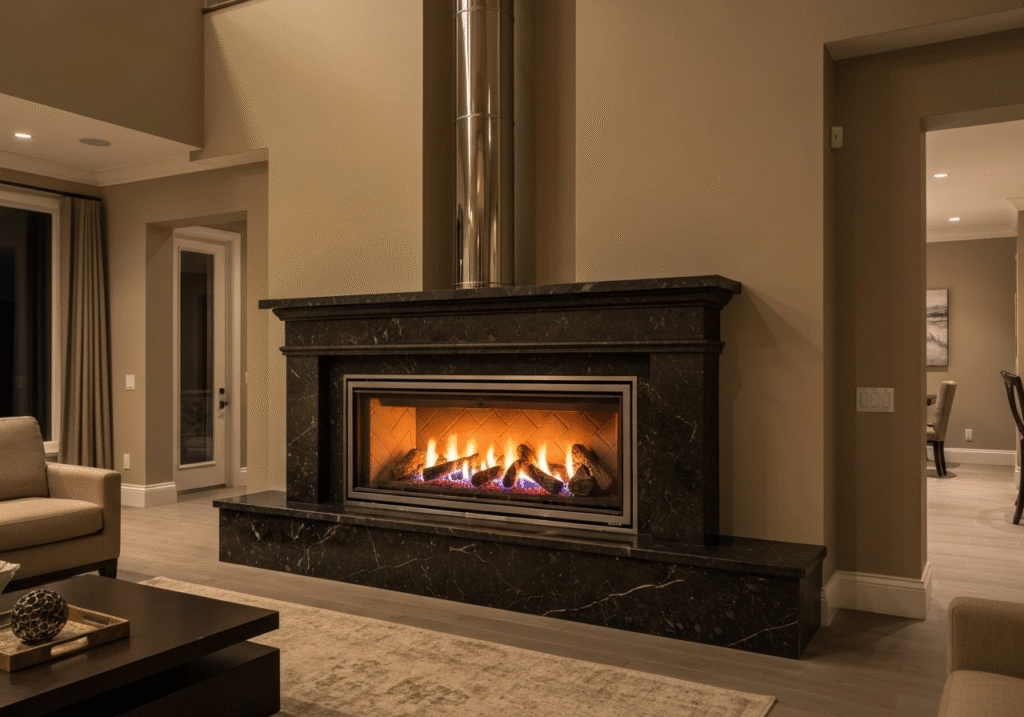
Vent-free gas fireplaces are engineered to operate without any connection to the outdoors. This makes them incredibly easy to install and highly efficient, but they are also the subject of significant debate due to indoor air quality concerns.
How Vent-Free Technology Works
Vent-free fireplaces achieve their clean burn through high-temperature combustion. They are designed to burn gas at nearly 100% efficiency, which theoretically reduces harmful byproducts to “minimal” or “safe” levels . The heat and combustion gases are released directly into the room. To address safety, they are equipped with an Oxygen Depletion Sensor (ODS). This safety device monitors the oxygen level in the room and will automatically shut off the gas supply if the oxygen level drops to a point that could lead to incomplete combustion and carbon monoxide production .
Advantages of Vent-Free Fireplaces
- Maximum Heating Efficiency: Because no heat escapes through a vent or chimney, 100% of the heat generated stays in the room. This makes them exceptionally efficient for zone heating, with an efficiency rating of about 99.9% .
- Installation Flexibility and Lower Cost: The lack of venting makes installation significantly easier and cheaper. There is no need to cut holes in walls or roofs, which makes them ideal for apartments, interior rooms, and homes without existing chimneys . The initial cost is also lower, with units starting around $800-$2,600 compared to $1,700-$12,500 for vented systems .
- Operational Cost: They are cheaper to run, costing approximately $0.25 per hour compared to about $0.52 per hour for a vented unit .
Disadvantages and Important Considerations
- Indoor Air Quality Impact: Even with high-efficiency burning, vent-free fireplaces release small amounts of carbon monoxide, nitrogen dioxide, and water vapor into the home . This can be problematic for individuals with asthma, allergies, or other respiratory conditions .
- Moisture Production: The combustion process produces a significant amount of water vapor. In a tightly sealed home, this can lead to increased humidity, window condensation, and potential for mold growth .
- Legal Restrictions: Due to the air quality concerns, vent-free gas fireplaces are banned in some states and localities, including California and certain cities . It is absolutely essential to check your local building codes before purchasing a vent-free unit.
- Less Realistic Flames: The flame pattern on vent-free units is often less realistic, appearing bluer and smaller, as the burner is optimized for clean combustion rather than aesthetics .
Section 4: Direct Comparison – Vented vs. Vent-Free
Choosing between a vented and a vent-free gas fireplace involves weighing several factors specific to your home, health, and priorities.
Detailed Comparison Table
Making the Right Choice for Your Home
The decision ultimately comes down to your primary goal:
- Choose a Vented Fireplace if: Your top priorities are safety and air quality, you want the most realistic flame appearance, you are using it as a primary heat source, or you have an existing chimney. It is also the only option in regions where vent-free units are banned.
- Choose a Vent-Free Fireplace if: Your main need is efficient supplemental heat in a room without existing venting, your primary concern is low installation and operational cost, and you do not have residents with respiratory issues. Always verify that they are legal in your area.
Section 5: Installation, Codes, and Professional Requirements

Installing a gas fireplace is not a DIY project. It involves gas lines, high temperatures, and critical safety considerations that require expert knowledge.
The Non-Negotiable Need for Professional Installation
A certified and licensed HVAC technician or fireplace installer must handle the installation . They will:
- Ensure the gas line is connected safely and without leaks.
- Correctly install the venting system (if applicable) with proper clearances from combustible materials.
- Verify that the unit operates correctly and that all safety features, like the ODS on a vent-free model, are functioning.
- Ensure the installation complies with all local building codes and manufacturer specifications .
Improper installation can lead to gas leaks, fire hazards, and carbon monoxide poisoning.
Understanding Local Building Codes
Building codes are not just bureaucratic red tape; they are based on safety standards developed over decades. Your installer will be familiar with the local codes, which will dictate :
- Whether vent-free fireplaces are permitted.
- Required clearances for vents from windows, doors, and overhangs.
- Room size requirements for vent-free units (e.g., minimum cubic footage).
- The need for permits and subsequent inspections.
Section 6: Maintenance and Safety for All Gas Fireplaces
Regardless of the type you choose, ongoing maintenance is crucial for safe and efficient operation.
Annual Inspection and Cleaning
You should schedule a professional inspection and cleaning for your gas fireplace at least once a year . A qualified technician will:
- Check for gas leaks.
- Clean the burner and logs to ensure proper flame.
- Inspect the venting system for blockages (birds’ nests, debris) or corrosion .
- Test safety systems, including the thermocouple and ODS sensor.
Essential Safety Practices for Homeowners
- Install Carbon Monoxide Detectors: This is critical for all homes with gas appliances. Install CO detectors on every level of your home, especially near sleeping areas .
- Keep the Area Clear: Maintain a clear zone of at least three feet from the fireplace, free from furniture, curtains, and other flammable materials .
- Recognize the Smell of Gas: Natural gas has a rotten egg odor added to it. If you smell gas, turn off the fireplace and the gas supply if safe to do so, leave the house immediately, and call your gas company or emergency services .
- Understand Unit Limitations: Do not use a vent-free fireplace as a primary heat source for extended periods. Follow manufacturer guidelines for maximum run time, and ensure the room is adequately ventilated, perhaps by cracking a window .
Conclusion
So, does a gas fireplace need a chimney? The answer is clear: Not necessarily. The choice between a vented and a vent-free model is the defining factor. Vented gas fireplaces require a chimney or a specialized venting system to safely expel combustion gases outdoors, offering unparalleled safety and a traditional ambiance. Vent-free gas fireplaces require no external venting, providing exceptional heating efficiency and installation flexibility, but they must be used with caution due to their impact on indoor air quality and are illegal in some jurisdictions.
The right choice for your home depends on a careful balance of your specific needs: your home’s layout, your local regulations, your budget, and, most importantly, your priorities regarding safety, air quality, and aesthetic appeal. By making an informed decision and committing to professional installation and regular maintenance, you can enjoy the warmth and comfort of a gas fireplace with complete peace of mind.
Key Takeaways
- Venting is a safety feature: Vented models expel all combustion byproducts outside, making them the safest option for indoor air quality .
- Vent-free units have limitations: While highly efficient, they release moisture and trace gases into the home and are not suitable for everyone or every location .
- Professional installation is mandatory: Gas line and venting work are not DIY tasks. Hire a certified professional to ensure safety and code compliance .
- Local codes are decisive: Always check your local regulations before purchasing a fireplace, as vent-free models are banned in some areas .
- Annual maintenance is essential: Regular professional inspections are crucial for the safe operation of both vented and vent-free gas fireplaces .