
How to Open Fireplace Flue: Safety and Operation Guide


The crackle of a fire on a cold evening is one of life’s simple pleasures. However, that cozy scene can quickly turn into a smoke-filled room and a safety hazard if you overlook one critical step: opening the fireplace flue. Knowing how to open fireplace flue is the most important skill for any fireplace owner, ensuring smoke and dangerous gases are vented outside instead of into your home.
This comprehensive guide will walk you through everything you need to know. We will demystify the components of your fireplace, provide detailed instructions for different damper types, and explain how to confirm the flue is open and functioning safely. You will learn not just the mechanics, but the crucial safety principles that protect your home and family, allowing you to enjoy your fireplace with complete confidence.
Section 1: Understanding Your Fireplace Flue and Damper
Before you operate the controls, it’s essential to understand what you’re adjusting. The terms “flue” and “damper” are often used interchangeably, but they refer to distinct components that work together.
What is the Flue?
The flue is the vertical passageway or inner channel of your chimney that acts as an exhaust pipe for smoke, gases, and other combustion byproducts . It provides the pathway for these elements to safely exit your home. A clean, unobstructed flue is non-negotiable for safe fireplace operation.
What is the Damper?
The damper is the movable valve or plate that opens and closes the flue . Think of it as a gate. When the fireplace is not in use, the damper should be closed to prevent warm indoor air from escaping up the chimney and to block cold drafts from coming down into your home . When you want to have a fire, you must open this “gate” to allow smoke to travel up the flue.
The Two Main Types of Dampers
Most residential fireplaces have one of two common types of dampers, which are operated differently.
1. Throat Damper (Most Common)
- Location: Installed just above the firebox at the base of the chimney . You can see it when you look up into the fireplace.
- Appearance: A curved metal plate (often cast iron or steel) that seals the throat of the chimney .
- Controls: Operated by a lever, handle, knob, or a push/pull rod located inside the firebox or on the fireplace surround .
2. Top-Mount Damper (Top-Sealing Damper)
- Location: Installed at the very top of the chimney, at the chimney cap .
- Appearance: Acts as a lid for your chimney. When closed, it provides a weather-tight seal.
- Controls: Operated by a chain or cable that runs down the length of the flue and is secured to a hook or bracket on the fireplace wall . These dampers are spring-loaded and are designed to be open by default; you pull the chain and hook it to close it .
Table: Key Differences Between Throat and Top-Mount Dampers
Section 2: Step-by-Step Guide: How to Open Your Fireplace Flue
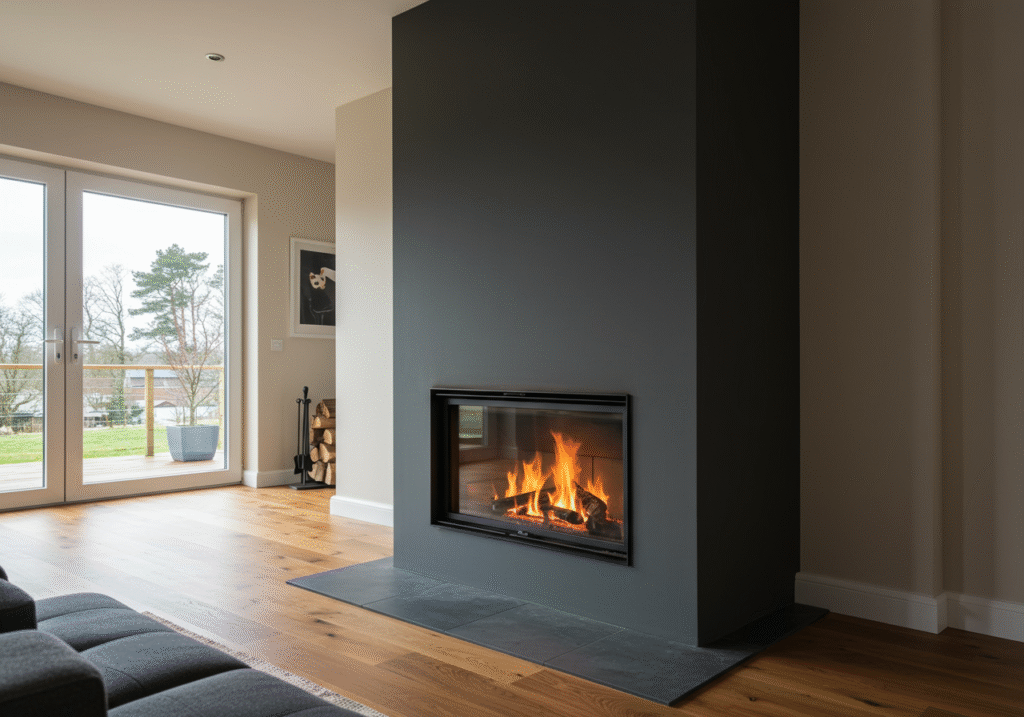
The process for opening the flue depends entirely on which type of damper you have. Follow these steps carefully.
Important Safety Precautions Before You Start
- Ensure the fireplace is completely cold with no active fire or hot embers .
- Wear work gloves to protect your hands from soot and sharp edges .
- Use a flashlight for better visibility when looking up into the fireplace .
How to Open a Throat Damper
- Locate the Control Mechanism: Look for a metal lever, handle, or a long rod inside the firebox or just above the fireplace opening . It may be centered or off to the side.
- Identify the Current Position:
- If you see a lever, it may be labeled “Open” and “Close.” If not, note its position. Often, pushing a lever to the right opens the damper, while pushing it to the left closes it .
- If you see a knob, it may need to be turned. Turning a knob clockwise often opens the damper, while counterclockwise closes it .
- If you see a rod, a rod that is pushed all the way up typically means the damper is open, while a rod hanging down low means it is closed .
- Operate the Control:
- Verify It’s Open: After moving the control, perform a visual check (see Section 3 below) to confirm the metal plate has swung up and out of the way, clearing the flue passage .
How to Open a Top-Mount Damper
- Locate the Chain: Find the metal chain or cable hanging inside your fireplace, usually attached to a side wall .
- Check its Status: If the chain is hooked tightly onto a bracket, the damper is closed. The chain will feel taut .
- Operate the Control: Simply unhook the chain from the bracket and let it go . Because these dampers are spring-loaded, the chain should spring upward, indicating the damper lid at the top of the chimney has opened .
- Verify It’s Open: The chain will now dangle freely. You should not be able to pull it down easily without engaging the closing mechanism .
Section 3: How to Confirm the Flue Is Truly Open
Never assume the damper has opened correctly. Always verify using one or more of these reliable methods before lighting a fire .
1. The Visual Inspection (Most Reliable Method)
- Action: Crouch in front of the firebox and shine a flashlight up the chimney .
- What to Look For: If the damper is open, you will see an unobstructed passageway going up the chimney. You might even see daylight at the top . If the damper is closed, you will see a metal plate blocking your view .
2. The Draft Test
- Action: Place your hand inside the fireplace opening (without touching any sooty surfaces) .
- What to Feel For: If the damper is open, you should feel a distinct draft of cool air coming down the chimney . If you feel no draft, the damper is likely closed . Note: This method can be less reliable with top-mount dampers, as cold air can be trapped in the flue even when open .
3. The Control Check
- Action: Once you understand how your damper’s controls work, their position can be a quick indicator.
- What to Check: A lever pushed to the right, a knob turned clockwise, or a freely dangling chain all typically indicate an open damper .
4. The Sound Test
- Action: Stand quietly near the open fireplace.
- What to Listen For: An open flue can act like an echo chamber. You may hear amplified outside noises, such as wind, birds, or traffic . A closed damper will significantly muffle these sounds.
Crucial Safety Warning: Never use the “smoke test” by starting a fire to see if smoke goes up. If the damper is closed, your home will immediately fill with dangerous smoke and carbon monoxide . Always verify the flue is open before igniting the fire.
Section 4: Common Problems and Troubleshooting
Sometimes, operating the damper isn’t straightforward. Here’s what to do if you encounter issues.
The Damper is Stuck or Won’t Move
- Possible Causes: Rust, debris buildup, or a mechanical malfunction .
- What to Do: Do not force it. Forcing a stuck damper can cause further damage. Check for obvious obstructions like fallen debris. If it remains stuck, refrain from using the fireplace and contact a certified chimney sweep for inspection and repair .
You See Visible Damage
- What to Look For: A warped, cracked, or severely rusted damper plate .
- What to Do: A damaged damper may not seal properly when closed or open fully when needed. Do not use the fireplace. Have a professional assess and replace the damper if necessary .
Smoke Comes Into the Room Even When the Damper is Open
- Possible Causes: This indicates a draft problem. The flue could be blocked by a bird’s nest, excessive creosote, or other debris . The chimney height might also be insufficient for proper draft.
- What to Do: Extinguish the fire safely. The chimney likely needs a professional cleaning (sweeping) or inspection to identify and clear the blockage .
Section 5: Essential Fireplace Flue Safety and Maintenance
Proper care of your flue and damper is a critical part of home maintenance.
Annual Inspection and Cleaning
- Have your chimney and flue inspected and cleaned annually by a qualified chimney sweep . They will check for creosote buildup (a highly flammable byproduct of wood burning), blockages, and the structural condition of the flue and damper . This is the single most important action to prevent chimney fires.
Close the Damper When Not in Use
- Always close the damper when the fireplace is cold and not in use. An open damper can let 8-10% of your home’s heated or cooled air escape, significantly increasing your energy bills . It also prevents drafts, moisture, and animals from entering your home .
Use Your Fireplace Responsibly
- Only burn seasoned hardwoods to minimize creosote buildup .
- Never burn trash, treated wood, or other inappropriate materials.
- Ensure you have working smoke and carbon monoxide detectors in your home.
Conclusion: Safety First, Comfort Always
Knowing how to open fireplace flue is a simple yet vital piece of knowledge for any homeowner. By correctly identifying your damper type, following the step-by-step opening procedure, and always verifying with a visual check, you ensure that every fire you light is safe and enjoyable. Remember that an annual professional inspection is not a luxury—it is a necessity for safe operation. With this guide, you can confidently master this essential skill, ensuring your fireplace remains a source of warmth and comfort, not worry.