
Ultimate Guide to Standard Fireplace Dimensions


Why Standard Fireplace Dimensions Are Your Blueprint for Success
Embarking on the journey of selecting or installing a fireplace is an exciting endeavor that promises to redefine the comfort and aesthetic of your home. However, this process involves far more than just picking a style you love. Understanding standard fireplace dimensions is the critical first step, a foundational blueprint that ensures not only a visually proportional installation but also one that adheres to strict safety codes and operates at peak efficiency. A fireplace that is too large can overwhelm a room and create drafting issues, while one that is too small may fail to serve as an adequate heat source or focal point. This comprehensive guide will decode all the necessary measurements, from the firebox itself to the surrounding mantel and hearth, providing you with the detailed size chart and knowledge needed to make an informed decision, whether you’re working with a traditional masonry build, a modern gas unit, or a versatile electric model.
Part 1: Understanding the Core Components of a Fireplace
Before diving into the specific numbers, it’s essential to understand what parts of a fireplace you’ll be measuring. A fireplace is more than just an opening in the wall; it’s a system of components each with its own dimensional requirements.
- Firebox: This is the interior chamber where the fire actually burns. Its dimensions determine the size of the fire you can build and much of the heat output .
- Fireplace Opening: This is the visible, front-facing entryway to the firebox. Its width and height are crucial for aesthetics and for determining the size of a potential insert .
- Surround: The decorative framework, often made of wood, stone, or tile, that encloses the fireplace opening and adds to the room’s decor .
- Mantel: The shelf or horizontal projection above the fireplace. It serves both decorative and safety purposes, with specific clearance requirements from the opening .
- Hearth: The non-combustible floor area extending in front of and sometimes to the sides of the fireplace. It protects your home’s flooring from sparks and embers and is mandated by building codes .
- Lintel: A structural, often metal, support beam that spans the top of the fireplace opening, supporting the masonry above it .
Part 2: Standard Fireplace Dimensions: The Ultimate Size Chart
Now, let’s get to the core data. The following table consolidates the standard dimensions for the most common types of fireplaces, providing a quick-reference size chart for your planning needs. All measurements are in inches (Width x Height x Depth).
Comprehensive Fireplace Dimensions Size Chart
Detailed Breakdown of Standard Fireplace Dimensions by Type
Standard Fireplace Dimensions for Masonry (Wood-Burning) Fireplaces
The traditional masonry fireplace is a significant architectural feature. Its dimensions must accommodate a fully functional firebox, a smoke chamber, and a flue. The standard masonry fireplace dimensions are typically 36-48 inches wide, 36-42 inches high, and 20-24 inches deep . The firebox opening itself generally falls within 24-36 inches wide and 24-30 inches high . These units are heavy and require a solid foundation, so consulting with a professional during the planning stage is non-negotiable.
Standard Fireplace Dimensions for Gas Fireplaces
Gas fireplaces are prized for their convenience and efficiency. They come as built-in units for new construction or inserts for existing openings. Standard gas fireplace dimensions for built-in models are generally 36-48 inches wide and 30-40 inches high, with depth being a more variable dimension depending on the venting system . A key feature to consider is the viewing area—the size of the glass through which you see the flames. This can range from intimate to expansive, directly impacting the visual impact of the unit .
Standard Fireplace Dimensions for Electric Fireplaces
Electric fireplaces offer the most flexibility in terms of installation. They produce no real flames or emissions, meaning they have fewer clearance and venting restrictions. Standard electric fireplace dimensions are often 36-50 inches wide, 20-30 inches high, and a notably shallow 10-15 inches deep . This shallow depth makes them ideal for wall-mounting like a television or recessing into a standard wall frame without major structural changes .
Standard Fireplace Dimensions for Fireplace Inserts
If you have an existing but inefficient masonry fireplace, a fireplace insert is the perfect upgrade. Inserts are designed to slide into the old firebox to improve heat output and efficiency. Therefore, their dimensions are constrained by the opening they must fit. Standard fireplace insert dimensions typically range from 28-44 inches wide and 20-30 inches high . Accurate measurement of your existing fireplace is absolutely critical when shopping for an insert.
Part 3: Fireplace Surround, Mantel, and Hearth Standards
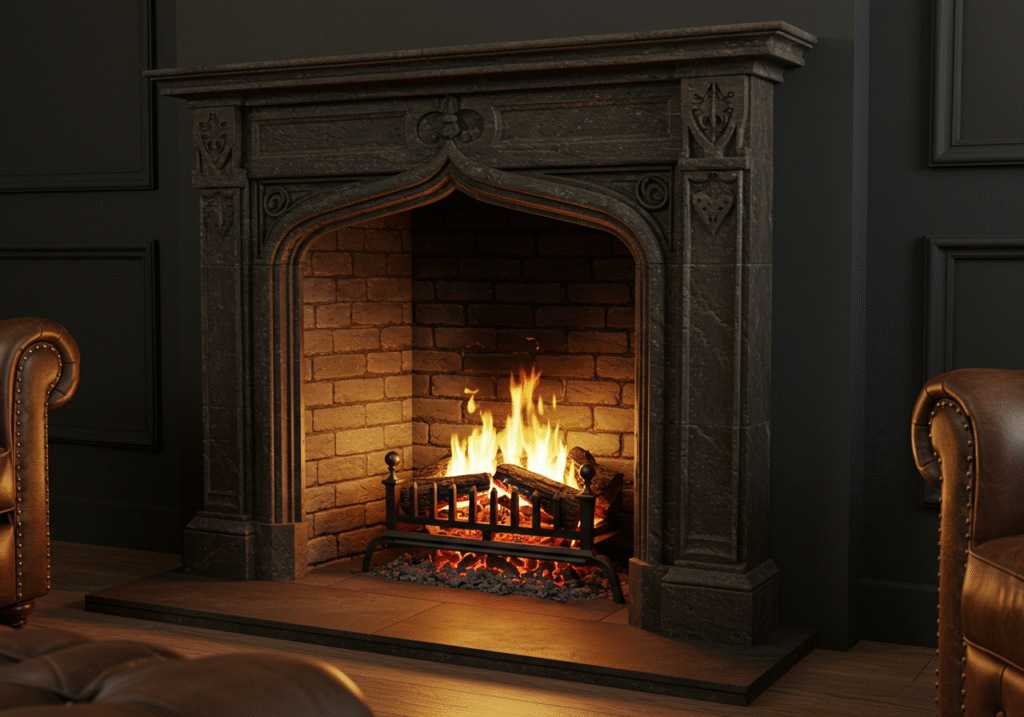
The fireplace itself is only part of the equation. The components that frame it are equally important for both design and safety.
Standard Fireplace Surround Dimensions
The surround frames the fireplace opening and serves as a transition to the surrounding wall. Standard fireplace surround dimensions are usually between 48 and 60 inches wide and 40 to 52 inches high . A common rule of thumb for a proportional look is to have the firebox width be about 50% to 70% of the total surround width .
Standard Fireplace Mantel Dimensions
The mantel is the crowning jewel of the fireplace ensemble. Standard fireplace mantel dimensions for width usually range from 48 to 72 inches, designed to extend slightly beyond the width of the surround . For safety and a comfortable viewing angle, mantels are typically installed 50 to 60 inches above the floor . Critically, building codes mandate specific clearance distances between the top of the fireplace opening and the bottom of the mantel to prevent a fire hazard .
Standard Fireplace Hearth Dimensions
The hearth is a critical safety feature. Standard fireplace hearth dimensions call for it to extend at least 16-20 inches in front of the fireplace opening and at least 8-12 inches beyond each side of the opening . The hearth must be made of a non-combustible material like tile, stone, or brick.
| Component | Standard Dimensions | Range |
|---|---|---|
| Fireplace Opening | 36″ W x 24″ H x 16″ D | 24-48″ W x 20-36″ H x 12-18″ D |
| Firebox | 30″ W x 24″ H x 16″ D | 24-36″ W x 24-29″ H x 16-18″ D |
| Hearth (Front) | 16″ | 16-20″ |
| Hearth (Sides) | 8″ | 8-12″ |
| Mantel Height | 12-16″ above opening | 10-18″ |
| Mantel Depth | 6-12″ | 4-12″ |
Part 4: How to Measure for a Fireplace Like a Pro
Whether you’re replacing an old insert or building anew, accurate measurements are paramount. Here is a step-by-step guide.
- Step 1: Measure the Width. Using a tape measure, record the width of the fireplace opening at the front (the widest point) and at the back (the narrowest point). Do this at both the top and bottom of the opening. Use the smallest of these measurements as your key width dimension .
- Step 2: Measure the Height. Measure the height from the floor of the firebox (the hearth) to the top of the opening at both the front and the back. Again, if there is a discrepancy, use the smallest measurement. Don’t forget to check for a lintel, a structural support beam at the top of the opening; if it protrudes, you must account for it in your height measurement .
- Step 3: Measure the Depth. Measure the distance from the front face of the fireplace to the back wall. Take this measurement from the center .
- Pro Tip: Always measure twice, even three times, to ensure accuracy. When in doubt, use the smallest dimension you find to ensure your new unit or insert will fit without issue .
Part 5: Choosing the Right Size Fireplace for Your Space
With the technical data in hand, the final step is applying it to your unique space. Here’s how to ensure a perfect fit.
- Consider the Room Size and Layout: The fireplace should be proportional to the room. A large, grand fireplace can overwhelm a small den, while a tiny unit will look lost in a vast, open-concept living area. A general guideline is that the fireplace surround should not take up more than 50% of the wall’s total width .
- Balance with a TV: A common modern dilemma is placing a TV above the fireplace. For a balanced look, the fireplace should be at least as wide as the TV. For larger TVs (65 inches and above), a fireplace that is slightly wider than the TV is often more aesthetically pleasing to prevent a top-heavy look .
- Understand Your Heating Needs: If supplemental heat is a primary goal, size matters for gas and wood units. A unit’s heating capacity is measured in BTUs and is often correlated with its size. Match the BTU output to your room’s square footage. For electric fireplaces, heat output is often consistent across many sizes, so your choice can be more style-driven .
- Never Ignore Building Codes and Clearances: This is the most critical rule. Building codes are not suggestions; they are legal requirements for safety. They govern everything from hearth thickness and mantel clearances to flue sizing and distances to combustible materials . Always follow the manufacturer’s installation instructions and have the final installation inspected by a qualified professional.
Standard Fireplace Dimensions
Complete reference chart with standard measurements and ranges in centimeters for all fireplace components
| Category | Dimension Type | Standard (cm) | Range (cm) |
|---|---|---|---|
| Fireplace Opening | |||
| Width | 91.44 | 60.96–121.92 | |
| Height | 60.96 | 50.8–91.44 | |
| Depth | 40.64 | 30.48–45.72 | |
| Firebox | |||
| Width | – | 60.96–91.44 | |
| Height | – | 60.96–73.66 | |
| Depth | – | 40.64–45.72 | |
| Hearth | |||
| Front Extension | 40.64 | 50.8 (for larger) | |
| Side Extension (each side) | 20.32 | – | |
| Mantel & Surround | |||
| Height Above Opening | – | 30.48–40.64 | |
| Depth | – | 15.24–30.48 | |
Note: These dimensions are standard measurements and may vary based on specific fireplace models, regional building codes, and installation requirements. Always consult manufacturer specifications and local building regulations before beginning any fireplace installation or renovation project.
Summary and Key Takeaways
Navigating standard fireplace dimensions is a multifaceted process that blends aesthetics, function, and stringent safety protocols.
- No Universal Standard: There is no single “standard” size; dimensions vary significantly by the type of fireplace (wood, gas, electric) and its specific model.
- Reference the Charts: Use the provided size chart and detailed breakdowns as a reliable starting point for understanding the typical dimensional ranges for your chosen fireplace type.
- Measure Meticulously: For replacements and inserts, accurate measurement of your existing opening—using the smallest of the width and height readings—is the most crucial step to ensure a proper fit.
- Design for Proportion and Safety: Choose a fireplace size that is visually proportional to your room and always, without exception, adhere to manufacturer clearances and local building codes for the mantel, hearth, and surrounding materials.
By using this guide as your comprehensive resource, you can confidently plan your fireplace project, ensuring the result is not only beautiful but also safe, efficient, and perfectly suited to your home.