15 Modern Tiny Mudroom Ideas Entryway Ideas with Smart Hacks
- Entryway Decor
 Ben
Ben- 0
- 48 minutes read
Listen, we need to talk about that disaster zone you call an entryway.
You know exactly what I mean – that cramped little spot where shoes pile up like Mount Everest, coats somehow end up on the floor instead of hooks, and finding your keys becomes a daily treasure hunt.
Been there, done that, got the frustrated sighs to prove it.
Here’s the thing: tiny entryways don’t have to suck. Seriously.
After wrestling with my own microscopic mudroom for years (and nearly losing my mind every winter), I’ve discovered some game-changing solutions that actually work.
Not those Pinterest-perfect ideas that require a contractor and a trust fund – real, practical stuff you can actually pull off this weekend.
Ready to transform that chaos corner into something that actually functions? Let’s talk about 15 brilliant tiny mudroom ideas that’ll make you wonder why you didn’t think of them sooner.
Slim Bench with Hidden Storage

The Space-Saving MVP
This baby right here? Total game-changer. I installed a slim bench with hidden storage in my entryway last year, and honestly, I don’t know how I survived without it. We’re talking about a bench that’s typically only 12-15 inches deep – narrow enough that you won’t trip over it, but sturdy enough to plop down on while wrestling with your boots.
The magic happens underneath. Most slim benches come with either a flip-up seat or sliding compartments where you can stash everything from winter gloves to dog leashes. Mine holds about six pairs of shoes comfortably, plus all those random items that somehow accumulate by the door.
What really sold me on this option? The dual functionality. You get seating AND storage without eating up precious floor space. Plus, if you go for one with a cushioned top, you’ve basically created a comfy spot that doesn’t scream “I live in a shoebox apartment.”
Installation Tips That Actually Matter
Here’s what nobody tells you about installing these benches:
- Anchor it to the wall – trust me, you don’t want it sliding around when you’re in a rush
- Choose one with adjustable feet if your floors aren’t perfectly level (spoiler alert: they never are)
- Look for models with soft-close hinges – slamming storage lids at 6 AM isn’t fun for anyone
- Consider the height carefully – standard is 18 inches, but go lower if you’ve got kids
Vertical Wall Hooks Organizer

Going Up When You Can’t Go Out
Who says you need a massive mudroom to stay organized? Vertical wall hook systems literally changed my entire approach to entryway storage. Instead of spreading out horizontally (which, let’s face it, isn’t happening in a tiny space), you’re utilizing that often-ignored vertical real estate.
I mounted a vertical organizer that runs from about knee height to just above eye level. Each family member gets their own column of hooks – no more “whose jacket is whose” arguments. The best part? You can customize the hook placement based on what you actually need to hang.
My setup includes:
- Three coat hooks per person at different heights
- Small hooks for keys and dog leashes
- Medium hooks for bags and backpacks
- One sturdy hook at the bottom for umbrellas
Making It Look Good (Because Aesthetics Matter)
Nobody wants their entryway looking like a janitor’s closet, right? Here’s how to keep it stylish:
- Stick to matching hook styles – mismatched hardware looks chaotic
- Space hooks evenly (I use 6-inch intervals)
- Add a small shelf on top for seasonal items
- Paint the board a contrasting color to make it a feature, not an eyesore
Floating Shoe Rack Design

The Floor Space Liberator
Ever counted how many square feet your shoes eat up? I did once, and nearly cried. Floating shoe racks solve this problem by getting everything off the ground while keeping shoes easily accessible. We’re talking about slim shelves mounted directly to the wall, usually about 6-8 inches deep.
My floating rack holds eight pairs of everyday shoes on two levels. The key is mounting them at the right height – bottom shelf at 12 inches, top at 24 inches works perfectly for most shoe types. Boots? They live elsewhere (we’ll get to that).
What makes floating racks superior to traditional shoe storage? Visibility, my friend. You can actually see all your options at once, which means no more digging through a pile of shoes while running late. Plus, the open design prevents that lovely eau de gym shoe from building up.
Smart Spacing Strategies
- Leave at least 5 inches between shelves for most shoes
- Install them slightly angled (about 15 degrees) to prevent shoes from sliding off
- Consider adding a lip or small rail on the front edge
- Group by person or shoe type – whatever makes your morning easier
Also Read: 15 Smart Narrow Mudroom Ideas Entryway Ideas You’ll Love
Narrow Console with Baskets

The Stylish Organizer’s Dream
Can we talk about how narrow consoles with baskets basically trick everyone into thinking you have your life together? These slim tables (usually 10-12 inches deep) provide a landing spot for keys and mail up top, while baskets below hide all the ugly stuff.
I scored a 36-inch console that fits perfectly against my entryway wall. Three woven baskets underneath hold:
- Basket 1: Winter accessories (sorted by person)
- Basket 2: Dog walking supplies
- Basket 3: Random stuff that needs to leave the house (library books, returns, etc.)
The console top stays clutter-free with just a small tray for keys and a fake plant that refuses to die (because it’s plastic, obviously).
Basket Selection That Makes Sense
Not all baskets are created equal:
- Fabric baskets = lightweight but can get gross quickly
- Woven/wicker = looks great, moderate durability
- Wire baskets = see everything inside, industrial vibe
- Canvas bins = washable, which is huge for mudroom use
FYI, labeling your baskets isn’t just for Type-A personalities – it actually keeps the system working long-term.
Pegboard Entryway System

The Customizable Wonder Wall
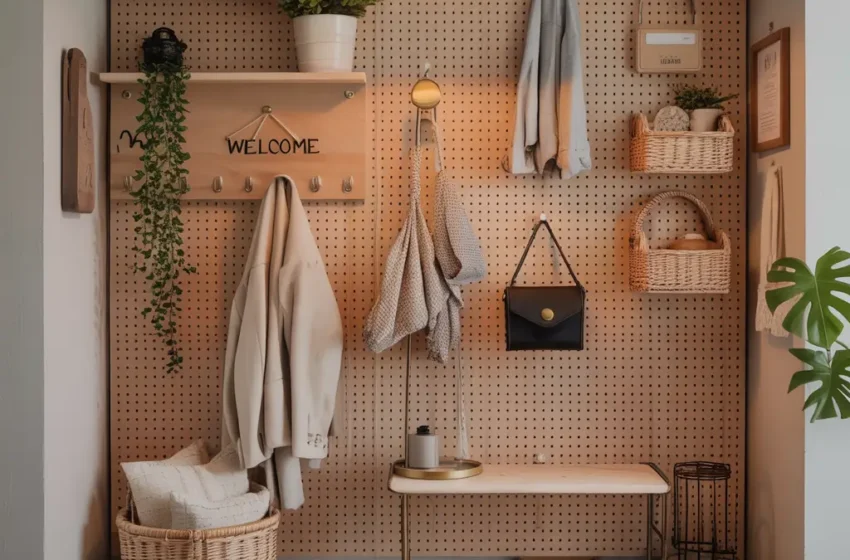
Remember pegboards from your dad’s garage? Well, they’ve had a serious glow-up. Modern pegboard systems offer infinite customization for tiny entryways, and honestly, they’re kind of genius. You can rearrange hooks, shelves, and baskets whenever your storage needs change.
I installed a 4×4 foot pegboard panel painted in charcoal gray (because beige pegboard is so 1985). The beauty is in the flexibility – winter means more coat hooks, summer means more spots for sun hats and beach bags. Currently, my setup includes:
- Multiple hook sizes for everything from backpacks to dog leashes
- Small shelves for sunglasses and mail
- A few small baskets for loose items
- Even a little mirror on a hook
Pegboard Pro Tips
Want to make your pegboard not look like it belongs in a workshop?
- Paint it a color that complements your walls
- Use matching accessories in metals like brass or matte black
- Create zones for each family member
- Add some decorative elements – a small plant or artwork breaks up the utility vibe
Over-the-Door Storage Solutions

The Hidden Storage Hero
Behind every door lies untapped potential. Seriously, over-the-door organizers might be the most underutilized tiny mudroom solution out there. And no, I’m not talking about those cheap shoe organizers from college (though those work too, just saying).
My coat closet door sports a heavy-duty organizer with:
- Four double hooks for guest coats
- A narrow shelf for gloves and hats
- Small baskets for each family member’s daily carry items
- Even a mirror for last-minute appearance checks
The best part? When the door closes, everything disappears. Instant clean look for unexpected guests 🙂
Choosing the Right Over-Door System
Here’s what actually matters:
- Door clearance – measure the gap between door and frame
- Weight capacity – cheap ones bend under real-world use
- Padding on contact points to prevent door damage
- Adjustable components for changing needs
Also Read: 15 Clever Small Mudroom Ideas Entryway Ideas with Smart Storage
Built-In Cubby Wall Niche

The “Wow, You’re So Organized” Feature
Okay, this one requires a bit more commitment, but built-in cubby niches transform tiny entryways like nothing else. If you’ve got a wall you can sacrifice a few inches from, you can create recessed storage that doesn’t steal any floor space.
My friend carved out a 14-inch deep niche in her entryway wall and added four cubbies. Each family member gets one, plus a shared cubby for guests. The result? Everything has a home, and the entryway looks intentional instead of cluttered.
What makes built-in cubbies so effective?
- They force you to limit what stays in the entryway
- Kids can actually reach their own stuff
- The recessed design feels less cramped than furniture
- You can add doors later if open storage drives you crazy
DIY vs. Professional Installation
Real talk: this isn’t always a DIY job. Consider:
- Load-bearing walls = definitely hire a pro
- Electrical or plumbing in the wall = also pro territory
- Basic drywall with no obstacles = potentially DIY-able
- Your skill level with power tools (be honest)
Fold-Down Wall Bench

The Disappearing Seat Trick
Who says you need permanent seating? Fold-down wall benches give you a spot to sit when needed, then fold flat against the wall when you don’t. Mine folds down to a sturdy 14-inch deep seat, then tucks away to just 3 inches from the wall.
The installation scared me initially, but it’s actually pretty straightforward if you hit the studs properly. Now I’ve got seating that appears on command – perfect for boot season. When spring rolls around? Up it goes, and suddenly I’ve got floor space again.
Weight Limits and Safety Stuff
Don’t skip this part:
- Most fold-down benches support 200-250 pounds
- Always mount into studs, not just drywall
- Test weight gradually after installation
- Consider adding a support chain for extra stability
- Keep the hinges lubricated for smooth operation
Multi-Use Coat and Key Rack

The Swiss Army Knife of Entryway Storage
Why have separate pieces when one multi-use rack handles everything? I’m talking about those clever units that combine coat hooks, key hooks, a small shelf, and sometimes even a mirror or mail slot. Mine measures just 24 inches wide but handles all our daily essentials.
The organization potential here is huge:
- Top shelf: sunglasses, wallet, spare change
- Key hooks: labeled for each car/person
- Coat hooks: sized for adult and kid heights
- Mail slot: because bills don’t stop arriving
IMO, the secret is choosing one with varied hook sizes. Those tiny key hooks won’t hold a winter coat, and those big coat hooks make finding keys annoying.
Positioning for Maximum Efficiency
Mount your multi-use rack at the right height:
- Eye level for the shelf/mirror component
- Coat hooks accessible for shortest family member
- Key hooks in the “grab zone” (usually chest height)
- Consider traffic flow – don’t create a bottleneck
Also Read: 15 Chic Mudroom Ideas Entryway Ideas and Organized Solutions
Sliding Barn Door Mudroom Closet
The Space-Saving Statement Piece
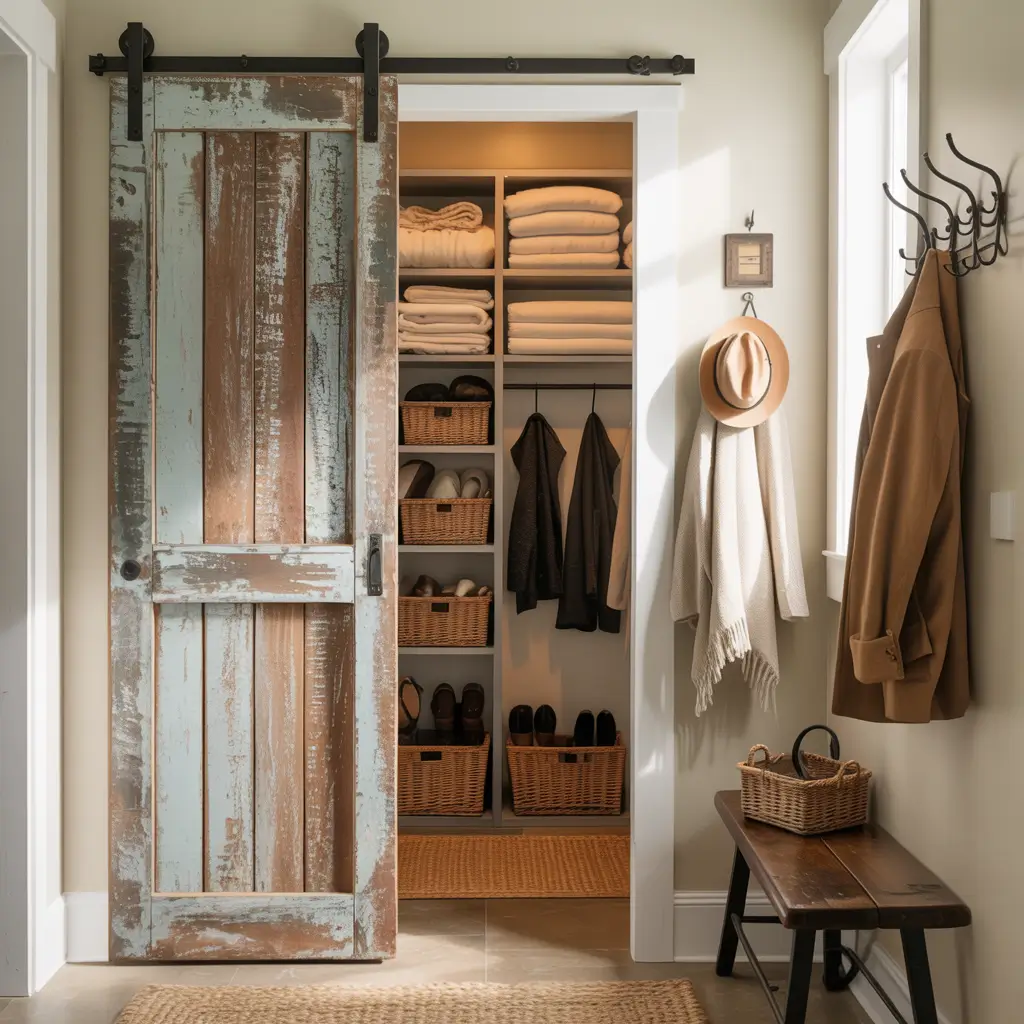
Remember when barn doors were everywhere? Well, they’re still brilliant for tiny spaces. Sliding barn doors don’t need swing clearance, making them perfect for converting a small nook into a hidden mudroom closet.
I helped my neighbor install one over a 3-foot wide alcove. Behind that stylish door? A complete mudroom setup with hooks, shelves, and shoe storage. When guests come over, slide it closed and boom – instant neat freak status achieved.
What sells me on barn doors:
- No floor space needed for door swing
- Adds architectural interest to boring walls
- Hardware comes in tons of styles now
- You can DIY with basic tools and patience
Hidden Storage Configuration Ideas
Behind your barn door, maximize every inch:
- Install hooks on the back of the door itself
- Use adjustable shelving for seasonal flexibility
- Add battery-powered LED strips for visibility
- Include a small mirror for last looks
- Mount a narrow shelf for daily essentials
Corner Shelf Entryway Hack
Making Dead Space Work Overtime
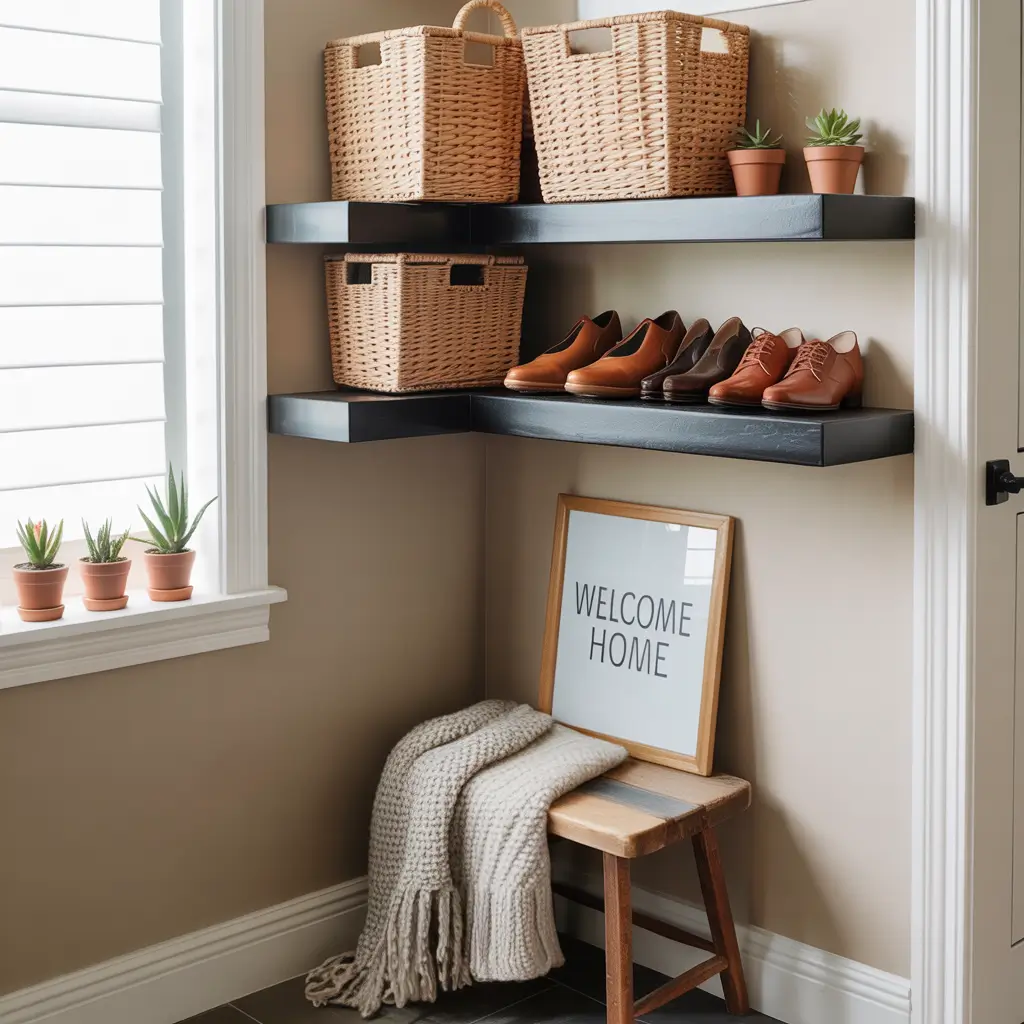
Corners are weird, right? They’re just… there. But corner shelving systems turn that awkward space into storage gold. I installed a five-tier corner unit that takes up virtually no floor space but holds an surprising amount of stuff.
Each shelf on mine serves a purpose:
- Top shelf: decorative (fake plant, because I can’t kill it)
- Second: seasonal items currently in rotation
- Third: daily bags and purses
- Fourth: shoe care supplies in a basket
- Bottom: everyday shoes that didn’t fit elsewhere
Corner Shelf Selection Criteria
Not all corner shelves work for entryways:
- Ladder-style = great for narrow spaces
- Floating corner shelves = clean, modern look
- Standing units = easiest to install
- Built-in options = most storage, most commitment
Pro tip: measure your corner carefully – walls are rarely perfectly 90 degrees.
Minimalist Open Locker Design

The “Less Is More” Approach That Actually Works
Here’s something that surprised me: open locker systems actually keep you more organized than closed storage. When everything’s visible, you can’t just shove stuff in and forget about it. My minimalist locker setup has three sections – one for each family member – with just hooks and one shelf each.
The forced simplicity is liberating:
- Each person gets: 3 hooks, 1 shelf, 1 shoe spot
- No doors to slam or break
- Everything visible = nothing gets lost
- Takes 30 seconds to tidy up
Making Minimalist Storage Work
The key to open storage success:
- Strict limits on what lives there
- Matching hangers/hooks for visual calm
- Regular purging of out-of-season items
- Designating overflow storage elsewhere
- Accepting that perfect isn’t the goal – functional is
Under-Stairs Mudroom Storage

The Harry Potter Space That Doesn’t Suck
Got stairs? You’ve got storage potential. That awkward under-stairs area can become a surprisingly functional mudroom with some creativity. My under-stairs setup isn’t pretty enough for Instagram, but it works like a charm.
Here’s how I configured mine:
- Tallest section: hanging coats and bags
- Middle height: pull-out drawers for accessories
- Lowest area: shoe storage on slanted shelves
- Tiny corner: vacuum and cleaning supplies
The slanted ceiling actually helps categorize storage by height naturally. Genius or just making the best of it? Both, honestly.
Dealing with Weird Angles
Under-stairs spaces are never standard:
- Custom shelving might be worth the investment
- Modular cube organizers can fill odd spaces
- Hooks at varying heights maximize vertical space
- Rolling storage bins access deep corners
- Battery-powered lights are your friend here
Two-Tier Shoe Cabinet Slim Fit

The Shoe Solution for Shoe Addicts
Let’s be real – shoes multiply when you’re not looking. A two-tier slim shoe cabinet keeps them contained without eating up your entire entryway. Mine is just 7 inches deep but holds 12 pairs of shoes on tilted shelves that keep everything visible.
What makes the two-tier system brilliant:
- Top tier: frequently worn shoes at easy grab height
- Bottom tier: less-used or seasonal pairs
- Closed front keeps things looking neat
- Ventilation slots prevent the stink factor
The slim profile means it fits even in narrow hallways. I’ve seen people squeeze these into spaces you wouldn’t think could hold furniture.
Maximizing Shoe Cabinet Efficiency
Smart organization makes all the difference:
- Sort by frequency of use, not by person
- Keep one pair of each type (sneakers, dress, boots) accessible
- Store out-of-season shoes elsewhere
- Use the cabinet top as a landing strip for keys
- Add cedar inserts to combat odors naturally
Mirror with Hidden Shelf Storage

The Secret Storage Nobody Expects
This might be my favorite tiny mudroom hack: mirrors with hidden storage. Mine looks like a regular full-length mirror, but it opens to reveal shelves for all those small items that clutter up entryways. Sunglasses, keys, mail, lip balm – everything has a spot.
The mirror serves triple duty:
- Storage for small essentials
- Last-minute appearance checks
- Makes the space feel larger (oldest trick in the book)
My hidden shelves hold:
- Top shelf: sunglasses and spare keys
- Middle shelves: mail and important papers
- Bottom shelf: dog leash and waste bags
- Side hooks: masks and hand sanitizer
Installation and Safety Notes
Mirrors need proper mounting:
- Use appropriate wall anchors for weight
- Consider safety backing in case of breaks
- Mount at height where everyone can use it
- Secure the opening mechanism to prevent slamming
- Check that shelves won’t dump contents when opened
Making It All Work Together
Here’s the thing about tiny mudroom organization – you don’t need every solution I’ve mentioned. Pick two or three ideas that solve your specific problems.
Maybe you’re all about shoes, so you focus on floating racks and a shoe cabinet. Or perhaps coats are your nemesis, making hooks and barn door storage your priorities.
My current setup combines four of these solutions, and honestly? My entryway finally works. No more morning chaos, no more tripping over shoes, no more lost keys.
The transformation took one weekend and about $300 total – way less than therapy for entryway-induced stress, right?
The real secret to tiny mudroom success isn’t finding the perfect Pinterest-worthy solution. It’s about choosing functional systems you’ll actually use and maintaining them consistently.
That minimalist open locker looks amazing, but if your family won’t put things back, it’s worthless.