
10 Innovative Half Garage Gym Ideas and Efficient Plans
- Garage Decor
 Ben
Ben- 0
- 42 minutes read

So you’ve got half a garage sitting there collecting dust, old paint cans, and maybe a few mysterious boxes you haven’t opened since 2017. What if I told you that cramped little space could become the best workout area you’ve ever owned? No monthly gym fees. No waiting for the squat rack. No awkward eye contact with strangers between sets.
I turned half of my own two-car garage into a fully functional gym about three years ago, and honestly, it changed everything about my fitness routine. The convenience alone made me more consistent than any gym membership ever did. But here’s the thing—I made a ton of mistakes along the way. I bought equipment that didn’t fit, ignored vertical space completely, and created a layout that felt more like an obstacle course than a workout zone.
That’s exactly why I put together these 10 innovative half garage gym ideas and efficient plans. Whether you’re working with a tight budget, limited square footage, or just want something that looks good while you sweat it out, there’s a setup here that’ll click for you. Let’s get into it.
1. Compact Cardio Corner
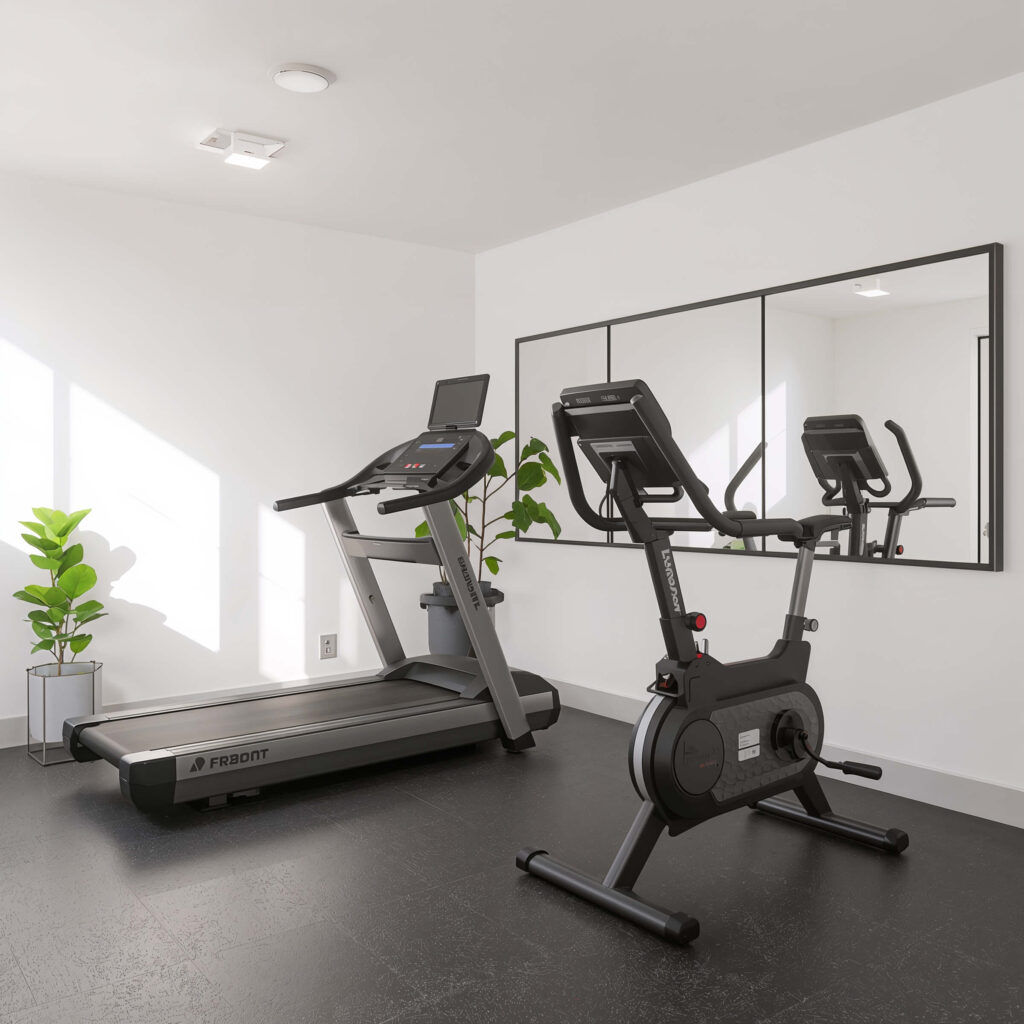
Not everyone wants to bench press a small car. Some of us just want to get our heart rate up, burn calories, and maybe survive a zombie apocalypse-level cardio session without leaving the house. A compact cardio corner dedicates your half garage space entirely to cardiovascular fitness, and it works brilliantly in smaller areas.
Choosing the Right Equipment
The trick here is picking cardio machines that deliver results without eating up your entire floor plan. You don’t need a commercial-grade treadmill that could double as a landing strip.
Consider these space-efficient cardio options:
- Foldable treadmill – Stores upright when not in use, freeing up 10–15 square feet instantly
- Air bike – Compact footprint and delivers a brutal full-body workout
- Jump rope station – Costs almost nothing and requires only a small cleared area
- Compact rowing machine – Many models fold in half for easy storage
- Mini stepper – Tiny, portable, and surprisingly effective for lower body cardio
Layout Tips
Place your primary machine against the back wall of the garage, leaving at least 3 feet of clearance on each side for safety. Use a rubber mat underneath to protect your garage floor and dampen noise. If you’ve got room left over, mount a small TV or tablet holder on the wall—because let’s be real, nobody wants to stare at drywall for 45 minutes.
I personally use a foldable treadmill paired with an air bike, and the combination covers everything from steady-state cardio to high-intensity intervals. The whole setup takes up roughly 60 square feet when everything’s unfolded.
2. Minimalist Strength Zone
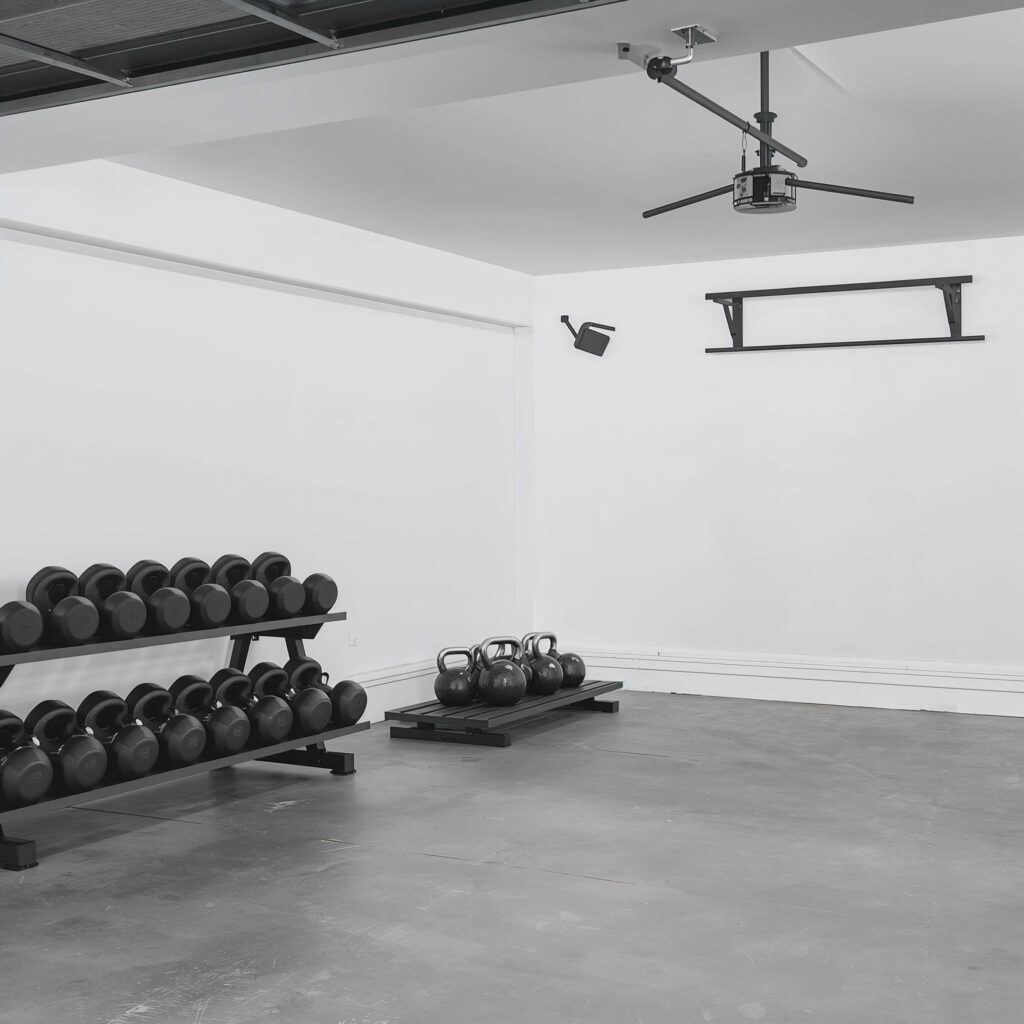
Ever noticed how the best home gyms aren’t the ones crammed with every machine imaginable? They’re the ones that nail the basics and do it well. A minimalist strength zone strips away the excess and focuses on the equipment that actually builds muscle.
The Essential Equipment List
You can build serious strength with surprisingly few tools. Here’s what a minimalist half garage gym needs:
- Power rack or squat stand – The backbone of any strength setup
- Olympic barbell and weight plates – Versatile enough for dozens of exercises
- Adjustable bench – Flat, incline, and decline options in one piece
- Pull-up bar – Wall-mounted or rack-attached
- Resistance bands – Perfect for warm-ups and accessory work
That’s it. Seriously. These five items cover squats, deadlifts, bench press, overhead press, rows, pull-ups, and about a hundred other movements.
Why Minimalism Works
When you limit your equipment, you eliminate decision fatigue. You walk into your garage, and you know exactly what you’re doing. No wandering around wondering which machine to try next. You load the bar, you lift, you grow. There’s a beautiful simplicity to it.
I spent my first year buying random gadgets and gimmicky equipment that promised “revolutionary results.” Most of it ended up in a donation pile. The barbell and rack? Those stayed. They always stay.
3. Foldable Equipment Setup
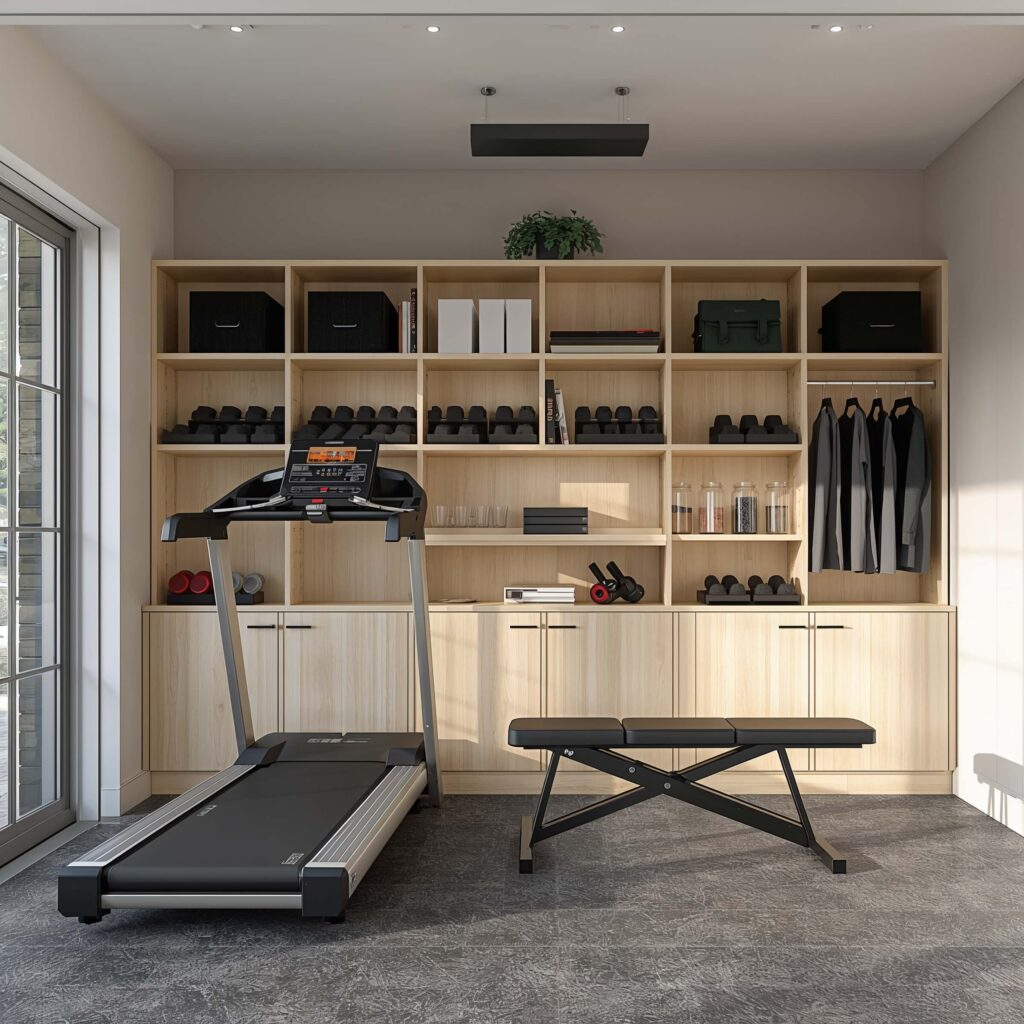
Here’s where things get clever. What if you need your half garage to still function as, well, a garage? Maybe you park a car there during the week, or you use the space for projects on weekends. A foldable equipment setup gives you a full gym that disappears when you don’t need it.
Best Foldable Equipment Options
The market for space-saving fitness gear has exploded in the last few years. You can find foldable versions of almost everything:
- Wall-mounted folding squat rack – Folds flat against the wall in seconds
- Foldable weight bench – Slides under a workbench or stands upright in a corner
- Collapsible dip station – Sets up and breaks down in under a minute
- Folding treadmill – Tilts vertically for compact storage
- Portable suspension trainer (like TRX) – Hangs from a door or ceiling mount and fits in a bag
Making It Work
The key to a successful foldable gym is organization. Designate a specific wall or corner for stored equipment. Use hooks, wall brackets, and pegboards to keep everything tidy and accessible. When it’s workout time, you should be able to set up your entire gym in under five minutes. If it takes longer than that, you’ll eventually stop bothering—trust me on this one.
I tested a wall-mounted folding rack from a popular brand last year, and it genuinely transformed how I thought about garage gym design. The thing folds flat to about 4 inches from the wall, and it holds up to 1,000 pounds when deployed. Engineering at its finest.
Also Read: 10 Perfect Garage Aesthetic Ideas to Boost Organization
4. Multi-Purpose Garage Gym
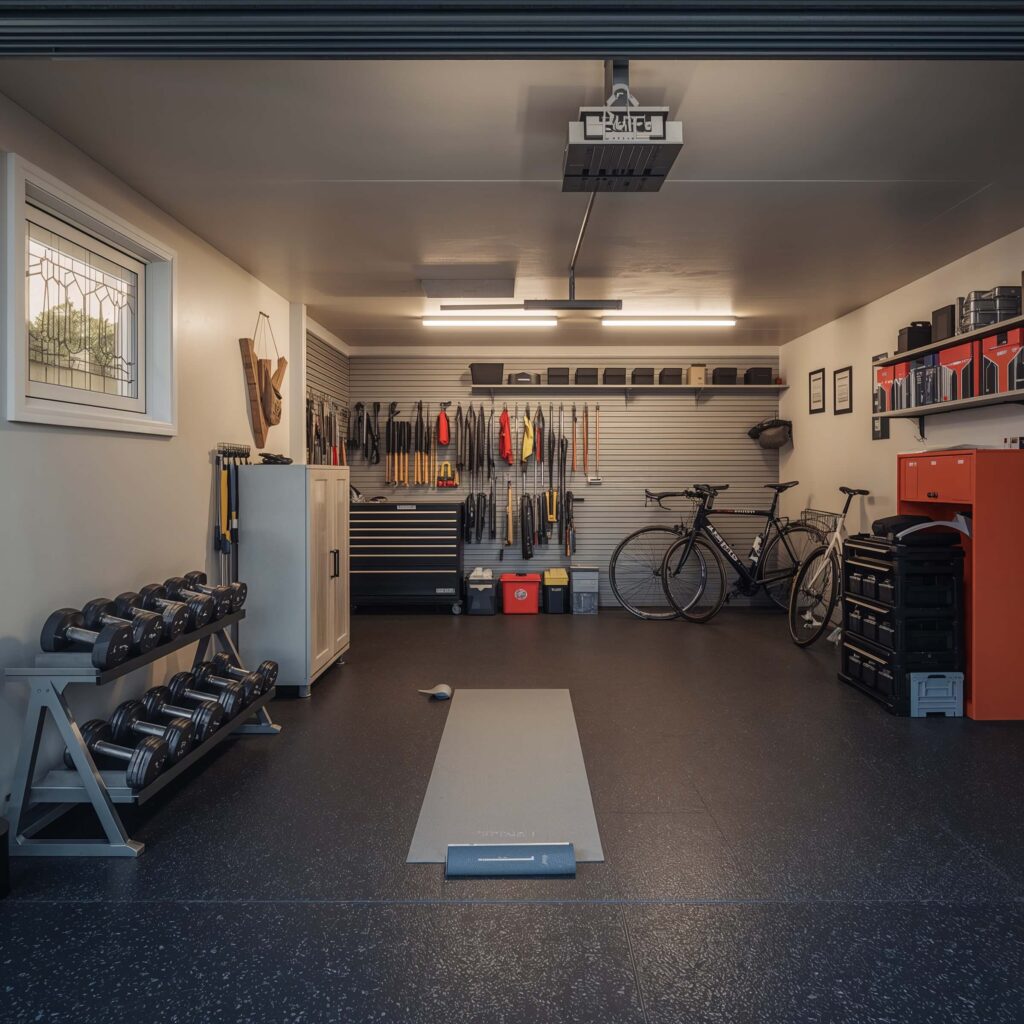
Why settle for one function when your half garage can handle several? A multi-purpose garage gym blends fitness equipment with other uses—workspace, storage, hobby area—without sacrificing your workout quality.
Zoning Your Space
The secret sauce here is zoning. Mentally (or physically, with floor tape or different colored mats) divide your half garage into distinct areas:
- Workout zone – Your primary exercise area with equipment
- Storage zone – Shelving for tools, seasonal items, or household overflow
- Flex zone – A cleared area that shifts between uses depending on the day
Smart Design Choices
Choose equipment that supports multiple functions. An adjustable dumbbell set replaces an entire rack of fixed dumbbells. A flat bench doubles as a seat for workbench projects. A wall-mounted pull-up bar stays out of the way when you’re not using it.
The real magic happens when you plan the transitions. Can you move from “gym mode” to “workshop mode” in under ten minutes? If yes, you’ve nailed the multi-purpose design. If you’re spending half an hour shuffling equipment around, your plan needs work.
Ever walked into someone’s garage and thought, “How does all of this fit in here?” That’s the reaction you want. Thoughtful planning makes small spaces feel massive.
5. Wall-Mounted Workout Station
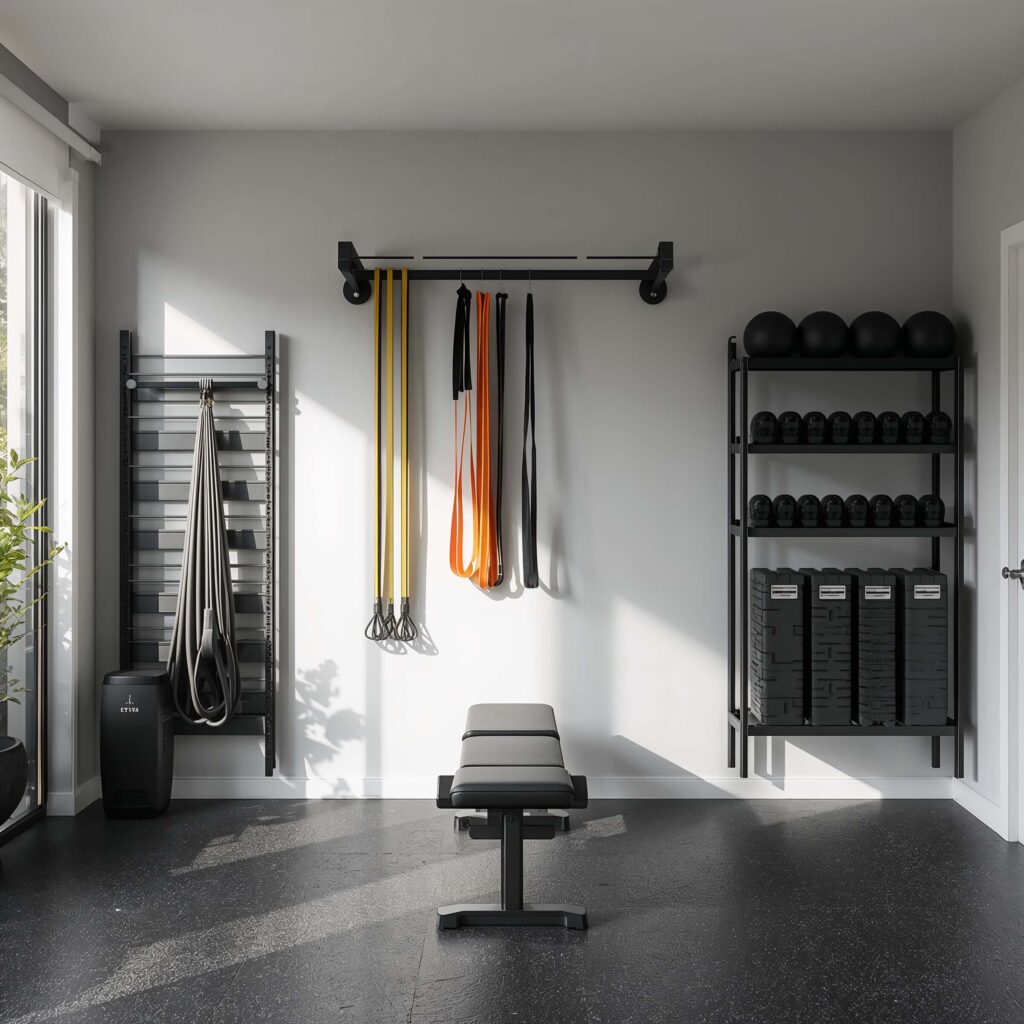
Floors are overrated. Okay, not really—you definitely need a floor. But when you’re working with a half garage gym, your walls become prime real estate. A wall-mounted workout station moves your equipment off the ground and onto vertical surfaces, freeing up floor space for actual training.
What to Mount on Your Walls
You’d be surprised how much gym equipment comes in wall-mounted versions:
- Folding squat rack – Mounts to wall studs and supports heavy loads
- Pull-up/chin-up bar – Bolts directly to the wall or ceiling joists
- Wall-mounted cable pulley system – Gives you cable crossover functionality in a fraction of the space
- Resistance band pegs – Simple hooks that hold bands at various heights
- Medicine ball storage rack – Keeps balls organized and off the floor
- Wall-mounted dip bars – Sturdy, permanent, and zero floor footprint
Installation Considerations
Before you start drilling holes, make sure you locate your wall studs. Garage walls can be tricky—some are drywall over studs, others are bare studs, and some older garages have concrete block walls. Every mounting system needs solid anchoring.
I recommend using a stud finder and lag bolts for any equipment that bears weight. Drywall anchors alone won’t cut it when you’re hanging from a pull-up bar. Nobody wants to learn that lesson the hard way. IMO, spending an extra hour on proper installation saves you from a very embarrassing trip to the emergency room.
6. Stylish Storage & Gym Combo
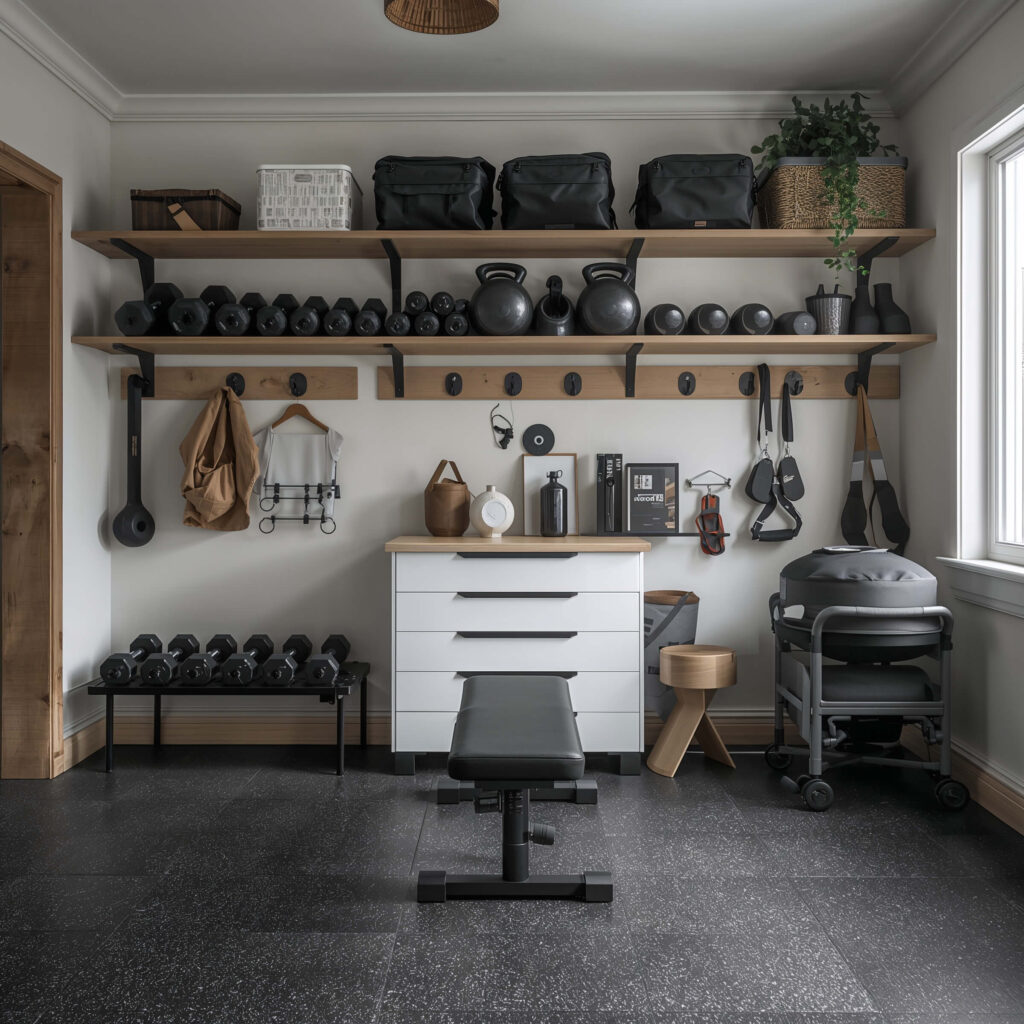
Let’s address something most garage gym articles ignore: aesthetics matter. Just because it’s a garage doesn’t mean it should look like a junkyard. A stylish storage and gym combo proves you can have a functional workout space that also looks legitimately good.
Design Elements That Elevate Your Space
Small touches make a huge difference in how your gym feels:
- Color-coordinated equipment – Choose a color scheme and stick with it (black and red, all matte black, gray and white, etc.)
- Slatwall panels – These modular wall systems hold shelves, hooks, and baskets while looking clean and modern
- Matching storage bins – Ditch the mismatched cardboard boxes for uniform containers
- LED strip lighting – Affordable, easy to install, and instantly makes any space feel premium
- Rubber gym flooring – Rolled or interlocking tiles in a consistent color
Combining Storage with Fitness
The best garage gyms I’ve seen integrate storage seamlessly with the workout area. Picture a tall shelving unit along one wall holding labeled bins for seasonal decorations and household items, while the opposite wall features mounted equipment and a weight rack. The center stays clear for training.
You can even use the top shelves of your storage system for lighter gym accessories—yoga mats, foam rollers, resistance bands—keeping everything in one organized ecosystem. When friends walk in, they won’t see a cluttered garage with a barbell shoved in the corner. They’ll see a space that looks intentional and put-together.
Also Read: 10 Eye-Catching Garage Bar Ideas and DIY Projects
7. Home Gym with Natural Light
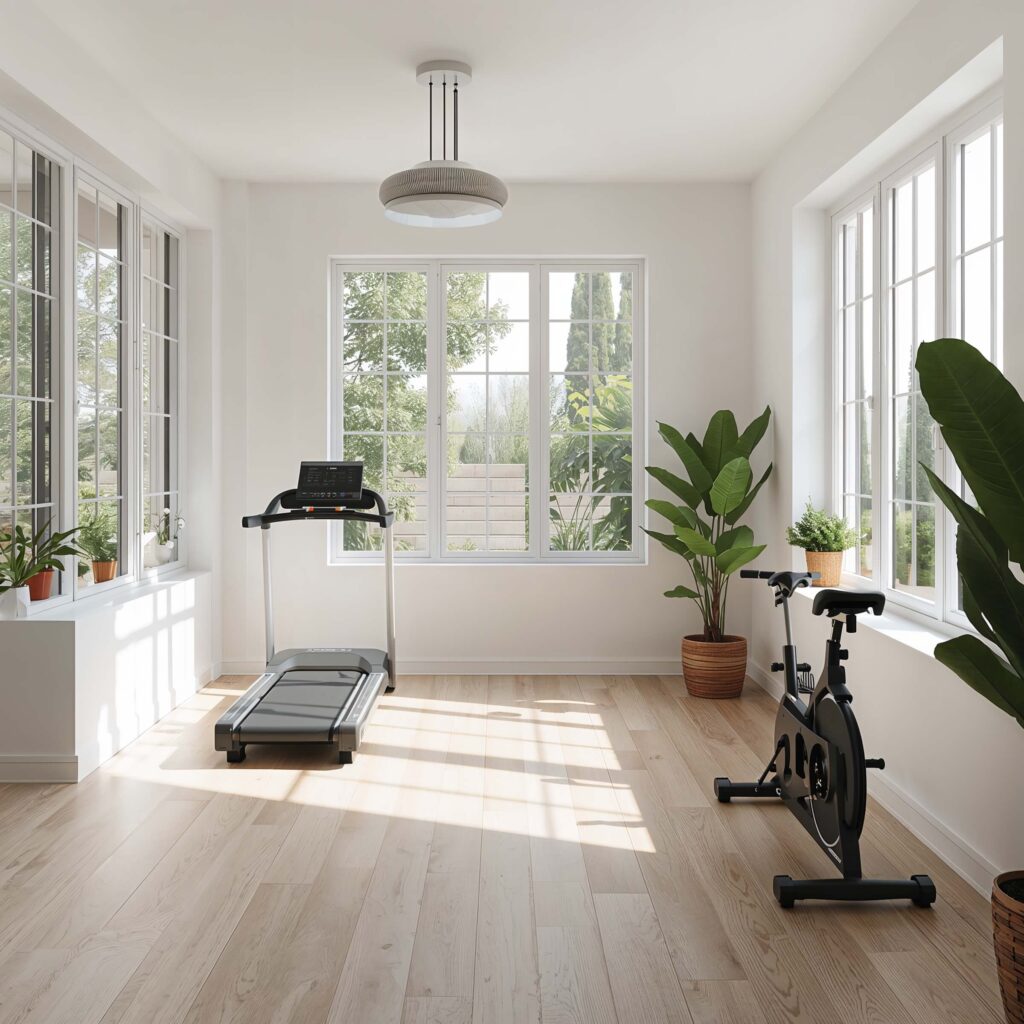
Training in a dark, dingy garage feels about as motivating as doing burpees in a cave. If your half garage has windows—or if you can add them—a home gym with natural light changes the entire training experience.
Why Natural Light Matters
This isn’t just about aesthetics (though it helps). Studies consistently show that natural light improves mood, energy levels, and even workout performance. You feel more alert, more motivated, and less likely to cut your session short.
Here’s how to maximize natural light in your garage gym:
- Keep windows unobstructed – Don’t stack equipment or storage in front of them
- Add a window if possible – A single egress window or glass block installation can transform a dark garage
- Use light-colored paint on walls and ceiling – White or light gray reflects light and makes the space feel bigger
- Install a glass garage door panel – Some garage doors offer frosted glass sections that flood the space with light
- Position mirrors strategically – They reflect natural light deeper into the room while helping you check your form
My Personal Experience
When I first set up my garage gym, the single small window barely helped. I painted the walls bright white, added a large mirror on the opposite wall, and replaced two panels of my garage door with frosted glass inserts. The difference felt dramatic. Training at 7 AM went from gloomy to genuinely enjoyable. That one upgrade probably added more to my consistency than any piece of equipment I’ve ever bought.
8. Budget-Friendly Half Garage Gym
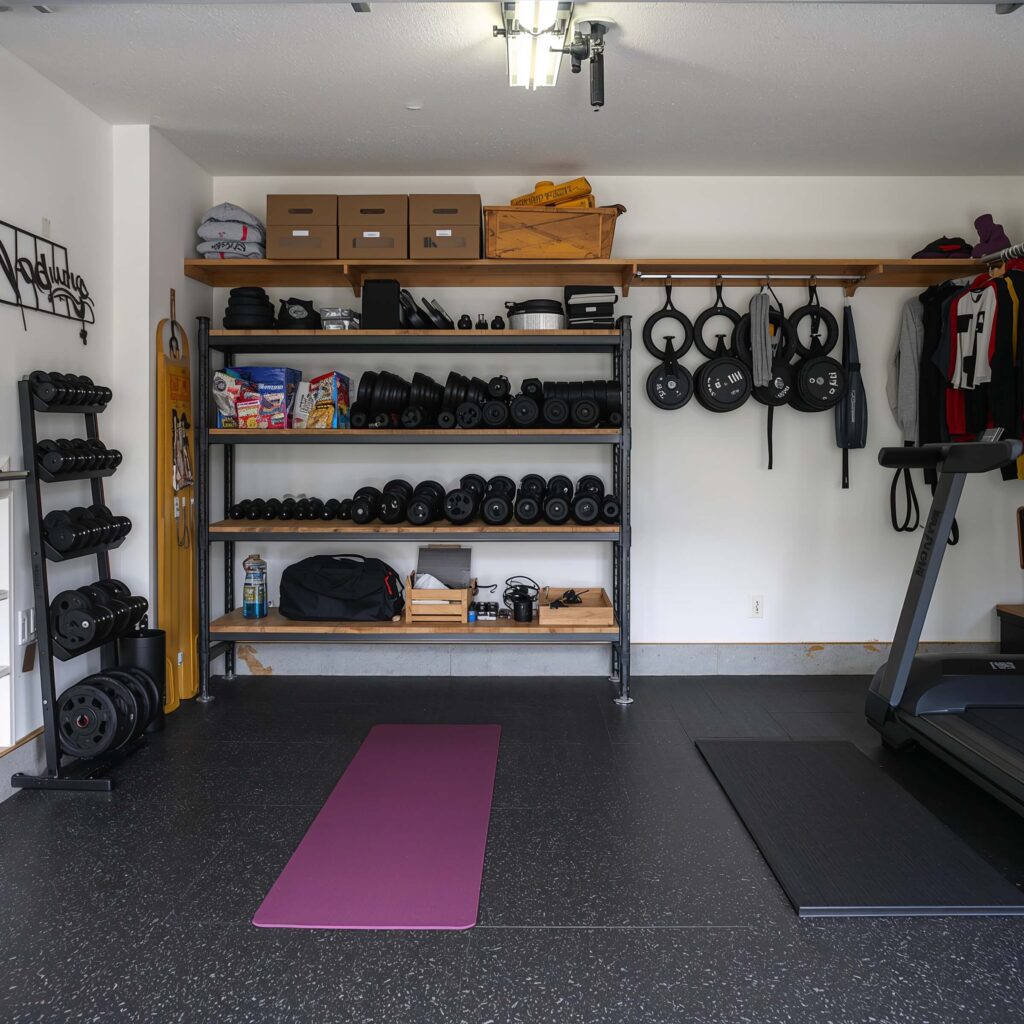
Not everyone has $5,000 to drop on a dream gym setup. And honestly? You don’t need it. A budget-friendly half garage gym can deliver excellent workouts for a fraction of what most people spend. You just need to be smart about where your money goes.
Priority Spending Guide
When your budget is tight, spend money on the things that matter most and get creative with the rest:
Worth the investment:
- Quality barbell – A good barbell lasts decades. Cheap ones bend, rust, and feel terrible
- Rubber flooring – Protects your equipment and your garage floor. Horse stall mats from farm supply stores cost around $40–50 each and work perfectly
- Sturdy squat stand or rack – Safety matters. Don’t cheap out on the thing that catches a failed squat
Where to save:
- Weight plates – Buy used. Check Facebook Marketplace, Craigslist, and garage sales. Iron is iron
- Bench – A basic flat bench costs $60–80 and handles most exercises
- Accessories – Resistance bands, ab wheels, and jump ropes deliver huge value for under $30 total
- Mirrors – Check local thrift stores or buy surplus mirrors from home renovation companies
Total Budget Breakdown
Here’s a realistic budget-friendly garage gym that covers all the basics:
| Item | Estimated Cost |
|---|---|
| Used squat stand | $150–200 |
| Olympic barbell | $150–250 |
| 300 lbs used plates | $150–300 |
| Flat bench | $60–80 |
| Horse stall mats (2) | $80–100 |
| Pull-up bar (doorframe) | $25–35 |
| Resistance bands | $20–30 |
| Total | $635–995 |
Under a thousand bucks for a complete gym? That’s less than two years of a basic gym membership at most commercial chains. The equipment pays for itself fast. FYI, patience with used equipment hunting can easily shave another 30% off these numbers.
9. Vertical Space Fitness Design
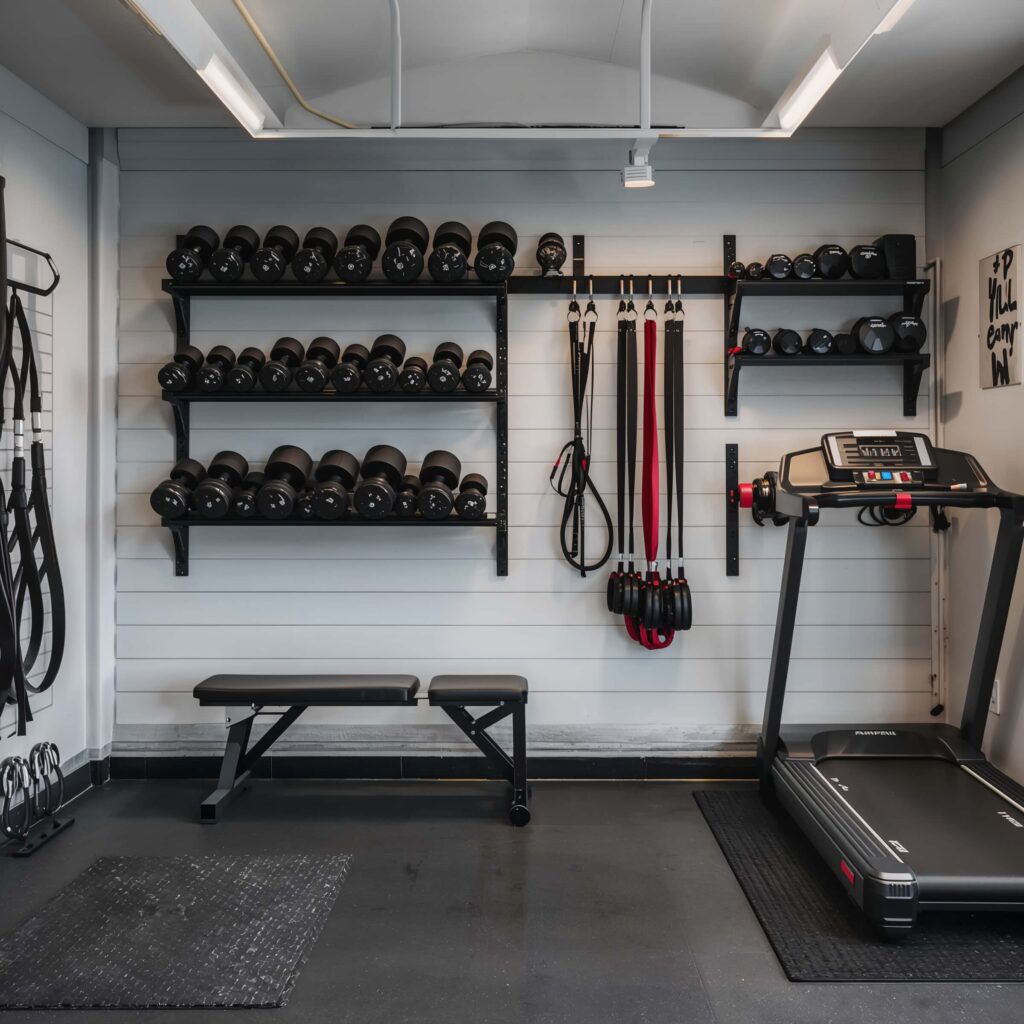
Here’s where most garage gym owners leave money—and gains—on the table. They focus entirely on floor space and completely ignore the 8 to 10 feet of vertical space sitting right above their heads. A vertical space fitness design takes advantage of every inch from floor to ceiling.
Going Up Instead of Out
Think about what you can move upward:
- Ceiling-mounted pull-up bar – Saves wall space and gives you more grip width options
- Overhead storage platforms – Build or install a ceiling-mounted platform for bins and seasonal items, freeing up floor space for equipment
- Pegboard walls – Mount a floor-to-ceiling pegboard for organizing bands, jump ropes, belts, and small accessories
- Vertical barbell storage – Wall-mounted vertical racks hold barbells upright instead of laying them across the floor
- Ceiling-mounted suspension trainers – TRX-style trainers hang from above and store by simply wrapping them up
- High shelving – Install shelves at the 6–7 foot mark for items you don’t grab daily
The Ceiling Platform Trick
This one’s a game-changer. Install a 4×8 foot overhead storage platform near the ceiling of your half garage. Use it to store holiday decorations, camping gear, or anything else that currently takes up floor space. Suddenly, you’ve reclaimed 32 square feet of usable gym area.
You can build one with basic lumber and hardware for under $100, or buy a kit from a home improvement store for around $200–300. Either way, the return on investment is massive when you measure it in reclaimed training space.
I built mine over a weekend with a friend, and we immediately moved six large bins off the floor and onto the platform. That cleared enough room for a full deadlift setup that I couldn’t fit before. Sometimes the best gym upgrade isn’t a new piece of equipment—it’s removing the clutter that’s already there.
Also Read: 10 Easy Bloxburg Garage Ideas for Beginner Builders
10. Modern Industrial Garage Gym
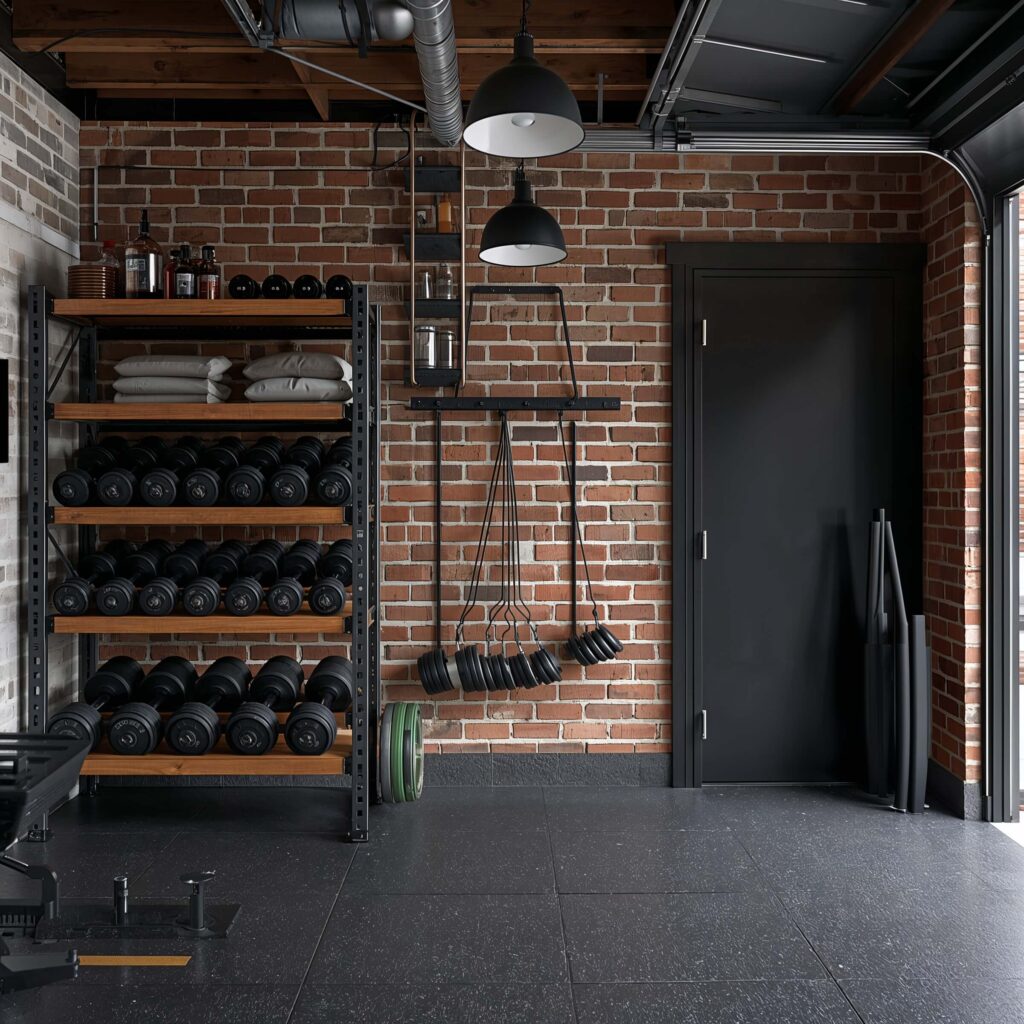
If you want your half garage gym to look like it belongs on an Instagram feed or a fitness magazine cover, the modern industrial garage gym aesthetic is the way to go. This style embraces the raw, unfinished nature of a garage while adding intentional design elements that make it feel polished and purposeful.
Key Design Features
The industrial gym look relies on a few signature elements:
- Exposed brick, concrete, or cinder block walls – Leave them raw or apply a clear sealant for a clean finish
- Matte black equipment – Black racks, bars, and benches create a cohesive, professional look
- Metal shelving and storage – Wire racks and steel shelves reinforce the industrial vibe
- Edison bulb or industrial pendant lighting – Functional and stylish. Warm light makes the space inviting
- Painted concrete floor with clear coat – Or use dark gray interlocking gym tiles for a sleek look
- Motivational signage – Metal or wood signs with clean typography. Skip the cheesy “No Pain No Gain” posters from 1995
Bringing It All Together
The modern industrial look works especially well in garages because the bones of the space already support the aesthetic. You’re not fighting against the environment—you’re working with it. Concrete floors, metal garage doors, exposed ceiling joists—all of these become design features rather than flaws.
Paint is your best friend here. A single accent wall in charcoal gray or deep navy blue instantly anchors the space. Pair it with matte black equipment and warm-toned lighting, and your garage gym suddenly looks like a boutique fitness studio.
I painted one wall in my setup a deep charcoal color and added two industrial pendant lights from a hardware store (about $30 each). The transformation was ridiculous for the cost. People walk in and assume I spent thousands on the design. The secret? Under $100 in paint and lighting 🙂
Bonus Tips for Any Half Garage Gym Setup
No matter which of these half garage gym ideas speaks to you, a few universal principles apply to every build:
Climate Control
Garages get hot in summer and freezing in winter. Address this early:
- Insulate your garage door – Foam board insulation kits cost $50–100 and make a noticeable difference
- Add a portable fan or space heater – Depending on your climate, one or both might be essential
- Consider a mini-split AC unit – If your budget allows, this is the ultimate comfort upgrade
Flooring Always Matters
Never train on bare concrete. It’s hard on your joints, slippery when wet, and damages dropped equipment. Invest in proper gym flooring—rubber tiles, rolled rubber mats, or horse stall mats. Your knees, your barbell, and your garage floor will thank you.
Sound Considerations
If your garage shares a wall with your living space—or your neighbor’s living space—think about noise. Deadlift pads, rubber bumper plates, and thick flooring all reduce impact noise significantly. Dropping iron plates on concrete at 6 AM is a fantastic way to make enemies.
Security
A garage full of fitness equipment is a target. Use a quality garage door lock, consider adding a security camera, and avoid leaving the door open and unattended with expensive gear on display. That shiny new power rack looks just as appealing to thieves as it does to you.
Wrapping It Up
Building a half garage gym doesn’t require a massive budget, a contractor, or an engineering degree. It requires a clear plan, smart equipment choices, and a willingness to get a little creative with your space.
Whether you go with a compact cardio corner for simplicity, a minimalist strength zone for serious lifting, or a modern industrial garage gym for that magazine-worthy aesthetic, the best setup is the one you’ll actually use consistently. A $10,000 gym means nothing if it collects dust. A $700 setup that gets you training five days a week? That’s the real win.
Start with one or two of these ideas, build from there, and adjust as your needs evolve. Your half garage has more potential than you think—it just needs someone willing to see it. And if you’ve read this far, that someone is clearly you.
Now stop reading and go measure your garage. Your future gym is waiting.