10 Genius Tiny House Stairs Ideas Small Space Saving Ideas
- Stairs Design
 Ben
Ben- 0
- 34 minutes read
You know that moment when you’re standing in your tiny house looking at the loft, wondering how on earth you’re going to get up there without sacrificing half your living space? Yeah, I’ve been there. Traditional staircases laugh in the face of tiny living—they’re space hogs that don’t understand the assignment. But here’s the thing: stairs don’t have to be your enemy.
I’ve spent way too much time obsessing over tiny house stairs (my search history is honestly embarrassing at this point), and I’m here to share the brilliant solutions I’ve discovered. These aren’t your grandma’s boring old stairs. We’re talking floating masterpieces, hidden compartments, and designs so clever they’ll make you question why regular houses waste so much space. Ready to transform that vertical challenge into your favorite feature? Let’s get into it.
1. Floating Ladder Stairs with Minimal Frame
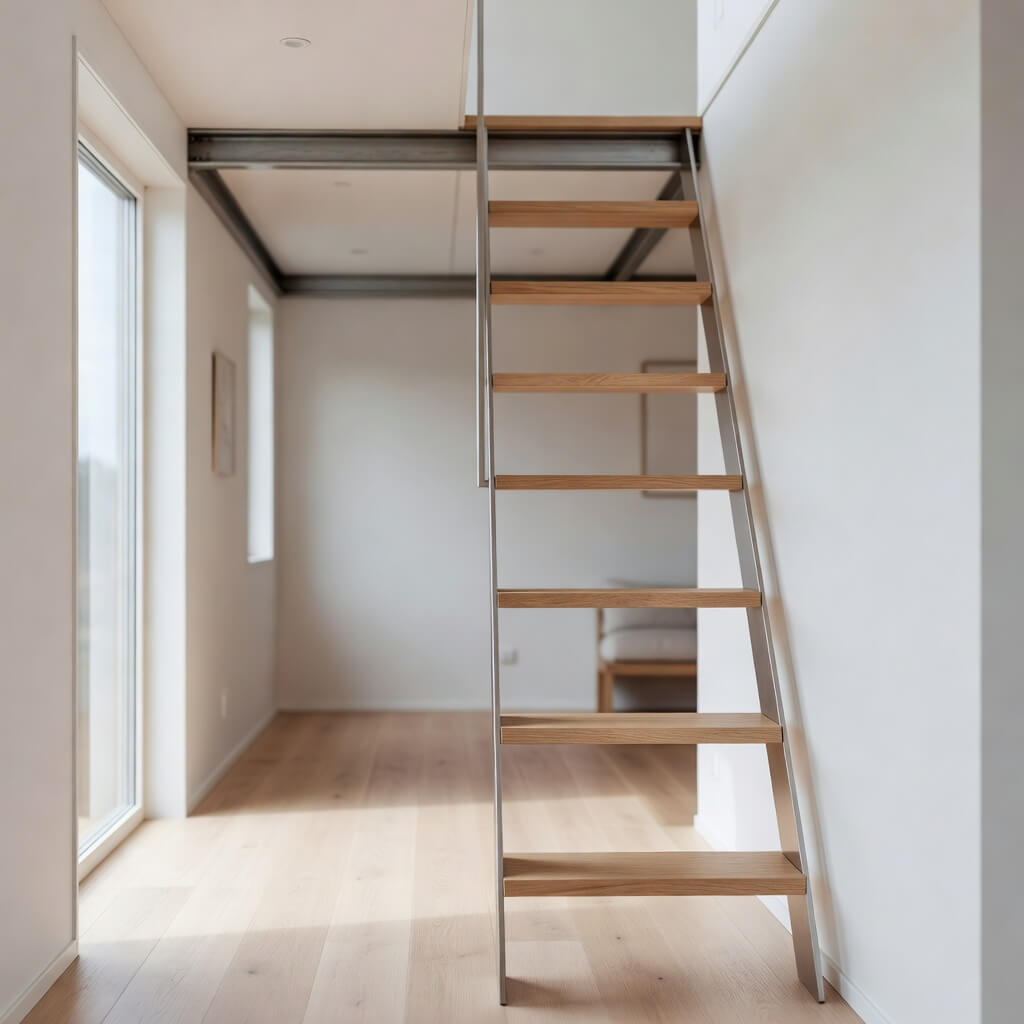
Ever walked into a tiny house and thought, “Wow, this feels surprisingly spacious”? Chances are, you were looking at floating ladder stairs. These beauties are the optical illusion your small space desperately needs.
Here’s what makes floating ladder stairs absolutely genius: they use minimal visual space while still being totally functional. The treads attach directly to the wall with hidden brackets, creating this amazing illusion that they’re just… floating there. No bulky side rails eating up precious square footage, no chunky framework making your space feel cramped.
I installed these in my friend’s tiny house last year, and the transformation was wild. Before, her traditional stairs made the living area feel like a hallway. After? The whole place opened up. The secret is in what you don’t see—those hidden support brackets do all the heavy lifting while keeping the aesthetic clean and minimal.
Key benefits you’ll love:
- Creates visual flow and makes spaces feel larger
- Easy to customize width based on your needs
- Modern aesthetic that photographs beautifully
- Typically costs less than traditional stair construction
- You can add a sleek handrail on the wall side for safety
The catch? You need a solid wall structure to support these properly. Definitely not a DIY project unless you really know what you’re doing (trust me on this one). But when installed correctly, they’re just as safe as regular stairs and way more impressive.
2. Built-in Storage Drawer Staircase Design
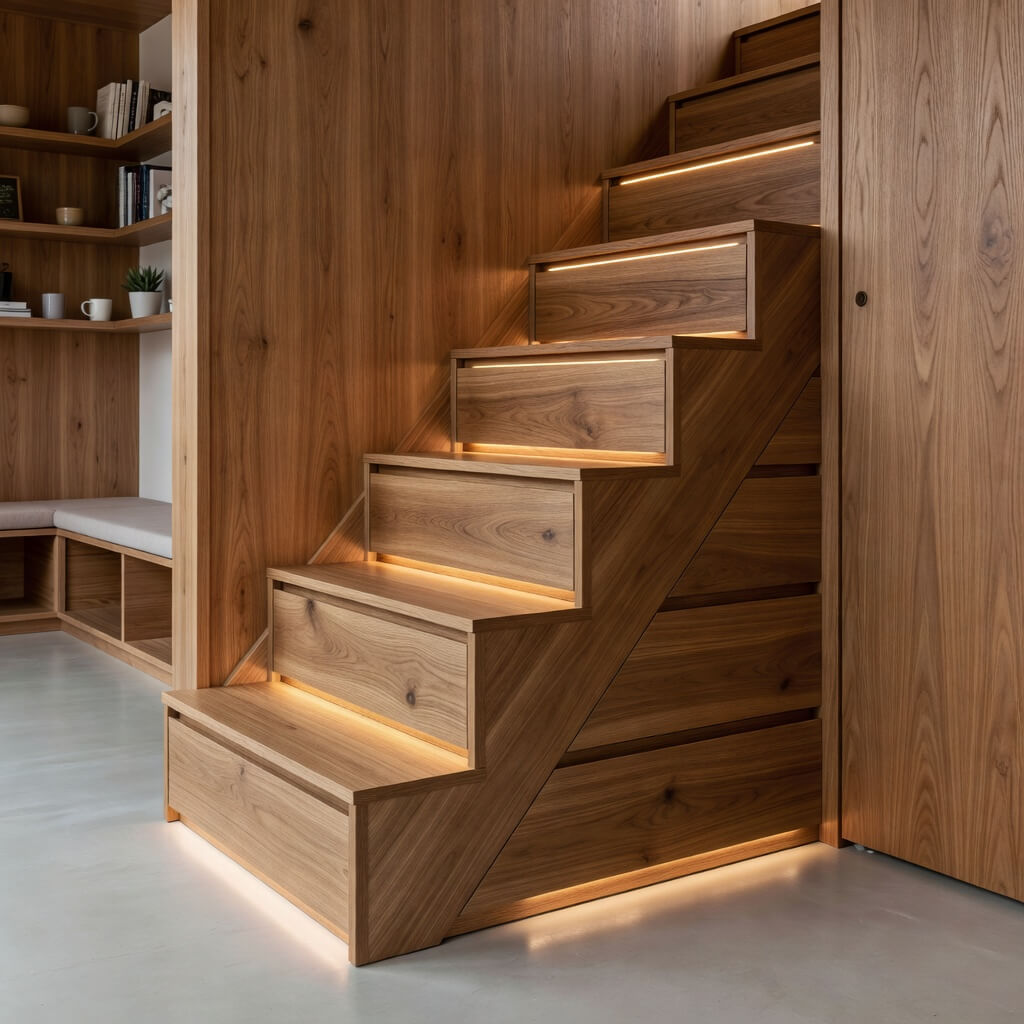
Okay, this is where tiny house stairs go from “necessary evil” to “best design decision ever.” Why would you waste all that space under your stairs when you could turn it into mega storage?
Storage drawer staircases are basically furniture that you climb. Each step becomes a deep drawer that pulls out, giving you storage space you didn’t even know you needed. I’m talking about hiding away shoes, tools, pantry items, linens, craft supplies—basically anything that’s cluttering up your tiny house.
The brilliance here is the efficiency. You’re using space that would otherwise be dead air. Traditional stairs just have that awkward triangle underneath that maybe fits a broom if you’re lucky. These stairs? They’re working overtime for you.
What you can realistically store:
- Seasonal clothing and accessories
- Kitchen appliances you don’t use daily
- Tools and hardware supplies
- Books, games, and entertainment items
- Pet supplies and food
- Emergency preparedness kits
I’ve seen designs where each drawer is different depths depending on the step height. The bottom steps become deep drawers perfect for boots or small appliances, while the top steps work great for flatter items. Some people even add dividers inside to organize smaller items—it’s like having a built-in dresser that doubles as stairs.
One word of caution: these babies get heavy when fully loaded. Make sure your construction can handle the weight, and maybe don’t store your rock collection in all of them at once 🙂
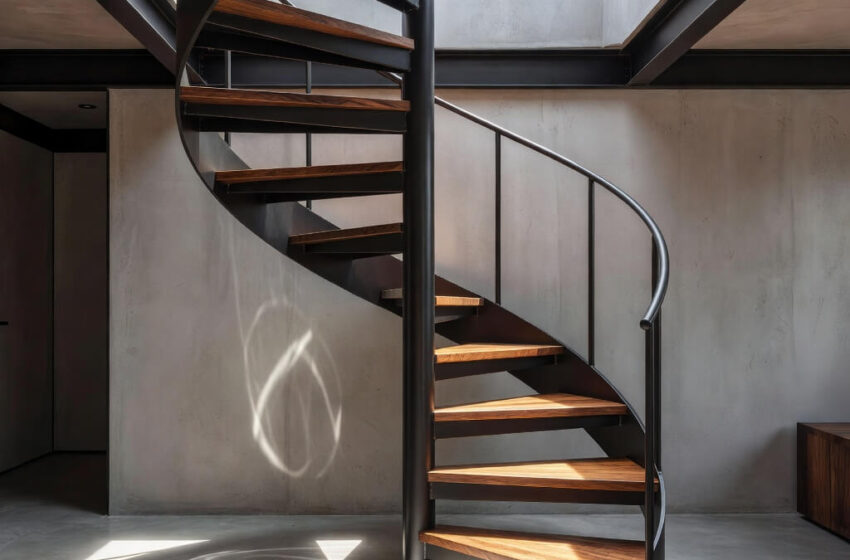
3. Spiral Compact Stairs for Tiny Homes
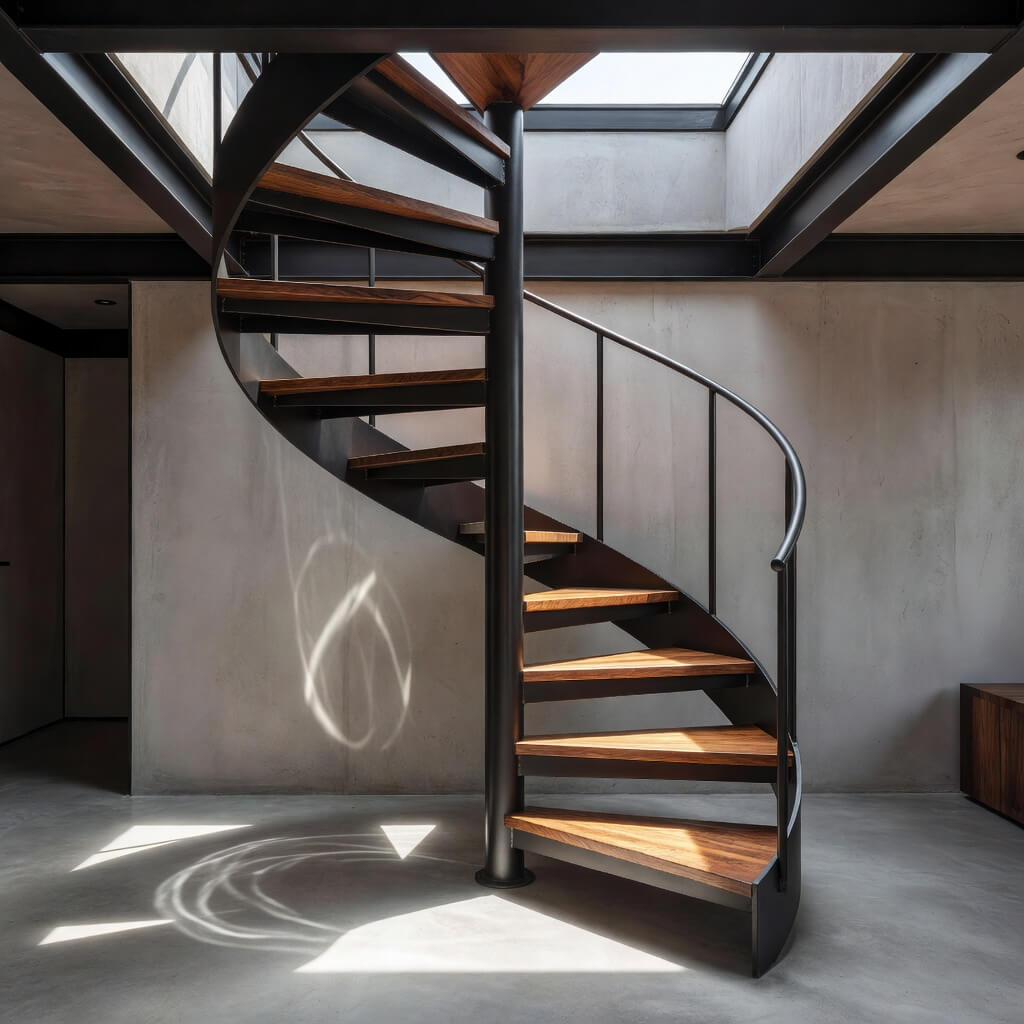
Look, spiral stairs aren’t everyone’s cup of tea, but hear me out. When you’re working with seriously limited floor space, these twisty wonders can be absolute lifesavers.
The footprint of a spiral staircase is ridiculously small compared to traditional stairs. We’re talking about a circle that’s maybe 3-4 feet in diameter versus a straight staircase that eats up 8-10 feet of linear space. That’s a massive difference when every square foot costs you real money.
Modern spiral stairs have come a long way from those rickety metal ones in old apartments. You can find gorgeous wooden designs, sleek metal frames, and even combo materials that look like art installations. I visited a tiny house in Portland last year that had a custom blackened steel spiral staircase, and it was honestly the centerpiece of the whole design.
Real talk about spiral stairs:
- They’re definitely trickier to navigate than straight stairs (especially going down)
- Moving furniture up them? Forget about it
- Not the best choice if you have mobility issues
- They create a dramatic visual focal point
- Code requirements vary by location, so check local regulations
The key is choosing the right diameter. Smaller means tighter turns and harder to use. Larger means easier climbing but more floor space. Most tiny house owners find that a 4-foot diameter hits the sweet spot between usability and space saving.
FYI, if you’re going custom, you can integrate storage into the center column or under the treads. Some designers get crazy creative with the negative space around spiral stairs too.
Also Read: 10 Gorgeous Bar Under Stairs Ideas for Home Upgrade
4. Foldable Wall-Mounted Stair System
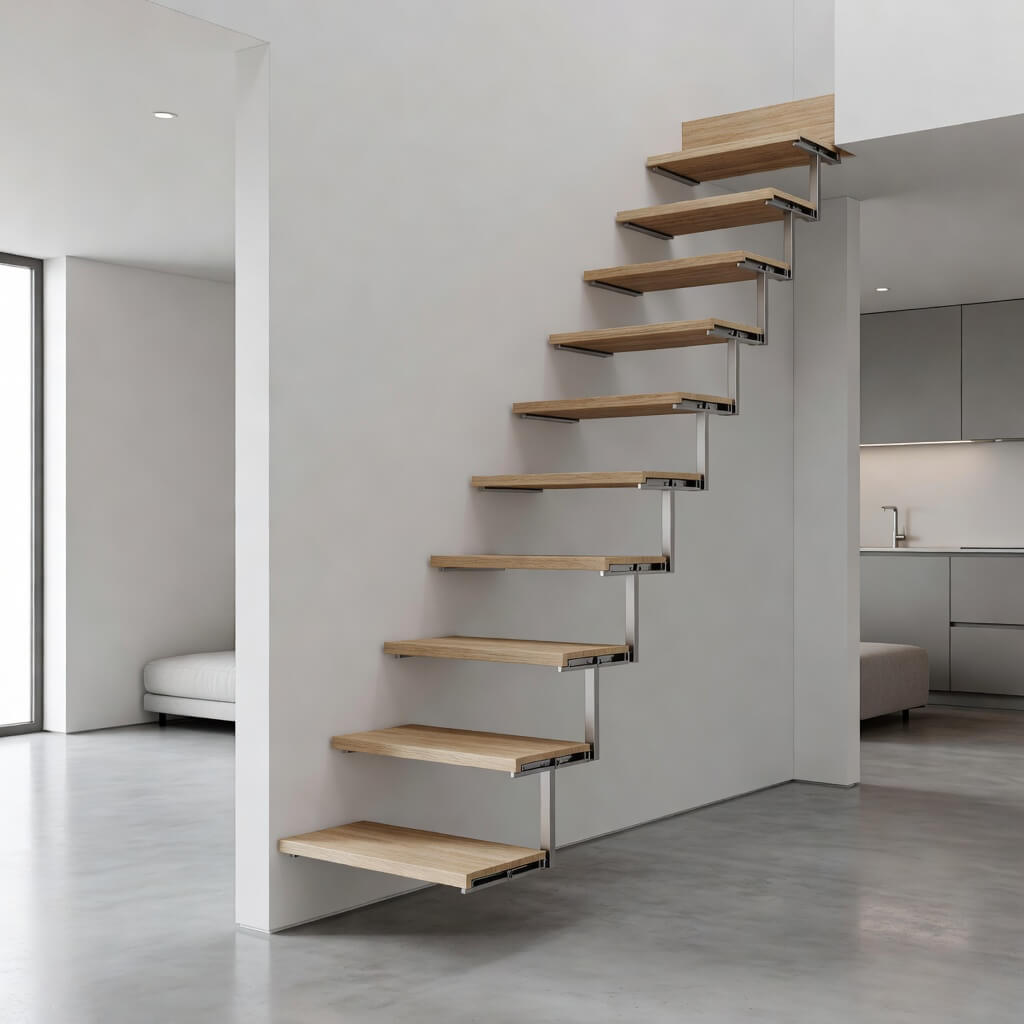
Alright, now we’re getting into the really clever territory. Foldable stairs are like the Murphy bed of the tiny house world—when you don’t need them, they practically disappear.
These systems mount to your wall and fold up when not in use. Some designs fold flat against the wall, others tuck up into the ceiling or under the loft platform. When you need to access your loft, you simply pull them down, and boom—instant staircase.
I’ll be honest: the first time I used one of these, I was skeptical. It seemed gimmicky, like something that would be annoying in daily use. But after a week? Totally converted. The extra floor space you get when the stairs are up is genuinely game-changing, especially in a small living area.
Things to consider:
- Requires good hardware and regular maintenance
- Takes a few seconds to deploy each time you use it
- Not ideal if you go up and down constantly all day
- Perfect for lofts you only access at bedtime
- Some models include counterweight systems for easy operation
The best designs I’ve seen incorporate safety features like locking mechanisms to prevent accidental folding while someone’s on the stairs. Because nothing ruins your day like stairs folding up mid-climb (that would be a hard no from me).
Price-wise, these tend to be more expensive than fixed stairs due to the hardware and engineering involved. But if space is your primary concern, the investment can totally be worth it.
5. Bookshelf Integrated Staircase Idea
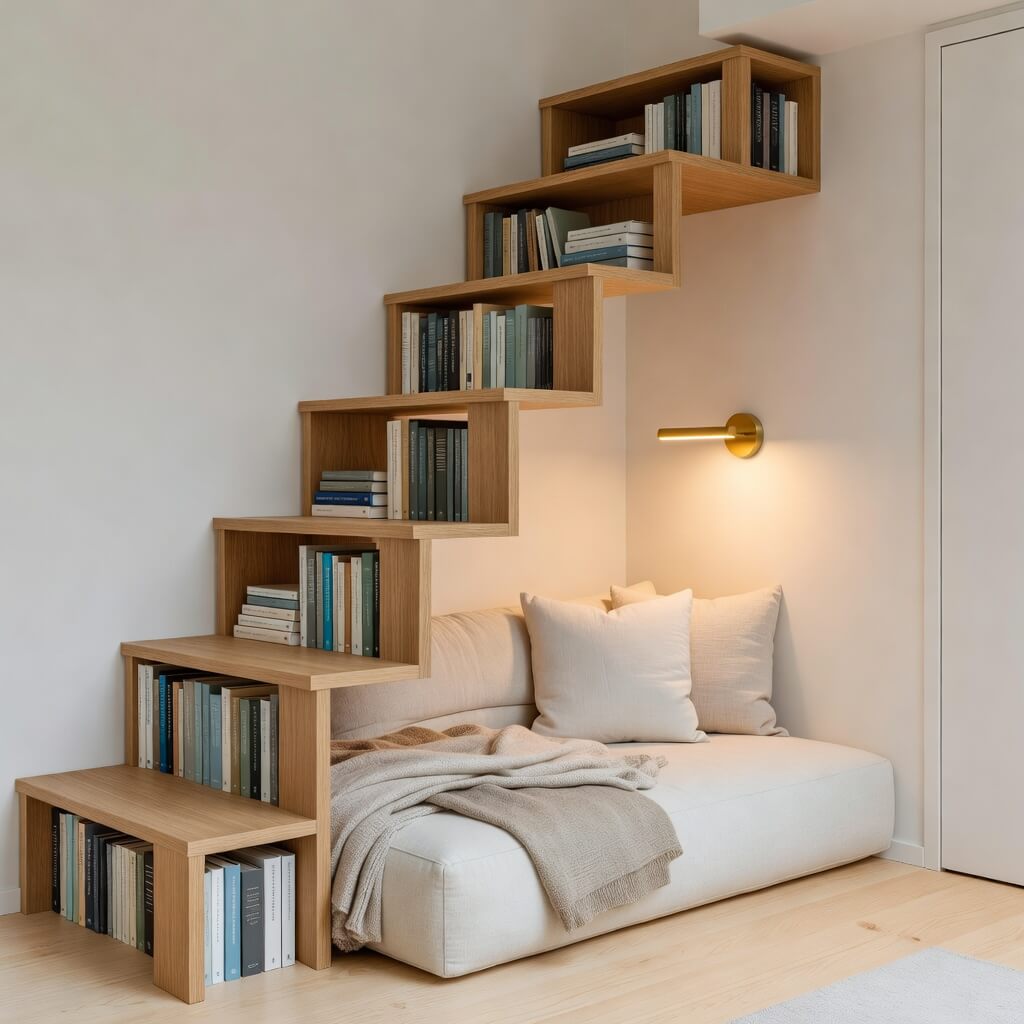
Book lovers, this one’s for you. Actually, scratch that—this works for anyone who needs vertical storage and stairs in the same footprint.
The bookshelf staircase is exactly what it sounds like: your stairs become shelving. The risers (vertical parts between each step) turn into display shelves, storage cubbies, or actual book storage. It’s beautiful, functional, and makes your tiny house feel like a cozy library.
I helped a friend build one of these, and we customized each shelf opening. Some were deep enough for books, others were shallower for displaying plants and small decorative items. The visual interest it creates is amazing—instead of blank risers, you’ve got this constantly changing display that adds personality to your space.
Creative ways to use these shelves:
- Book storage (obviously)
- Plant display for a vertical garden effect
- Photo frames and personal mementos
- Kitchen spice storage if stairs are near cooking area
- Art supplies and craft materials
- Wine bottle storage (yep, seen it done brilliantly)
The trick is not overloading the shelves. Too much stuff makes it look cluttered and can actually make your space feel smaller. I recommend rotating items seasonally and keeping it curated rather than cramming every shelf full.
Safety note: make sure items are secured or pushed back far enough that they won’t fall off when people are climbing. Little earthquake putty dots work great for securing decorative items on stairs that get a lot of traffic.
6. Alternating Tread Space Saver Stairs
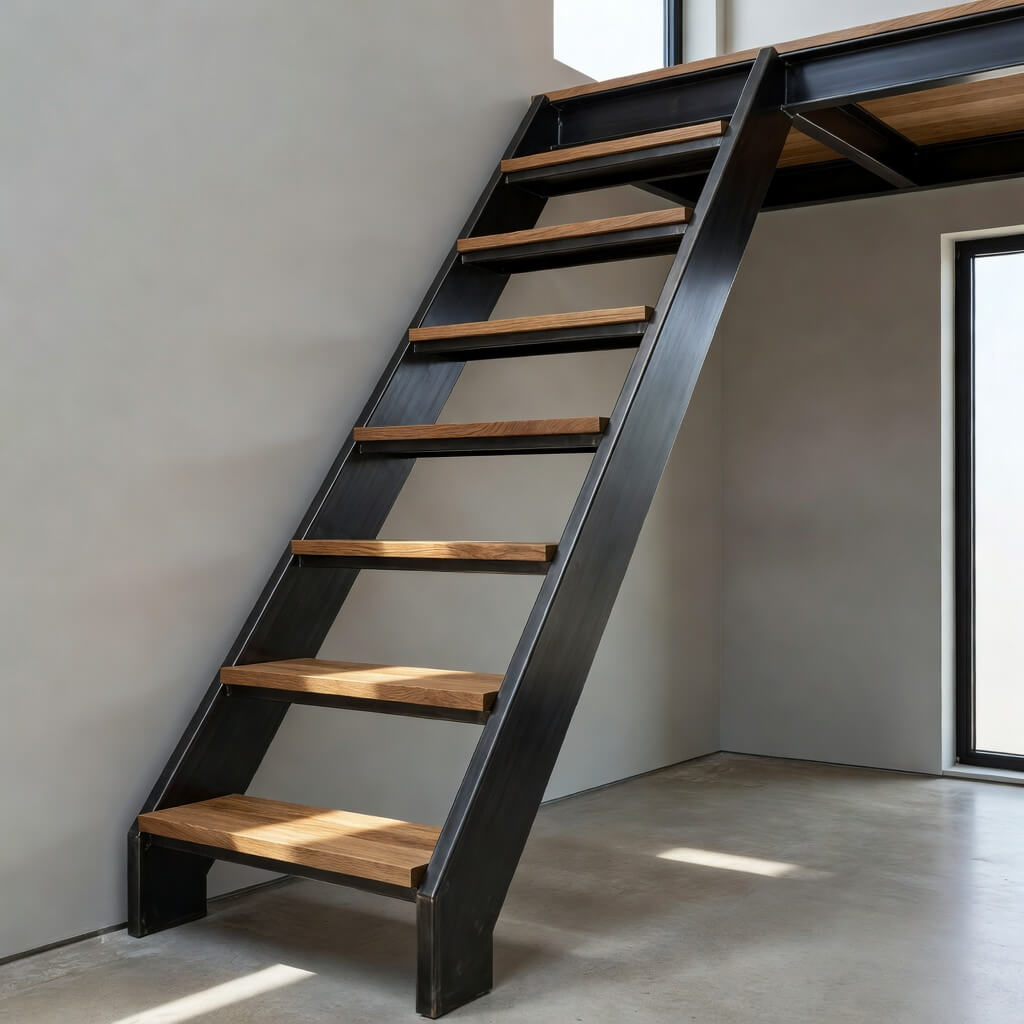
These stairs look weird. I’m not going to sugarcoat it—the first time you see alternating tread stairs, your brain does a little confused pause. But once you understand the genius behind them, you’ll never look at stairs the same way.
Here’s the deal: alternating tread stairs (also called paddle stairs or ship’s ladders) cut the floor space requirement nearly in half compared to traditional stairs. They do this by alternating which side of each tread is deep. Your left foot hits a left-sided tread, your right foot hits a right-sided tread, and so on.
The result? You can achieve a steeper angle while still maintaining safe, comfortable footing. They take up way less length than normal stairs but are significantly easier and safer to use than a ladder.
Why they work so well:
- Reduce stair run by 30-50% compared to traditional stairs
- Much safer than ladders for daily use
- Still maintain comfortable tread depth for each foot
- Easier to carry items up and down than on ladders
- Meet building codes in many jurisdictions for secondary access
IMO, these are the best compromise between space saving and functionality. Sure, you have to think about which foot goes where at first, but it becomes second nature crazy fast. I used them in a cabin for two weeks, and by day three, I wasn’t even thinking about it anymore.
The downside? They’re definitely not for everyone. If you have mobility issues or often carry large items between floors, traditional stairs might be better. But for able-bodied folks in seriously space-crunched tiny homes, alternating tread stairs are absolute champions.
Also Read: 10 Perfect Farmhouse Stairs Ideas for Beautiful Home Style
7. Hidden Pull-Out Stair Steps Design
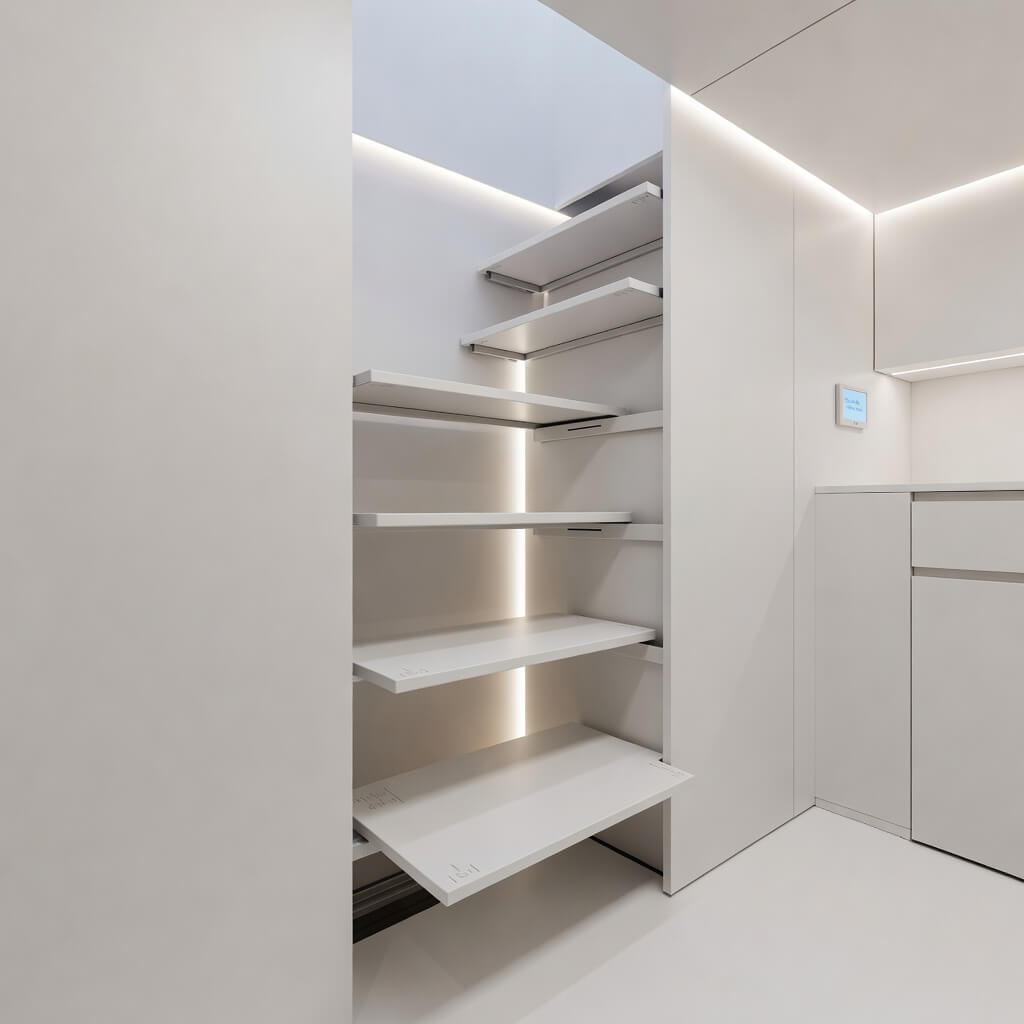
Want to blow your friends’ minds when they visit your tiny house? Hidden pull-out stairs are your answer. These sneaky devils disguise themselves as something else entirely—a cabinet, a wall panel, a platform edge—until you need them.
The most common version integrates into a kitchen island or cabinet system. What looks like standard cabinetry actually contains stairs that pull out on heavy-duty drawer slides. When you’re done using them, you push them back in, and poof—just looks like regular furniture.
I saw an incredible version of this at a tiny house festival where the stairs pulled out from under the loft platform itself. The builder used industrial-grade slides rated for something like 500 pounds. The mechanism was smooth as butter, and when retracted, you’d never know they were there.
Design variations I’ve encountered:
- Kitchen island with stairs that pull from the side
- Platform bases that slide out on tracks
- Wall-mounted units that extend accordion-style
- Multi-section stairs that telescope out
- Combination drawer-stair hybrids
The engineering on these is pretty serious. You absolutely need quality hardware—those cheap drawer slides from the big box store won’t cut it. Professional-grade heavy-duty slides are a must, and proper installation is critical for safety.
These systems tend to be pricier than standard stairs because of the custom work and hardware costs. But if you want maximum flexibility and the “wow factor,” hidden pull-out stairs deliver big time.
8. Modern Metal Frame Tiny House Stairs
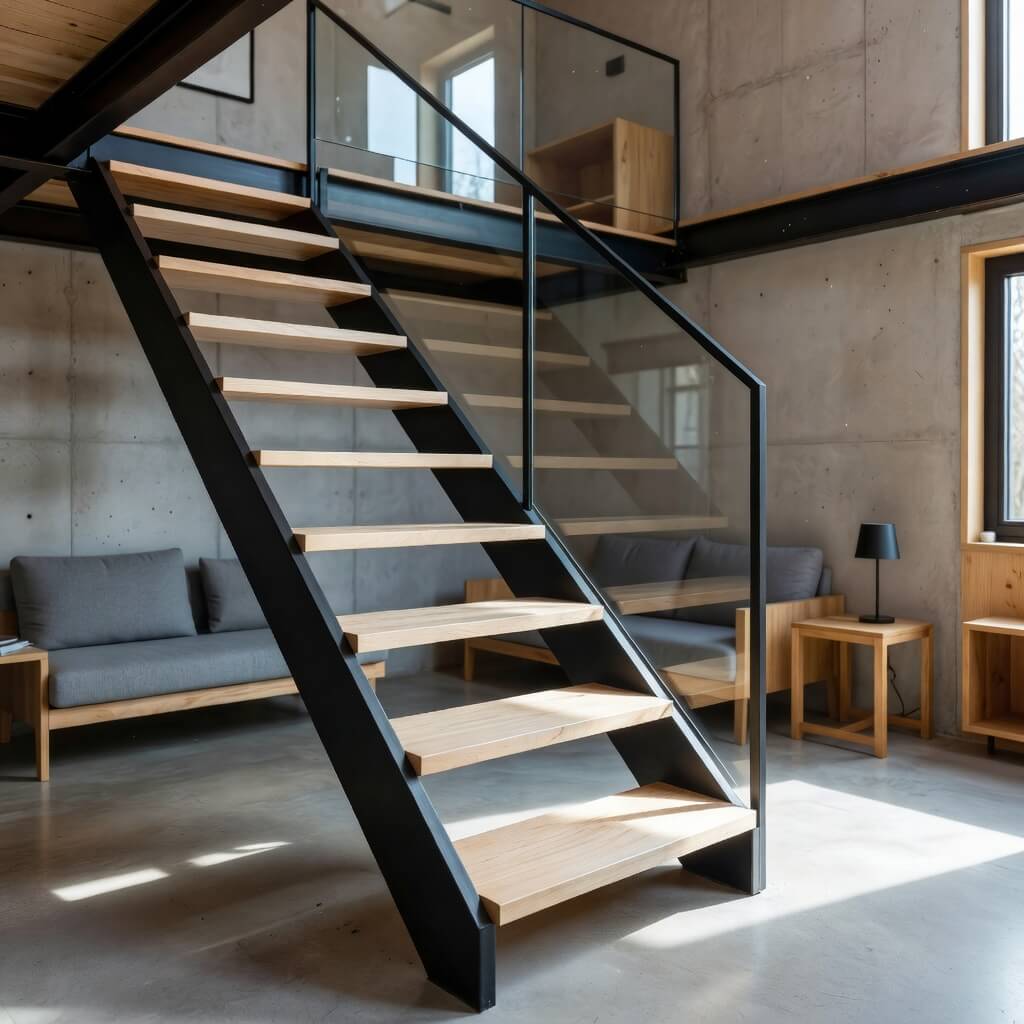
Let’s talk aesthetics for a minute. Sometimes you want your stairs to be more than just functional—you want them to make a statement. Modern metal frame stairs do exactly that while keeping the space feeling open and airy.
The beauty of metal frame stairs is in their transparency. Unlike solid wood construction that creates a visual barrier, metal frames let light and sight lines pass through. This makes your tiny house feel less divided and more cohesive.
I’m personally obsessed with the industrial-chic vibe that metal stairs bring. Whether you go with powder-coated black steel, raw steel that develops patina, or sleek aluminum, there’s something inherently cool about the look. Pair them with wood treads for warmth, or go full metal for an ultra-modern aesthetic.
Material options and their vibes:
- Black steel: Industrial, modern, super trendy right now
- Galvanized steel: Rustic-industrial, ages beautifully
- Aluminum: Lightweight, won’t rust, sleek appearance
- Powder-coated colors: Adds personality and protects metal
- Raw/weathering steel: Develops unique patina over time
The practical benefits are solid too. Metal frames are typically thinner than wood framing, which means they take up less visual and actual space. They’re also incredibly durable—properly treated metal stairs will outlast most wood construction.
One consideration: metal can be noisy. Every footstep rings out unless you add dampening elements like rubber pads under the treads or sound-absorbing materials. Learned that one the hard way in my first tiny house build :/
9. Under-Stair Closet Storage Stair Design
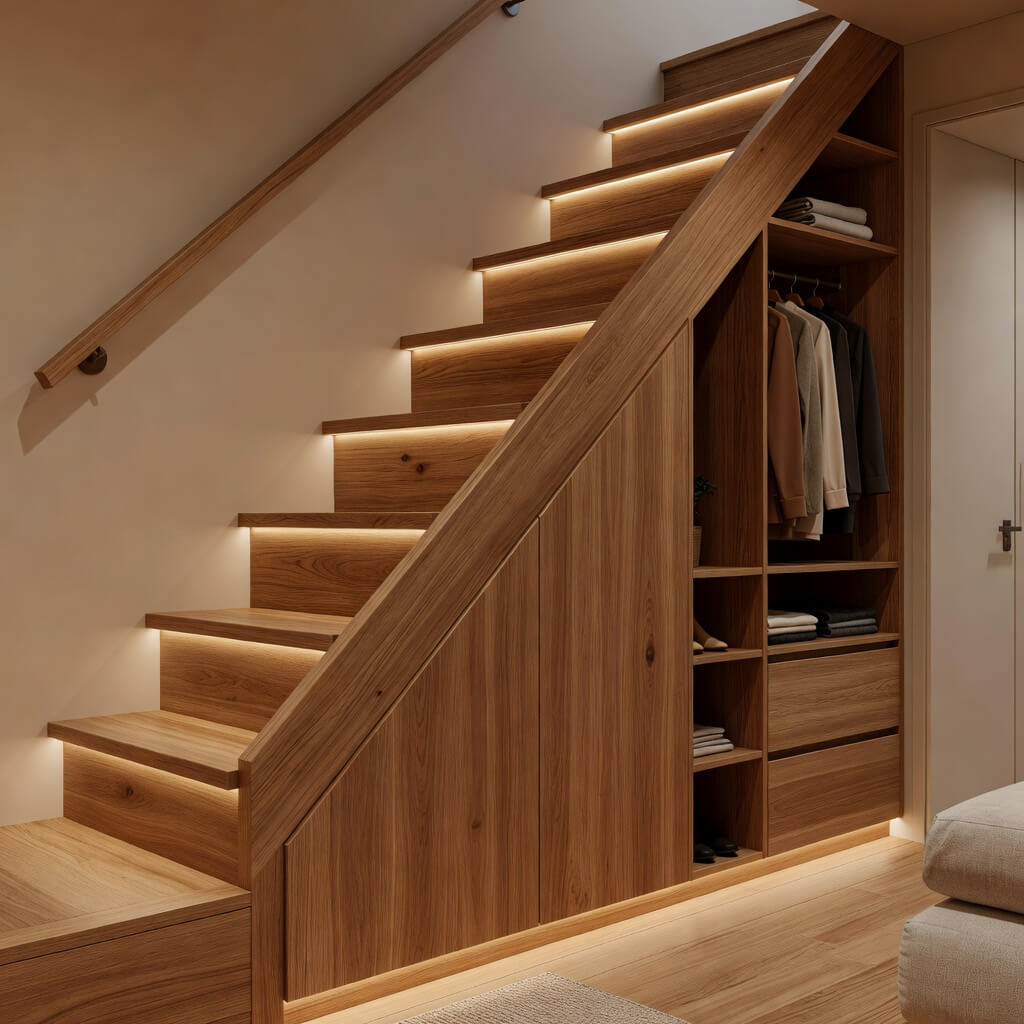
Remember how I said wasted space under stairs drives me crazy? The under-stair closet takes that principle and runs with it. Instead of drawers that pull out, you get actual closet space accessed from the side.
This design treats the area beneath your stairs as valuable real estate—because it absolutely is. You can fit a surprising amount of stuff in there. I’ve seen people create legitimate walk-in closets under their tiny house stairs, complete with hanging rods, shelves, and even lighting.
The configuration possibilities are endless. You could do a single large closet door that opens to the whole space, or multiple smaller access points at different levels. Some designs I’ve seen include a mix of drawer access on one side and closet doors on another.
Smart uses for under-stair closets:
- Coat closet near the entrance
- Pantry storage for dry goods and kitchen overflow
- Utility closet for vacuum, cleaning supplies
- Home office nook (seriously, I’ve seen this work)
- Pet hideaway and food storage
- Bathroom storage if stairs are near the bathroom
The key to making these work is thoughtful internal organization. Just creating a triangular closet without shelving or structure becomes a black hole where stuff goes to die. Custom shelving, hooks, and organizers turn it into genuinely useful storage.
Lighting makes a huge difference too. A simple battery-powered LED puck light or motion-sensor strip makes accessing items way easier than fumbling around in the dark.
Also Read: 10 Amazing Steel Stairs Design Ideas for Luxury Interiors
10. Multi-Level Platform Stair Landing System
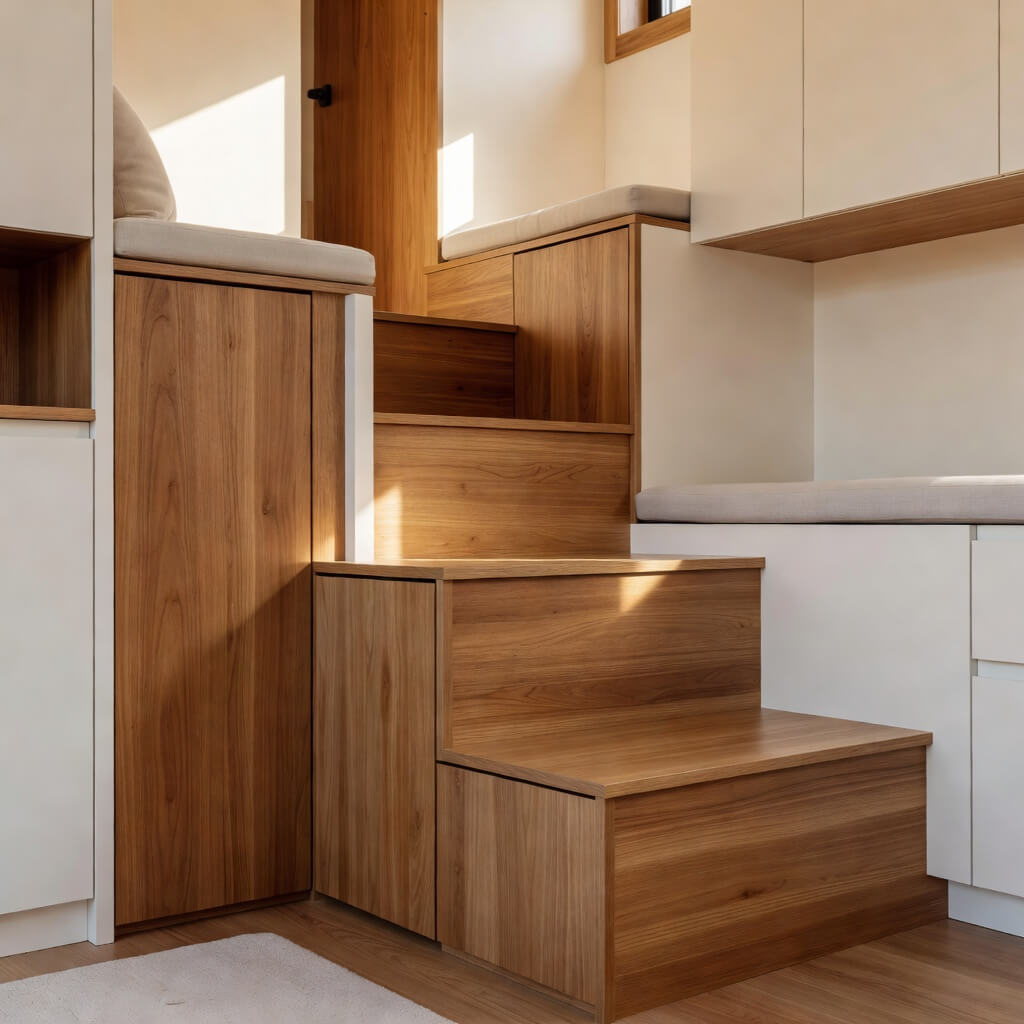
Okay, this last one is for those of you who want to completely reimagine what stairs can be. The multi-level platform system isn’t really stairs in the traditional sense—it’s more like a series of platforms at different heights that you use to ascend to your loft.
Think of it like giant steps or platforms that also serve as furniture. One platform might be at coffee table height, the next at counter height, then bar height, and so on until you reach the loft. Each level serves a dual purpose—it’s a step AND a functional surface.
I visited a tiny house that nailed this concept. The first platform was a bench for putting on shoes. The second level was the kitchen counter. The third was a desk workspace. The fourth was a reading nook. And the top platform was the loft bed. Every single level had a purpose beyond just getting you upstairs.
Why this design is brilliant:
- Maximizes the functionality of vertical space
- Creates distinct zones in an open floor plan
- Reduces the “stair-ness” of the stairs
- Adds architectural interest and dimension
- Can incorporate storage under each platform
The challenge with this system is that it requires more floor space than compact stair designs. You’re essentially creating stepped rooms rather than minimal stairs. But if you have a bit more length to work with and want maximum functionality, it’s incredible.
This approach works especially well if your tiny house has good floor space but limited vertical storage options. Each platform creates storage possibilities underneath, and the varied heights create visual interest that makes the space feel larger and more complex.
Building this requires serious planning. You need to map out exactly what each platform will be used for and ensure the heights work ergonomically for their intended purposes. A desk at the wrong height is just a poorly placed platform, you know?
Wrapping It All Up
So there you have it—ten legitimately clever ways to tackle the stair challenge in tiny houses. From floating minimalist designs to furniture-integrated masterpieces, there’s an option for pretty much every space constraint and aesthetic preference.
The real question is: what matters most to you? Space savings? Storage? Aesthetics? Functionality? Maybe it’s a combination. The beautiful thing about tiny house design is that you get to be intentional about every single element. Your stairs don’t have to be an afterthought or a necessary compromise—they can be a highlight.
I’ve learned that the “perfect” stair solution doesn’t exist universally. It’s different for everyone based on their specific needs, physical abilities, budget, and design goals. The person who needs storage will make different choices than someone prioritizing floor space. The acrobat who doesn’t mind ladder-steep stairs has different requirements than someone with knee issues.
My advice? Really think about how you’ll use your space daily. Those Instagram-worthy floating stairs might look amazing, but if you’re carrying laundry up and down three times a day, maybe storage stairs make more sense. Be honest about your lifestyle and your priorities.
And hey, if you’re still in the planning phase, consider mocking up your top choices with cardboard or temporary materials. Actually climbing your prototype stairs will tell you way more than any amount of theorizing. Trust me on this—spending a weekend with temporary stairs beats spending years with permanent ones you hate.
Whatever you choose, make it yours. Add that personal touch, whether it’s custom drawer pulls, a bold paint color, integrated lighting, or an unexpected material choice. These stairs are going to be a major feature in your tiny house, so they might as well reflect your personality.
Now go forth and conquer that vertical space like the tiny house genius you are! ????