10 Creative Half Partition Design Ideas for Small Spaces
- Partition Design
 Ben
Ben- 0
- 42 minutes read
Living in a small space feels like playing Tetris with your furniture, right? You want to create distinct zones without making your place feel like a cramped shoebox. That’s where half partitions swoop in to save the day—and honestly, they’re the unsung heroes of interior design.
I’ve spent years cramming personality into tiny apartments, and let me tell you, half partitions changed my whole game. They’re not those clunky, floor-to-ceiling walls that make you feel like you’re living in a series of closets. Nope, these beauties give you separation while keeping that precious open, airy vibe we all desperately need in small spaces.
So grab your coffee (or wine, no judgment here), and let’s chat about ten half partition ideas that’ll transform your compact space from “meh” to “wait, can I move in?” 🙂
Modern Wooden Slat Half Partition Ideas
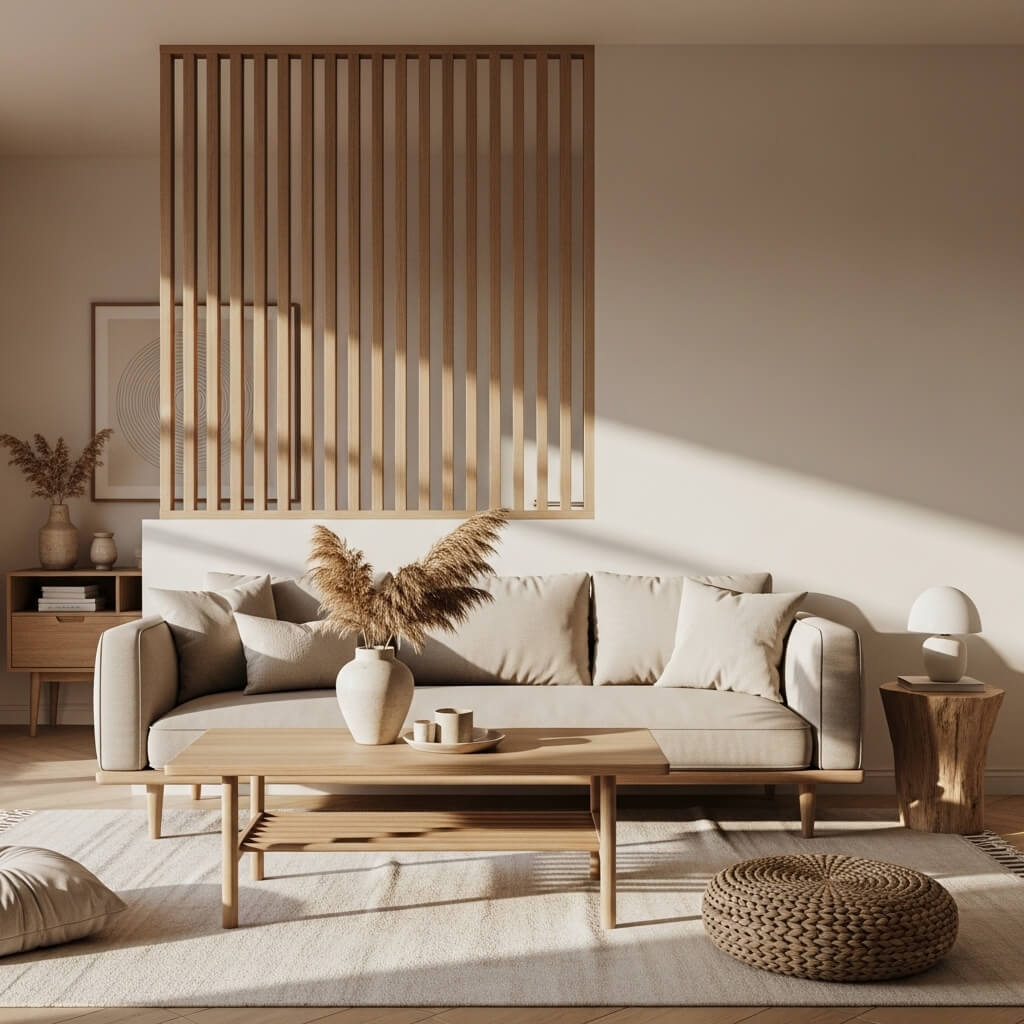
You know what’s having a major moment right now? Wooden slat partitions. They’re everywhere on Pinterest, and honestly, I get it. There’s something about those clean vertical lines that just screams sophisticated without trying too hard.
I installed one of these bad boys between my living room and entryway last year, and the compliments haven’t stopped. The beauty of wooden slats is that they create visual separation while letting light flow through—which is crucial when you’re working with limited square footage. You don’t want to block those precious rays of sunshine, especially if you’re like me and your apartment gets light from exactly one direction.
Why Wooden Slats Work Magic
Here’s the thing about wooden slat partitions: they’re ridiculously versatile. You can go:
- Light wood (like oak or birch) for that Scandinavian minimalist vibe
- Dark walnut for a more dramatic, moody atmosphere
- Painted slats if you want to inject some color personality
- Mixed spacing between slats to control how much privacy you actually want
The spacing between the slats matters more than you’d think. Tight spacing gives you more privacy but blocks more light. Wider gaps keep things breezy but everyone can see your laundry pile. Balance, my friend. It’s all about balance.
Installation Reality Check
FYI, you don’t need to hire a contractor for this unless you’re really not handy. I’ve seen some killer DIY versions using pre-made slat panels from IKEA or your local hardware store. Just mount them to a simple frame, secure it properly (please don’t skip the anchoring—nobody wants a timber avalanche), and boom. You’ve got yourself an Instagram-worthy partition.
One quick tip from personal experience? Make sure your slats run vertically if you have low ceilings. Vertical lines trick the eye into thinking your ceiling is higher than it actually is. Sneaky but effective.
Glass and Metal Half Wall Divider Designs
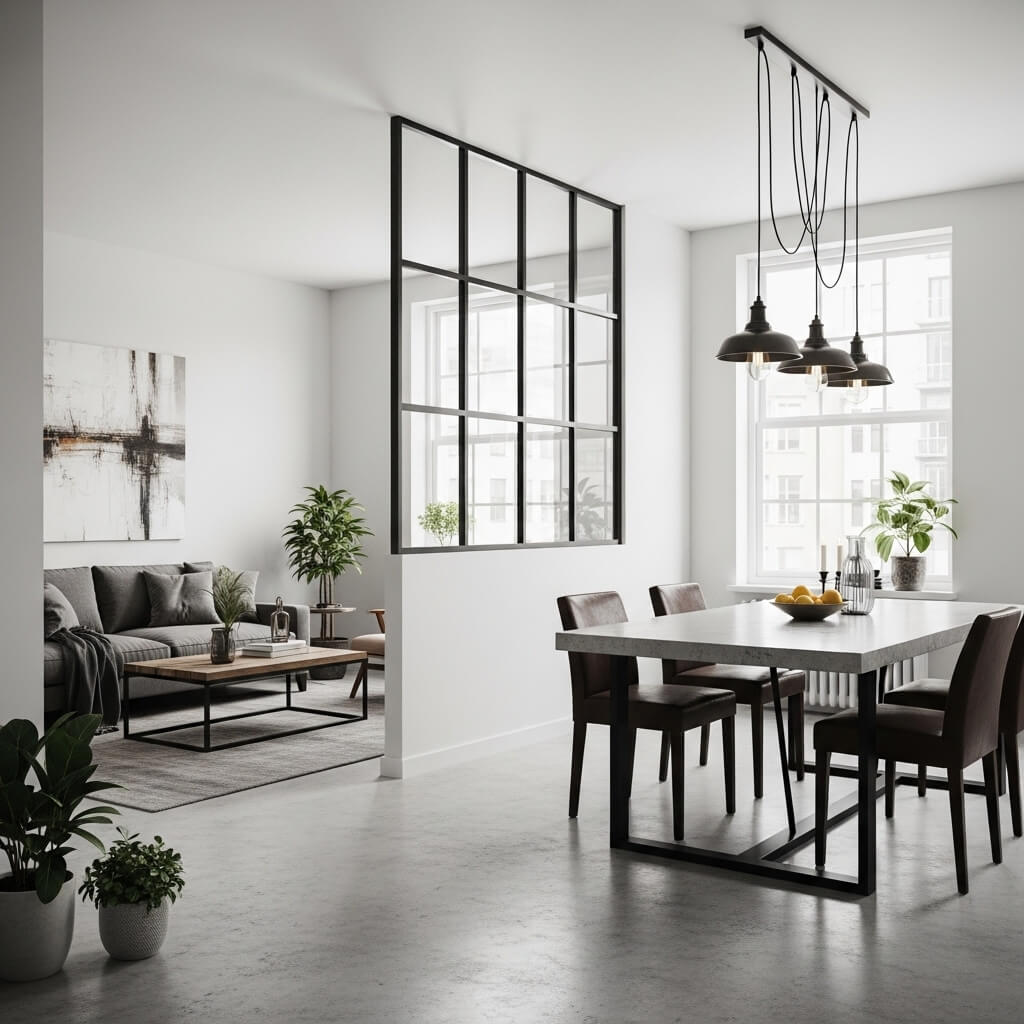
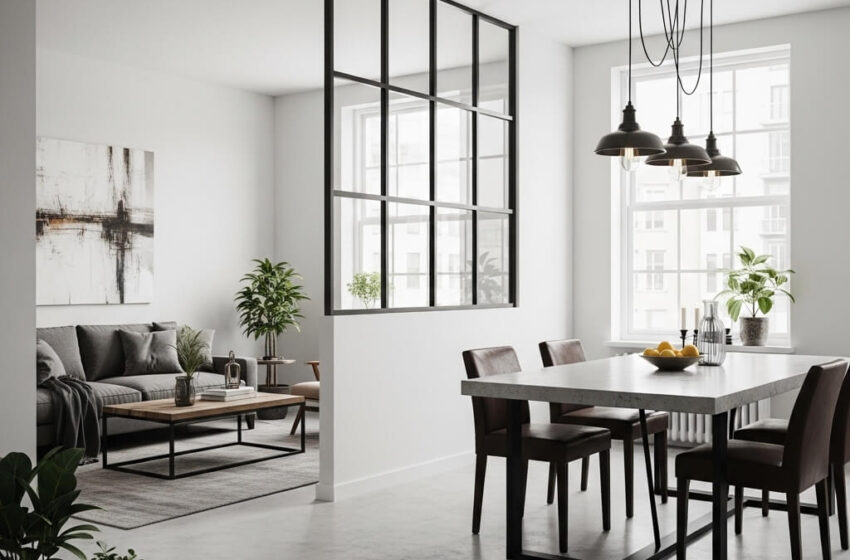
Ever wondered why high-end lofts always look so damn good? It’s the glass and metal combo, I’m telling you. This design approach is perfect if you want to keep your small space feeling open while still creating distinct zones.
I’m slightly obsessed with frosted glass and black metal frames—they give off major industrial-chic vibes without making your apartment look like an unfinished warehouse. Plus, glass partitions are phenomenal for maintaining that sense of spaciousness that small spaces desperately need.
Types of Glass to Consider
Not all glass is created equal, and choosing the right type makes all the difference:
- Clear glass: Maximum light flow, but zero privacy (great for separating your dining area from living room)
- Frosted glass: The sweet spot—you get light transmission but can’t see through it clearly
- Textured glass: Adds visual interest and diffuses light beautifully
- Tinted glass: Adds a subtle color wash while maintaining transparency
The metal framing is where you can really express your style. Black frames are having their moment (and rightfully so), but brass or copper frames add warmth that works beautifully in cozy spaces. Chrome works if you’re going ultra-modern, though IMO it can feel a bit cold.
Practical Considerations
Here’s something nobody tells you about glass partitions: they show fingerprints like crazy. If you have kids or pets (or if you’re just naturally clumsy like me), be prepared to become best friends with glass cleaner. Worth it? Absolutely. Annoying? Sometimes.
Also, make sure you’re using tempered glass. It’s stronger and safer—if it does break, it crumbles into small granular chunks instead of dangerous shards. Safety first, style second, but honestly, you can have both.
Budget-Friendly Half Partition Ideas for Small Spaces
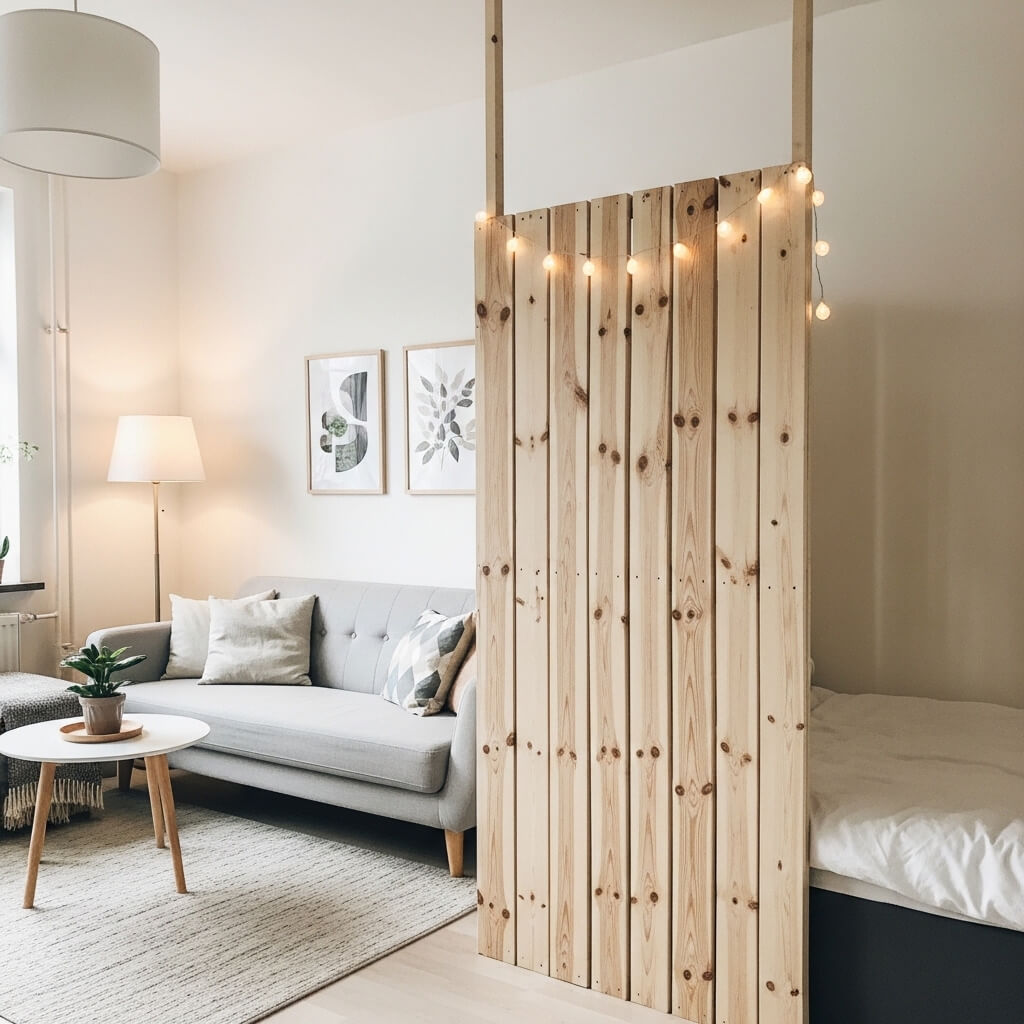
Let’s get real for a second—not everyone has thousands of dollars to drop on custom partitions. I certainly didn’t when I started out. But here’s the beautiful truth: you don’t need big money to make a big impact.
My first partition was literally made from rope and wooden dowels, and it cost me about $40. People thought I’d hired a designer. The secret? Creativity beats cash every single time.
Affordable Materials That Look Expensive
Check out these budget-friendly options that punch way above their weight class:
- Rope or macramé: Creates a bohemian vibe and costs next to nothing
- Bamboo screens: You can find these at thrift stores or IKEA for pocket change
- Fabric panels: Use curtain rods and interesting textiles for a soft partition
- Repurposed doors or windows: Hit up architectural salvage yards for unique pieces
- Pegboard: Paint it a fun color and use it as both partition and storage
I once made a partition from old wooden pallets (free from behind a grocery store, just ask nicely), sanded them down, stained them, and mounted them on a simple frame. Total cost? About $25 for stain and hardware. Total compliments from guests? Too many to count.
The DIY Advantage
Building your own partition isn’t just cheaper—it’s also custom-sized for your specific space. No awkward gaps or weird proportions. Plus, there’s something ridiculously satisfying about pointing to something in your home and saying, “Yeah, I made that.”
The internet is your best friend here. YouTube tutorials can walk you through pretty much any partition style you can imagine. Just promise me you’ll measure twice and cut once. Learn from my mistakes, please :/
Also Read: 10 Trendy Modern Partition Design Living Rooms Ideas for Cozy
Minimalist Half Wall Partition Designs for Living Rooms
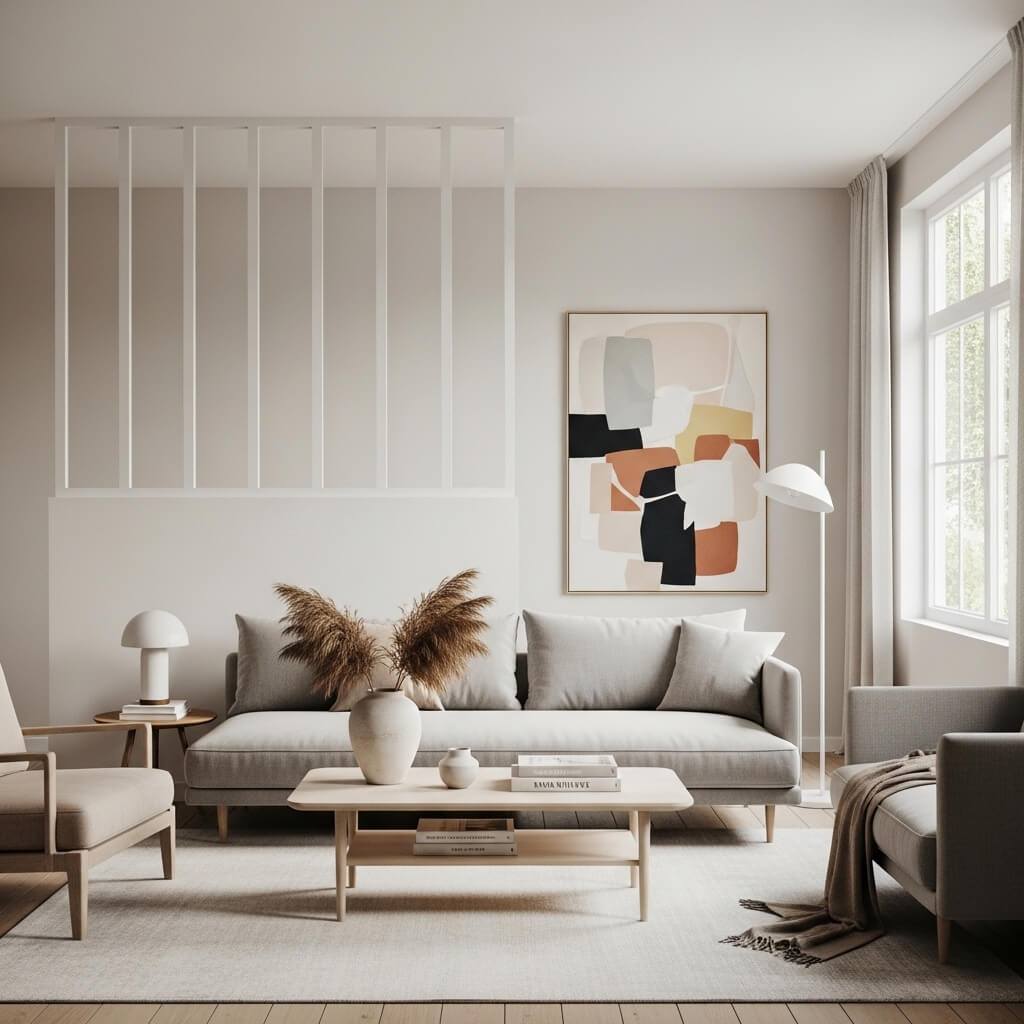
Minimalism isn’t about having nothing—it’s about having only what matters. And in small spaces? That philosophy is basically essential for survival.
I’m talking about clean lines, neutral colors, and zero clutter. A minimalist half partition should blend into your space while still doing its job of creating separation. Think of it as the quiet, competent friend who gets stuff done without making a big fuss about it.
Key Elements of Minimalist Partitions
The minimalist approach follows some pretty specific principles:
- Monochromatic color schemes: Stick to whites, grays, or one subtle accent color
- Simple geometric shapes: Rectangles, squares, clean circles—nothing too fussy
- Minimal hardware: Hidden fasteners, seamless joins, nothing visually cluttered
- Functional design: Every element serves a purpose, no decoration for decoration’s sake
My living room has a half-height solid wall painted the exact same color as the rest of the room. It separates my seating area from my work nook, but because it’s the same color and only about 3.5 feet tall, it doesn’t chop up the visual space. Sometimes the simplest solution is the best one.
Material Choices for Minimalist Vibes
Concrete, matte metal, smooth wood with minimal grain—these materials embody minimalist aesthetics. The finish matters too. Go for matte over glossy, smooth over textured, uniform over varied.
One thing I learned the hard way? Minimalist doesn’t mean boring. The beauty comes from perfect proportions and quality materials. A simple white partition made from cheap materials looks cheap. The same design in quality medium-density fiberboard (MDF) with a professional paint job? Chef’s kiss.
Stylish Open Shelf Half Partition Ideas
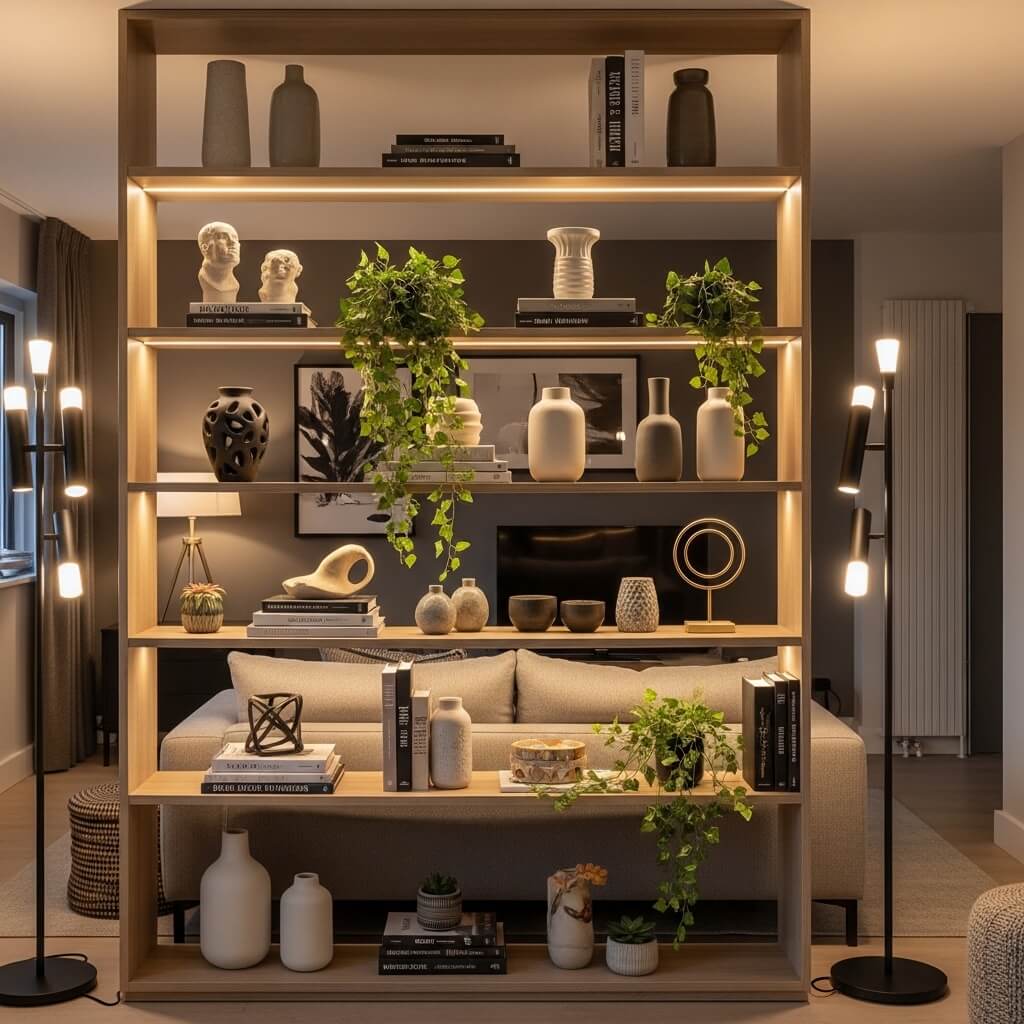
Want to know my absolute favorite type of partition? Open shelving. Why? Because it multitasks like a boss—it separates your space, provides storage, displays your personality, and doesn’t block light. What more could you want from a piece of design?
I have an open shelf partition between my kitchen and living area, and it’s the hardest-working piece of “furniture” in my apartment. It holds cookbooks, plants, decorative objects, and my embarrassingly large mug collection. Plus, you can see through it, so the space still feels connected.
Designing Your Open Shelf Partition
Here’s what you need to think about when planning an open shelf unit:
- Shelf depth: 8-10 inches is usually perfect—deep enough to be useful, shallow enough not to dominate
- Number of shelves: Odd numbers (3, 5, 7) tend to look more balanced than even
- Material weight: Heavy materials like solid wood add stability but make installation harder
- Back panel or no?: No back panel keeps it airier; a back panel adds more privacy
The arrangement of items on your shelves matters more than you’d think. I follow the rule of thirds—roughly one-third books, one-third decorative objects, and one-third breathing room. Nobody likes a cluttered shelf situation.
Styling Tips That Actually Work
Mix heights and textures. Place a tall vase next to stacked books next to a small plant. Create little vignettes on each shelf. And please, for the love of good design, leave some empty space. Negative space is just as important as the stuff you display.
Also, consider adding small LED strip lights on the top or bottom of shelves. It creates this gorgeous ambient glow that makes your partition look like it belongs in a design magazine. Plus, mood lighting is always a win.
Half Partition Designs with Built-In Storage
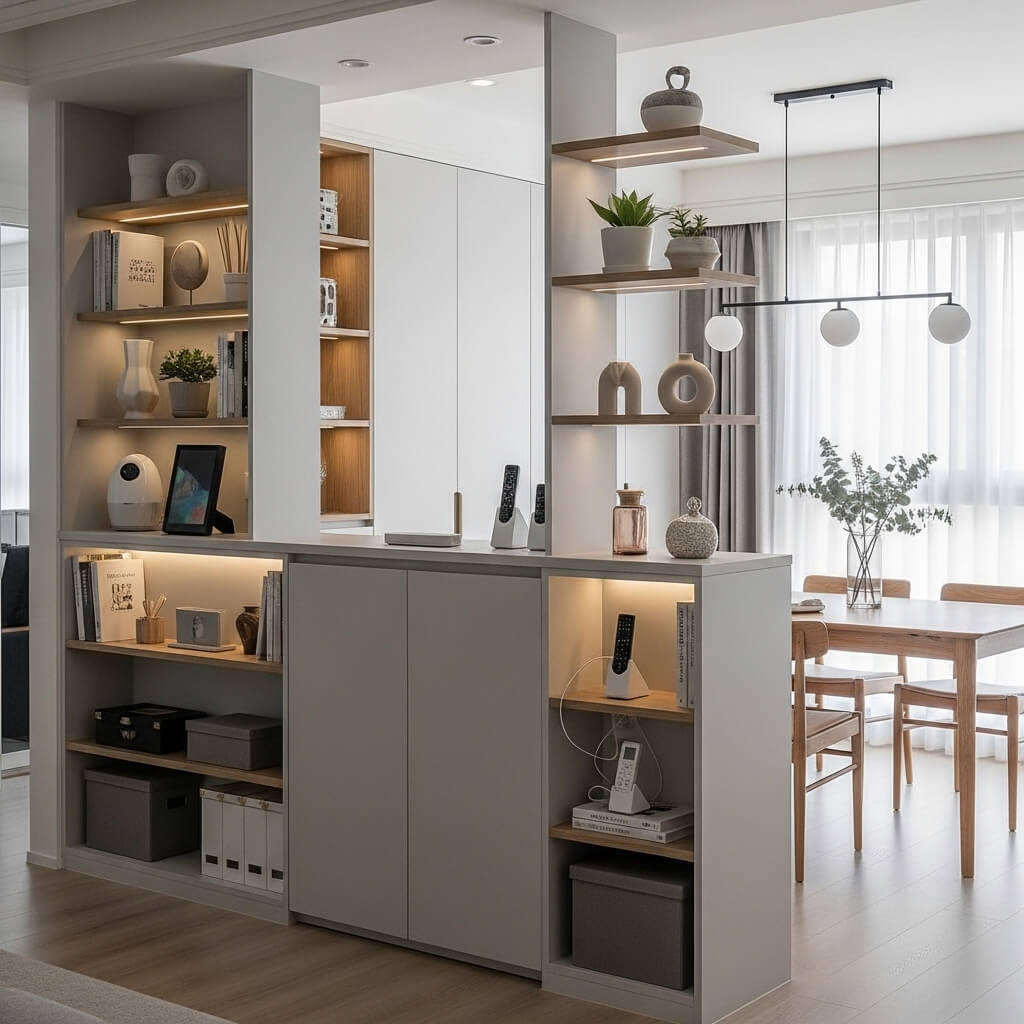
Small space living rule number one: every square inch needs to earn its keep. A partition that just sits there looking pretty? That’s a missed opportunity, my friend.
Built-in storage partitions are the MVP of small space design. They create zones AND solve your storage problems at the same time. When I redesigned my studio, I installed a partition with cabinets on one side and open shelving on the other. Game. Changer.
Storage Configuration Options
You can customize storage partitions in endless ways:
- Cabinets with doors: Hide the stuff you don’t want guests to see
- Drawers: Perfect for smaller items that need organizing
- Cubbies: Great for baskets, bins, or displaying specific items
- Combination units: Mix closed and open storage for maximum flexibility
- Hidden compartments: Get fancy with pull-out sections or secret storage
I built mine with filing cabinet drawers at the bottom (for all that adult paperwork nobody wants to deal with), open shelving in the middle (for books and plants), and closed cabinets at the top (where I hide all my craft supplies and random cables).
Planning Your Storage Needs
Before you commit to a design, actually assess what you need to store. I made a list of every category of stuff I owned—books, office supplies, kitchen overflow, electronics, etc.—and designed compartments accordingly.
Pro tip: Build in slightly more storage than you think you need. You will accumulate more stuff. It’s inevitable. Future you will thank present you for that extra shelf space.
Also Read: 10 Luxury Hall Partition Design Ideas for Elegant Homes
Contemporary Vertical Panel Half Partition Ideas
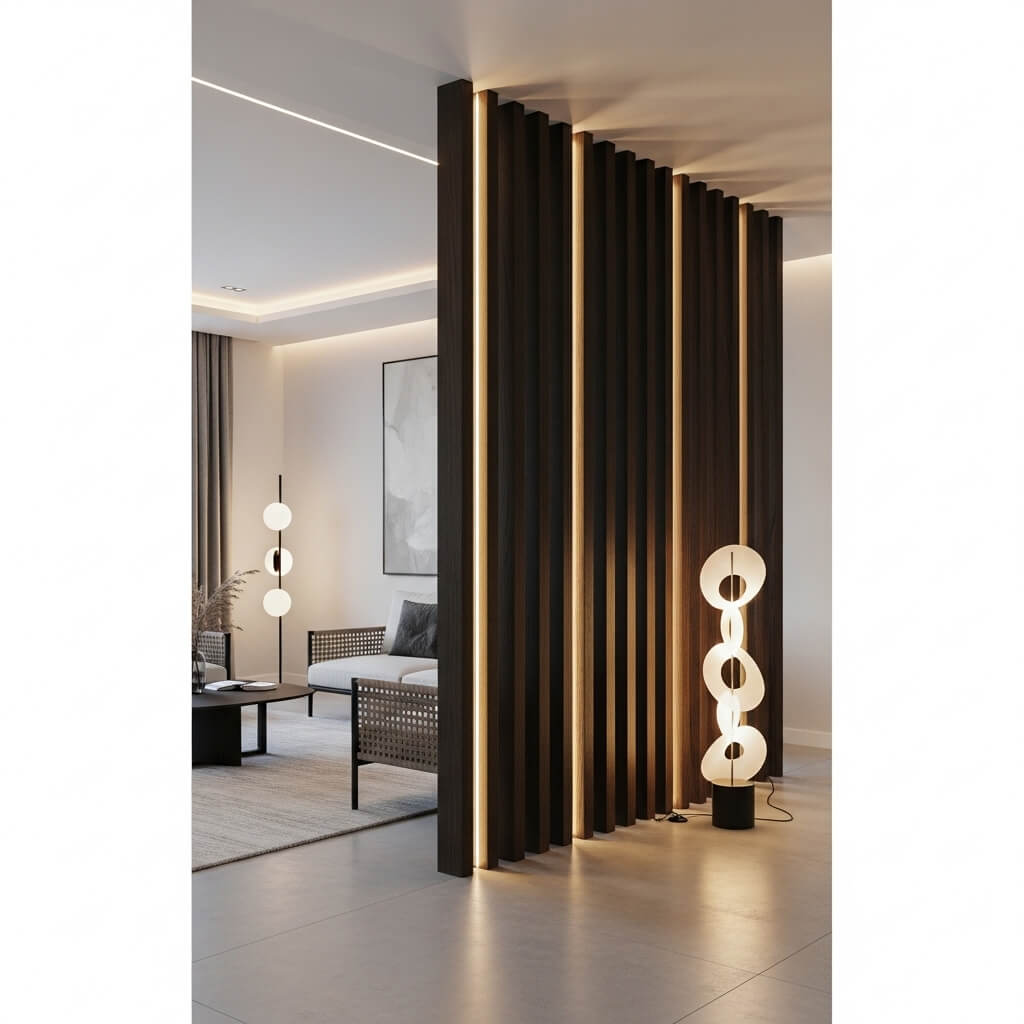
Vertical panels are having a serious moment right now, and I’m here for it. They’re sleek, modern, and they make your ceilings look taller. What’s not to love?
The contemporary vertical panel approach uses tall, narrow panels arranged in various patterns to create visual interest while maintaining that crucial sense of openness. Think of them as sophisticated cousins to the wooden slat partition we talked about earlier.
Panel Material Options
The material you choose completely changes the vibe:
- Wood panels: Warm and natural, works in almost any style
- Metal panels: Industrial and modern, makes a bold statement
- Acrylic panels: Super modern, can incorporate color and light
- Fabric-wrapped panels: Soft and sound-absorbing, cozy vibes
- 3D textured panels: Adds serious visual drama
I experimented with white acrylic panels with LED backlighting, and wow—the effect is stunning. During the day, they’re clean and minimal. At night, they glow softly and create the most incredible ambiance. Fair warning though: everyone who visits will ask where you got them.
Pattern and Spacing Considerations
You can arrange vertical panels in numerous ways. Regular spacing creates a calm, orderly feel. Irregular spacing adds visual interest and a more artistic vibe. Some panels could go floor-to-ceiling while others stop at different heights—asymmetry is very “in” right now.
The width of your panels matters too. Skinny panels (2-4 inches) create a more delicate look. Wider panels (6-8 inches) make a bolder statement. I personally like mixing widths—alternating wide and narrow panels creates rhythm and movement.
Space-Saving Half Partition Ideas for Studio Apartments
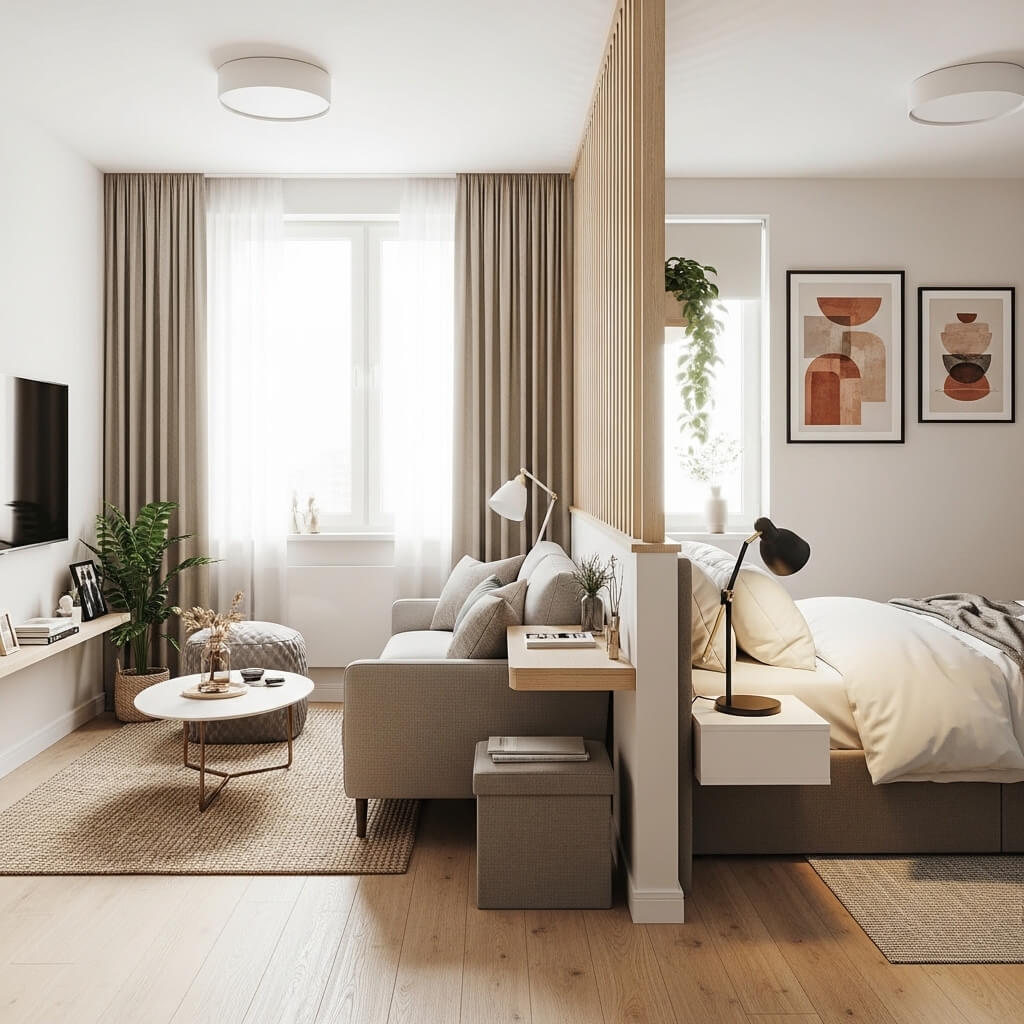
Studio apartment living is an extreme sport, and you need every space-saving trick in the book. I lived in a 400-square-foot studio for three years, and strategic partitioning was literally the only thing standing between me and complete chaos.
The challenge with studio apartments is creating the illusion of separate rooms without actually building walls. You need to define zones for sleeping, living, working, and cooking—all while maintaining flow and not making the space feel claustrophobic.
Murphy Partition Concepts
Ever heard of a Murphy bed? Apply that folding concept to partitions. I’m talking about:
- Accordion-style partitions: Fold them away when you want open space
- Rolling partitions: Move them around based on your needs
- Pivoting panels: Swing them open or closed depending on the situation
- Sliding track systems: Keep floor space clear while maintaining flexibility
My studio used a ceiling-mounted sliding partition between my bed area and living space. During the day, I slid it open for maximum space. At night, I closed it for privacy (even though I lived alone—sometimes you just want your bedroom to feel like an actual bedroom, you know?).
Multi-Purpose Partition Solutions
In a studio, your partition needs to work overtime. Consider designs that:
- Function as a headboard and room divider simultaneously
- Incorporate a fold-down desk or table
- Include hidden storage compartments
- Double as a TV mount or media center
- Serve as a clothing rack or closet extension
I built a partition that was basically a bookshelf on one side and had hooks for hanging clothes on the other. It separated my sleeping area from my living space while solving two storage problems. Efficiency at its finest.
Elegant Half Wall Divider Ideas with Lighting
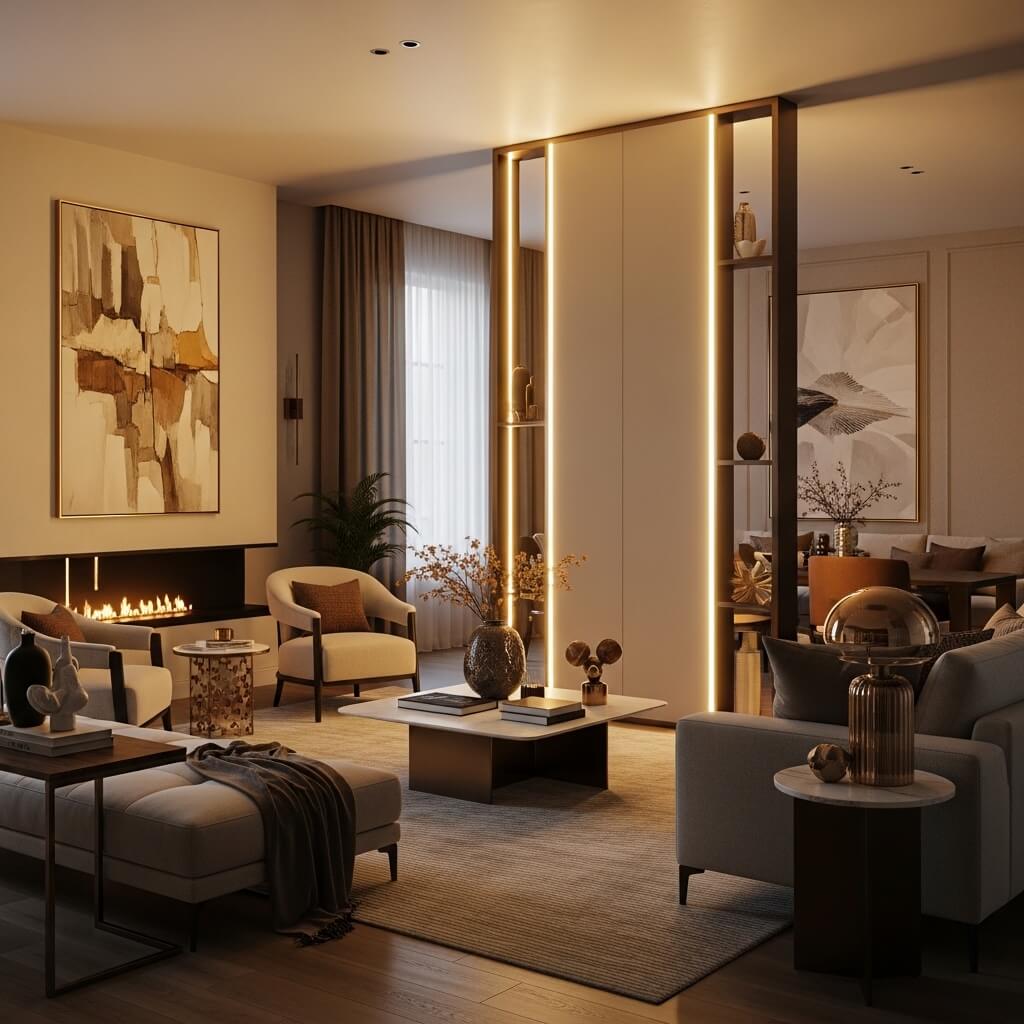
Let me tell you about the first time I added lighting to a partition—it was like someone flipped a switch (pun intended) on my entire design game. Integrated lighting transforms a functional partition into a genuine design feature.
Lighting does double duty: it enhances the partition itself while also providing ambient illumination for your space. And in small areas, good lighting is absolutely critical for making the space feel larger and more inviting.
Types of Lighting to Integrate
You’ve got options, and each creates a different mood:
- LED strip lights: Hidden along edges or behind translucent materials for a soft glow
- Puck lights: Small, focused spotlights that highlight specific areas
- Pendant lights: Hang from the top of your partition for dramatic effect
- Backlit panels: Mount lights behind frosted glass or acrylic for gorgeous diffusion
- String lights: Casual and cozy, perfect for bohemian or eclectic styles
My current favorite is vertical LED strips running up the edges of a dark wood slat partition. At night, these strips create these beautiful lines of light that make the whole partition look like a piece of art. Plus, the warm LED glow is way more flattering than harsh overhead lighting.
Installation and Control
Here’s the thing about adding lighting to partitions—plan your electrical work first. Running power to a partition in the middle of your room can be tricky. Some options:
- Battery-operated LED lights (easier installation, but you’ll need to change/recharge batteries)
- Plug-in systems with cord management solutions
- Hard-wired systems (requires an electrician but looks cleanest)
- Smart bulbs that you can control with your phone (yes, I’m that person who changes partition lighting color based on my mood)
Adding a dimmer switch or smart controls lets you adjust the lighting intensity. Bright for entertaining, dim for movie nights, off when you want the partition to recede into the background.
Also Read: 10 Amazing Office Partition Design Ideas for Stylish Interiors
Creative Half Partition Ideas for Living and Dining Separation
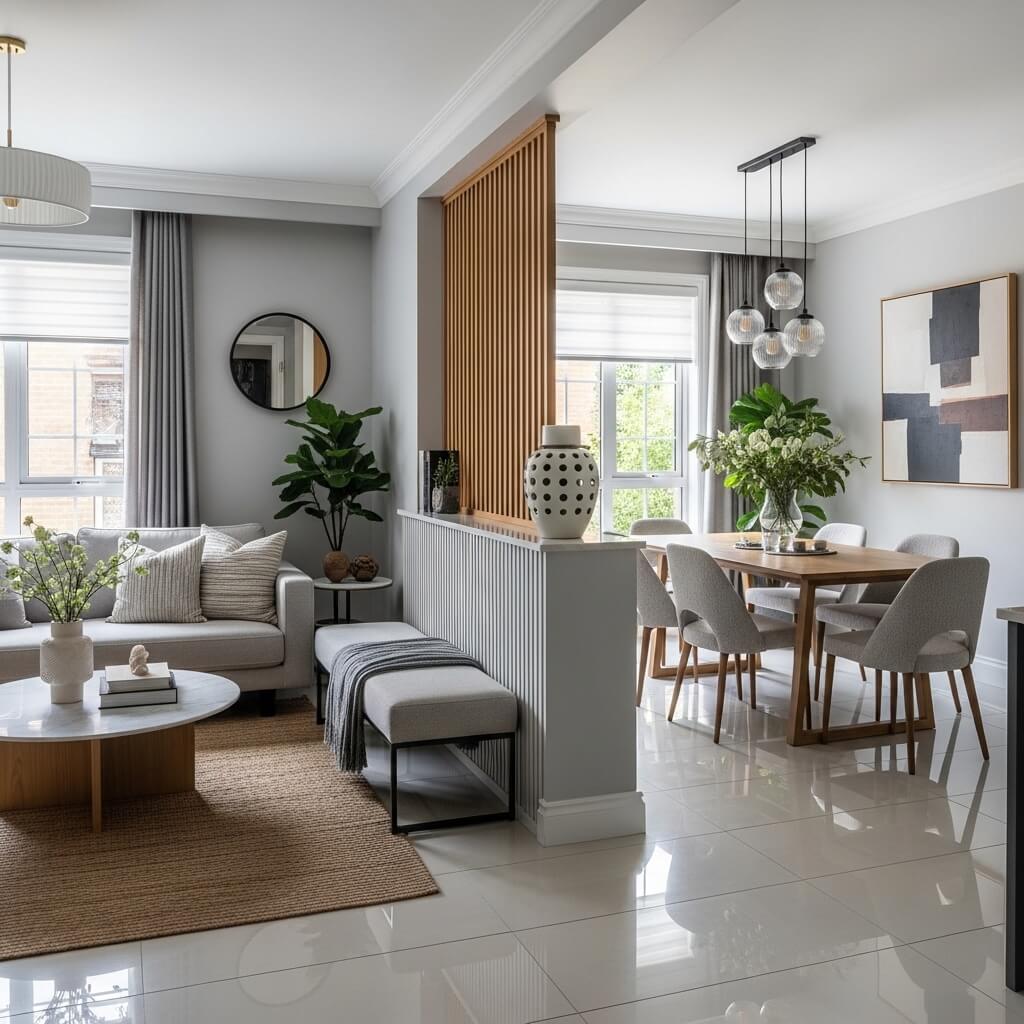
The living-dining separation is probably the most common partition need in small spaces. You want these areas to feel distinct but not totally disconnected—like two scenes in the same movie rather than completely different films.
I struggled with this exact challenge in my current apartment. The living and dining areas flow into each other, which is great for open-concept vibes but terrible when you’re trying to enjoy dinner while your messy couch situation is staring you down.
Design Approaches That Maintain Flow
The key is choosing a partition style that creates visual separation without blocking connection. Here’s what works:
- Low-height partitions (waist-high or counter-height): You can see over them, but the zones feel defined
- Transparent or semi-transparent materials: Glass, acrylic, or open frameworks
- Furniture-based partitions: Console tables, low bookcases, or even a sofa positioned strategically
- Hanging elements: Suspended panels or plants that create a “ceiling” of separation
- Platform levels: If you can raise your dining area even slightly, it creates distinction
I ended up installing a console table-style partition—essentially a narrow table at bar height that runs perpendicular to the wall. On the living room side, it’s backed by the sofa. On the dining side, it provides a surface for serving dishes or displaying a vase of flowers. It defines the spaces without building a wall.
Enhancing the Separation
Sometimes the partition itself isn’t enough—you need to reinforce the separation with other design elements:
- Different lighting: Pendant lights over the dining table, floor lamps in the living area
- Area rugs: Define each zone’s footprint
- Color variation: Subtle shifts in wall color or accent pieces
- Distinct styling: Modern in the living room, more traditional in the dining area (or whatever combination speaks to you)
The partition starts the conversation about separation, and these other elements finish it. Together, they create clearly defined zones that still feel cohesive.
Flexibility for Entertaining
Here’s where clever partition design really shines: you want the option to open things up when hosting. I’ve been to too many apartments where permanent partitions made entertaining awkward.
Consider partitions that can:
- Slide or fold away completely
- Rotate to different configurations
- Get wheeled into storage
- Simply look good whether you’re using the spaces separately or together
My console table partition actually has locking wheels hidden underneath. For normal daily life, it stays put. When I’m hosting a dinner party, I can wheel it against the wall and create one big flowing space. Best of both worlds? Absolutely.
Conclusion
Alright, so here’s the bottom line: small spaces don‘t have to feel small. The right half partition can completely transform how you experience your home, creating distinct zones while maintaining that precious sense of openness.
Whether you go with sleek wooden slats, industrial glass and metal, budget-friendly DIY solutions, or any of the other ideas we’ve explored, the key is choosing something that fits your specific needs and aesthetic. Don’t just copy what you see on Instagram (though Pinterest is definitely a great starting point—I’m not going to pretend I haven’t spent hours scrolling through partition inspiration).
Think about how you actually use your space. What zones do you need to create? What functions does your partition need to serve beyond just visual separation? Do you need storage? Lighting? Flexibility? Answer these questions first, and the right design will become obvious.
And remember—you don’t need to get it perfect on the first try. I’ve moved partitions, rebuilt them, painted over my initial color choices, and completely started from scratch more times than I can count. That’s part of the fun, honestly. Your space should evolve with you.
Now go forth and partition with confidence! Your small space is about to feel a whole lot bigger. And when your friends ask who designed your place? Just smile mysteriously and say you had some help from a fellow small-space enthusiast who gets the struggle. 🙂
Happy decorating!