10 Clever Shoe Rack Design Ideas for Small Space Solutions
- Rack Design
 Ben
Ben- 0
- 34 minutes read
Look, I get it. You’ve got seventeen pairs of shoes cluttering your entryway, and your apartment is approximately the size of a shoebox itself. The irony isn’t lost on me. I’ve lived in spaces where I genuinely wondered if the architect forgot that humans own things—like, you know, shoes. But here’s the thing: small spaces don’t mean you have to live like a chaotic mess or sacrifice your shoe collection (because let’s be real, that’s not happening).
I’ve spent years figuring out how to make tiny spaces work, and I’m about to share some genuinely clever shoe storage solutions that’ll make you wonder why you ever tolerated that pile of sneakers by your door. These aren’t your grandma’s boring shoe racks. We’re talking smart, stylish, and space-savvy designs that actually fit into real life.
Hidden Under-Stairs Shoe Storage Cabinet
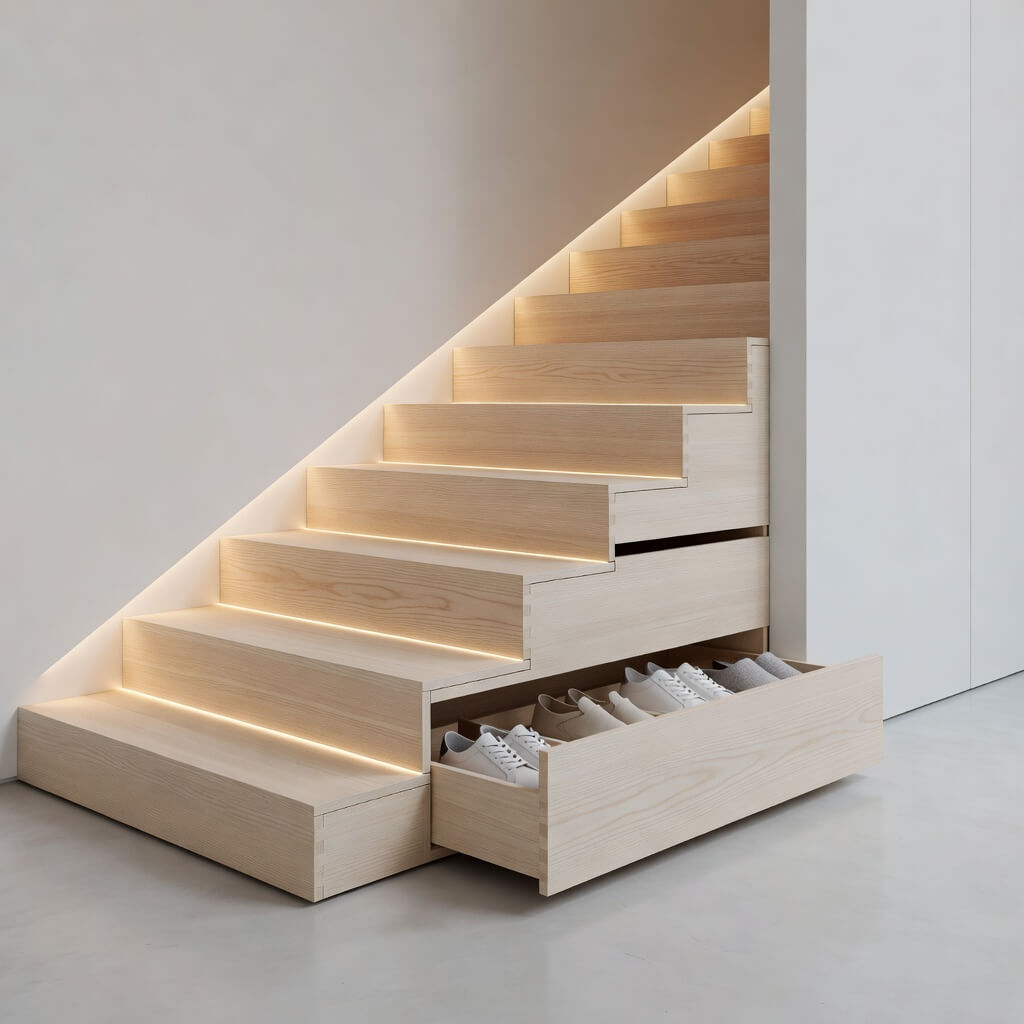
Ever look at that weird triangular space under your stairs and think, “What even is that for?” Well, my friend, that’s prime real estate you’ve been ignoring.
Under-stairs shoe storage cabinets are absolute game-changers for small homes. I installed one in my last place, and it held about 30 pairs of shoes while looking like just another sleek cabinet. The beauty of this design lies in using dead space—that awkward area that usually collects random junk and forgotten umbrellas.
You can customize these cabinets with pull-out drawers, tilted shelves, or even small cubbies for different shoe types. Here’s what makes them brilliant:
- Maximum capacity: Depending on your staircase, you can fit 20-40 pairs easily
- Hidden storage: Guests won’t see your shoe chaos
- Multi-functional: Add a cushioned top, and boom—you’ve got seating
- Custom fit: Every under-stairs space is different, so you can design it exactly for your needs
The installation does require some carpentry skills or hiring someone who knows what they’re doing. I learned this the hard way when my first DIY attempt looked like something from a horror movie :/ But once it’s done right, you’ll kick yourself for not doing it sooner.
Making It Work for You
Consider what shoe types you own most. Got tons of heels? Install slanted shelves. Mostly sneakers? Go with standard shelving. You can even add LED strip lighting inside to make finding shoes easier—because who hasn’t fumbled around in the dark looking for that one specific shoe?
Minimalist Wall-Mounted Floating Shoe Rack
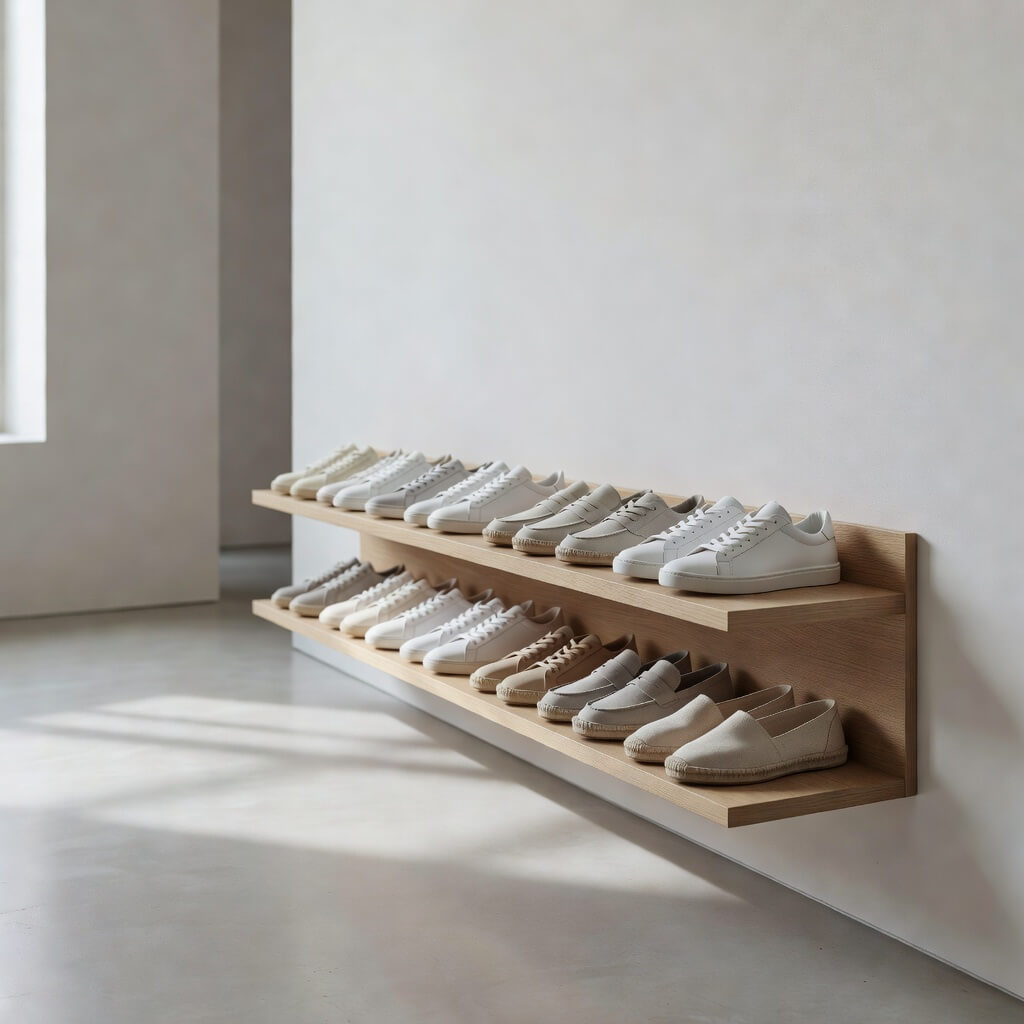
If you’re renting or just hate bulky furniture, wall-mounted floating shoe racks will become your new obsession. These sleek designs mount directly to your wall and create the illusion that your shoes are just… floating there. Stylish? Check. Space-saving? Double check.
I threw one of these up in my entryway last year, and the compliments haven’t stopped. The minimalist design works with literally any decor style, from industrial lofts to cozy cottages. Plus, they keep your floor completely clear, which makes your space feel larger and makes cleaning ridiculously easy.
Here’s what you need to know:
- Weight capacity matters: Check how much each rack holds (usually 15-30 pounds)
- Stud mounting: Always mount into wall studs for heavy-duty holding power
- Height placement: Install at knee-to-waist height for easy access
- Multiple racks: Stack them vertically for more storage without eating floor space
The only downside? You need to be comfortable drilling into walls. If your landlord has a meltdown over holes, this might not be your solution. But honestly, a little spackle fixes everything when you move out.
Style Options
You’ll find these in metal, wood, acrylic, and even rope designs. IMO, the metal ones in matte black or brass look incredibly sharp and handle weight better than the wooden versions. But if you’re going for that warm, Scandinavian vibe, light wood floating racks are chef’s kiss.
Sliding Door Entryway Shoe Organizer
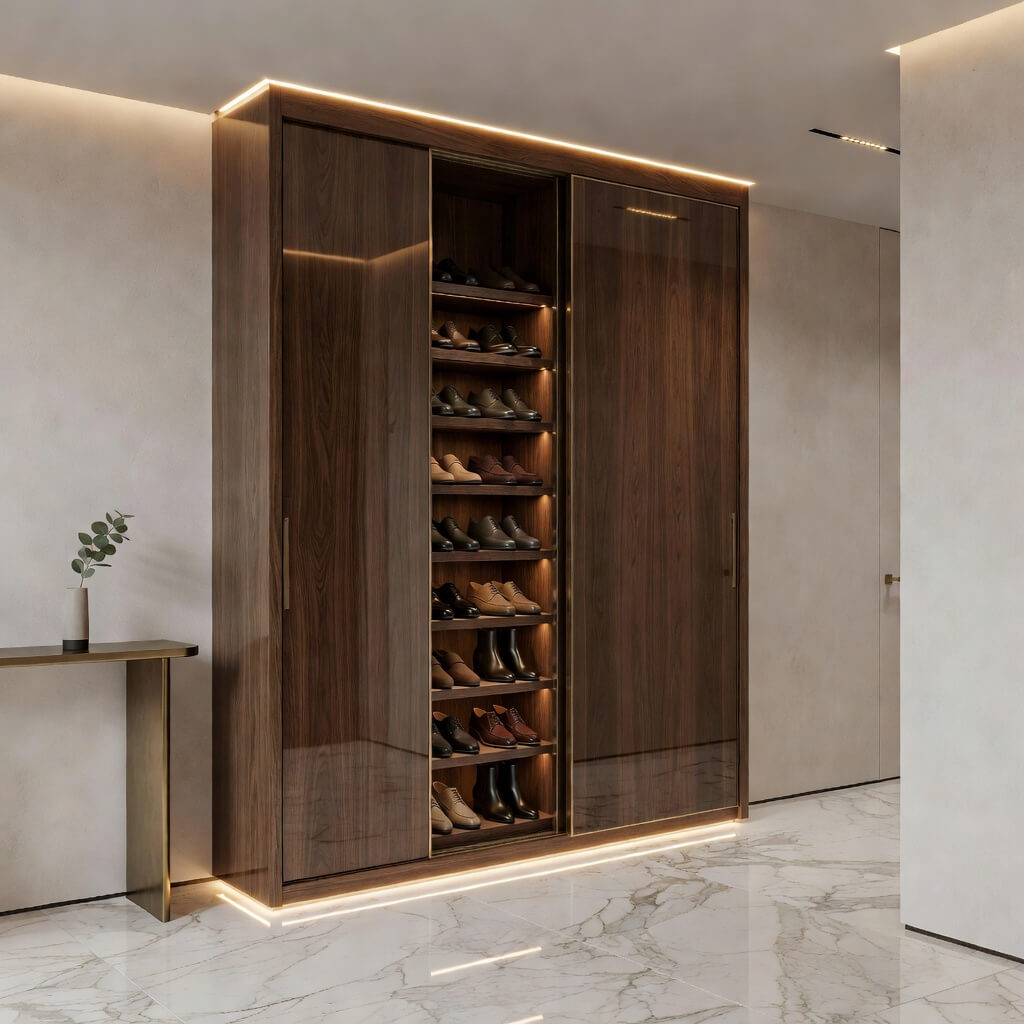
Want to know a secret? Sliding doors are the unsung heroes of small space living. They don’t require swing clearance, which means you save a ton of functional space right there.
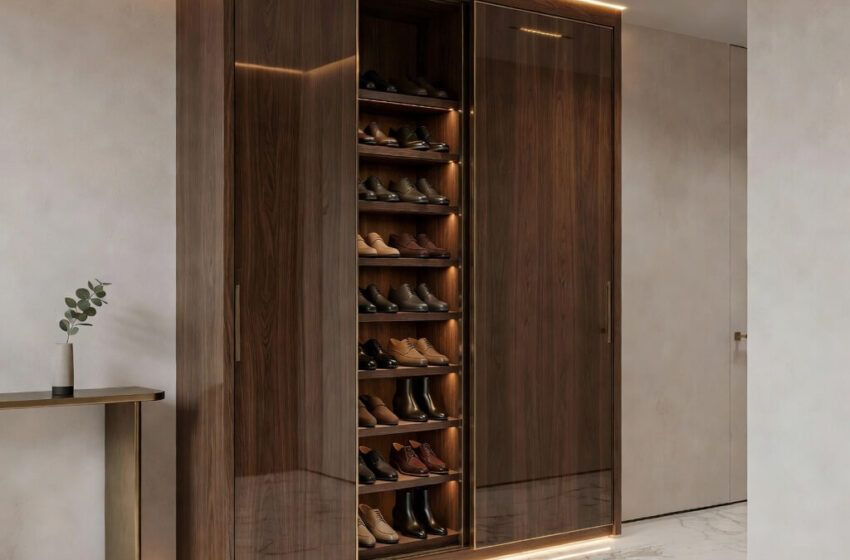
A sliding door shoe organizer works perfectly in entryways where every inch counts. Picture this: a sleek cabinet with sliding doors that glide open to reveal organized rows of your favorite footwear. When closed, it looks like a piece of furniture that actually belongs in a grown-up’s home.
I recommended this to my sister who lives in a studio apartment, and she practically cried tears of joy when she installed it. Her shoes went from being scattered across three different areas to being centrally located and completely hidden.
Key features to look for:
- Soft-close mechanism: Prevents slamming and makes it feel expensive
- Adjustable shelving: Accommodates everything from flats to boots
- Depth options: Slim designs (around 10-12 inches deep) work better for tight entryways
- Top surface: Use it as a landing spot for keys, mail, and your phone
You can find these in various sizes, but for small spaces, aim for something around 30-40 inches wide. Any larger, and it starts dominating the room. Any smaller, and you might as well just use a basket.
Installation Tips
Most sliding door organizers come as standalone furniture pieces, so no wall mounting required. Just assemble (grab a friend and some wine for this part) and position it. The sliding doors should move smoothly—if they stick or derail easily, return that sucker immediately.
Also Read: 10 Brilliant Kitchen Under Stairs Ideas for Organized Spaces
Bench Style Shoe Rack with Seating Space
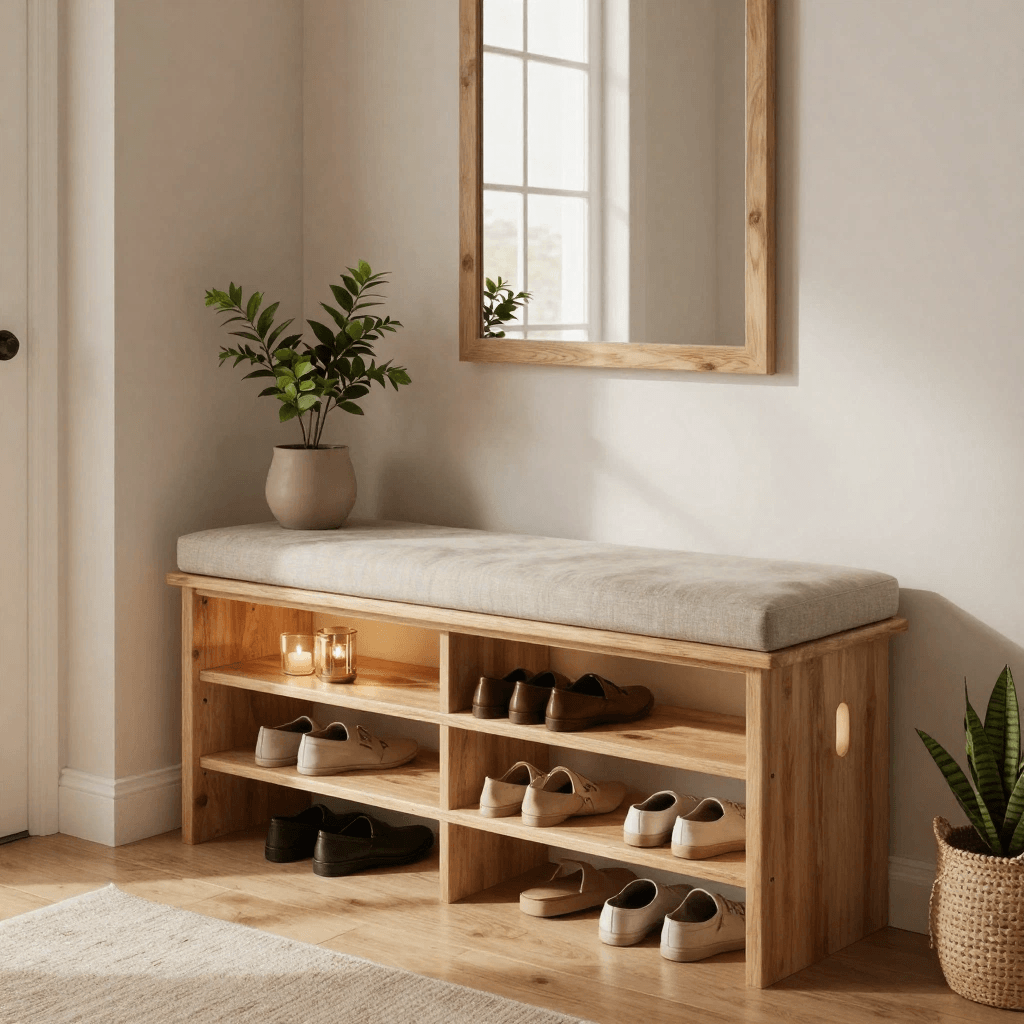
Why have furniture that only does one thing when it can do two? Bench-style shoe racks are the multitaskers you didn’t know you needed.
These clever designs combine a comfortable seat with shoe storage underneath. You sit down to put your shoes on (like a civilized person instead of that awkward flamingo stance we all do), and your shoes live right below. It’s so logical that I’m annoyed I didn’t think of it first.
I’ve got one in my entryway right now, and I genuinely can’t imagine life without it. Guests use it when they arrive, my kids can actually reach it to put their shoes away (well, sometimes), and it holds about 8-12 pairs depending on the size.
What makes bench-style racks awesome:
- Dual function: Seating + storage = small space win
- Sturdy construction: Most support 200-300 pounds of sitting weight
- Open or closed storage: Choose based on whether you want shoes visible
- Cushioned tops: Add comfort and a pop of color or texture
You’ll find these in tons of styles—from rustic farmhouse wood to modern upholstered designs. Pick something that matches your space’s vibe, but don’t sacrifice storage capacity for looks. That’s a rookie mistake.
Choosing the Right Size
Measure your entryway before you buy. A bench that’s too large will block traffic flow, and one that’s too small won’t hold enough shoes. For most small spaces, a 36-inch wide bench hits the sweet spot. It seats two people comfortably and stores a decent amount of footwear.
Vertical Stackable Shoe Storage Tower
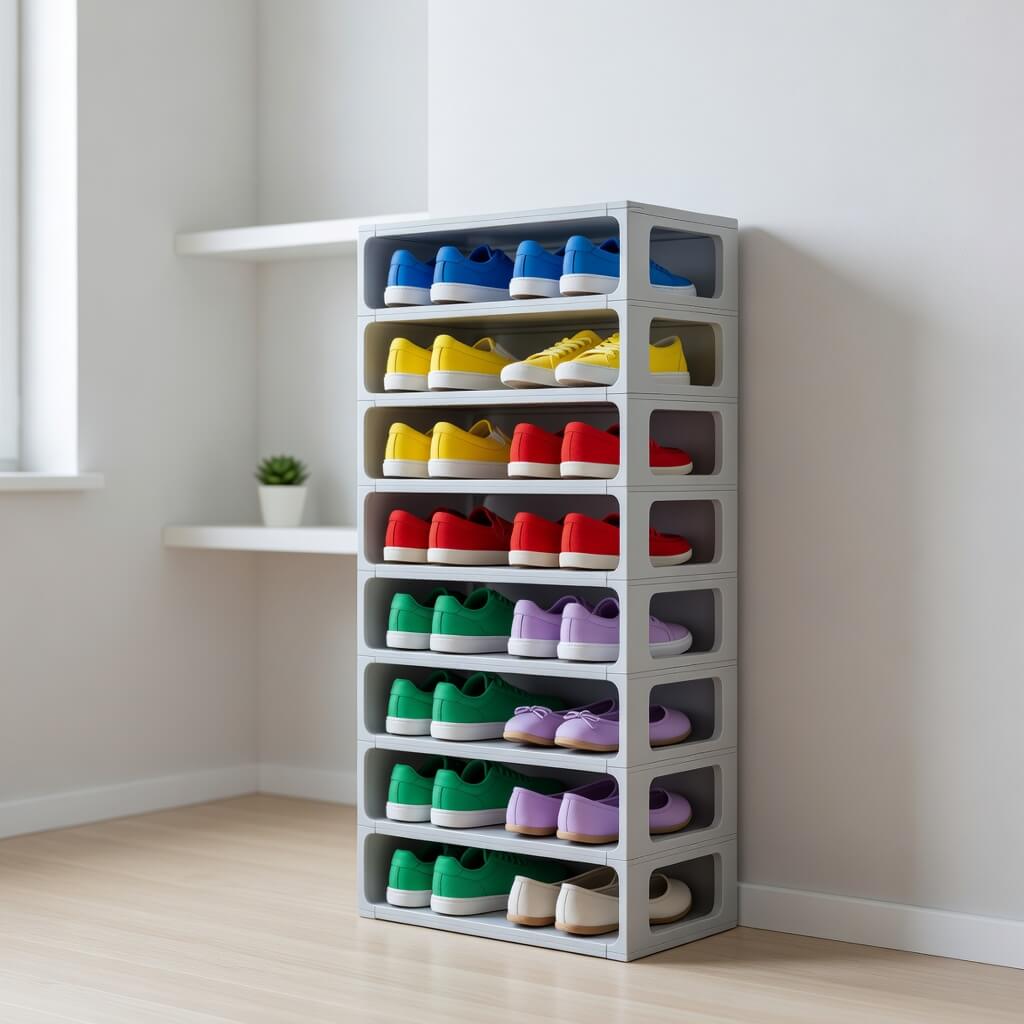
When you’re short on floor space, the answer is simple: go vertical. Stackable shoe storage towers make use of your wall height instead of your precious floor real estate.
These towers stack shoe cubbies or shelves vertically, creating a column of organized footwear that takes up minimal floor space. I used one in a closet that was embarrassingly narrow, and it completely transformed the space. Suddenly, I could see all my shoes at once instead of digging through a pile like some kind of desperate archaeologist.
Vertical towers work especially well in closets, corners, or alongside furniture. They’re like the Tetris solution to shoe storage—fitting into spaces you didn’t think could hold anything useful.
Benefits of going vertical:
- Small footprint: Usually only 12-18 inches wide
- High capacity: Can hold 15-30+ pairs depending on height
- Modular design: Add or remove sections as your collection changes
- Visibility: See everything at once, so you actually wear all your shoes
Some designs come with angled shelves that display shoes better, while others use simple flat shelves. The angled ones look cooler but hold fewer shoes—there’s always a trade-off, isn’t there?
Stability Matters
Here’s something I learned the hard way: tall, narrow furniture + earthquakes (or clumsy moments) = disaster. FYI, most quality vertical towers come with wall anchors. Use them. I don’t care how stable it seems—anchor that thing to the wall. Your shoe collection will thank you.
Corner Space-Saving Shoe Shelf Design
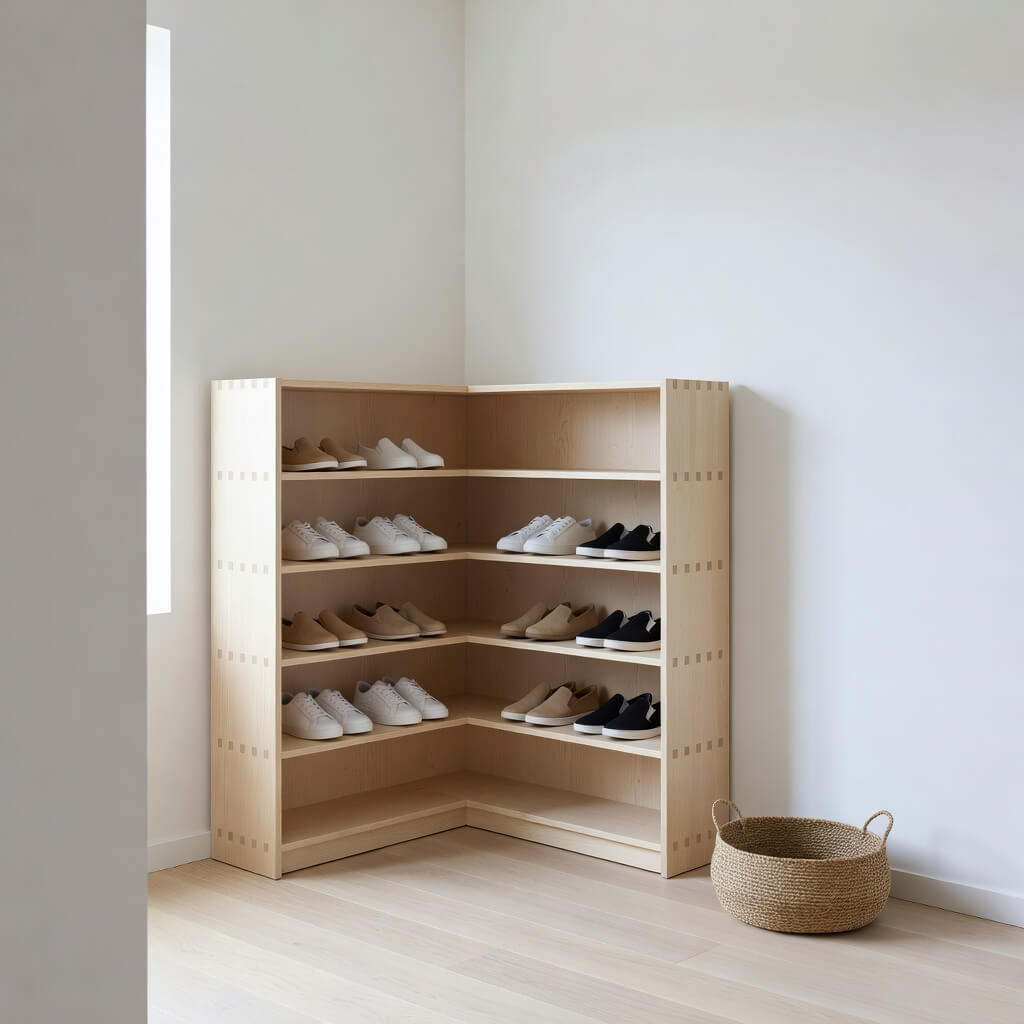
Corners are the Bermuda Triangle of small spaces—stuff goes there and somehow disappears forever. But corner shoe shelves turn that dead zone into something actually productive.
Corner shelves are specifically designed to fit into those 90-degree angles that standard furniture can’t utilize. They’re perfect for tiny entryways, bedroom corners, or even bathroom corners if you’re one of those people who changes shoes multiple times a day (no judgment here).
I put a three-tier corner shelf in my bedroom, and it holds about 9-12 pairs while taking up space I wasn’t using anyway. Plus, it looks intentional and decorative rather than just “I needed somewhere to dump my shoes.”
Why corner shelves work:
- Utilize wasted space: Corners usually sit empty anyway
- Compact design: Typically 12-15 inches on each side
- Multiple tiers: 3-5 levels are common
- Easy access: Everything stays visible and reachable
You’ll find corner shelves in metal, wood, and plastic. The metal ones tend to be sturdier and hold weight better, but wooden designs add warmth to the space. Plastic… well, it’s cheap, but it also looks cheap. You get what you pay for.
Styling Your Corner Shelf
Don’t just cram shoes onto every available surface. Add a small plant on the top tier or a decorative box to store shoe care supplies. Mix function with style, and suddenly your corner shoe shelf looks like an intentional design choice rather than a desperate storage solution.
Also Read: 10 Genius Tiny House Stairs Ideas Small Space Saving Ideas
Pull-Out Drawer Shoe Rack Cabinet
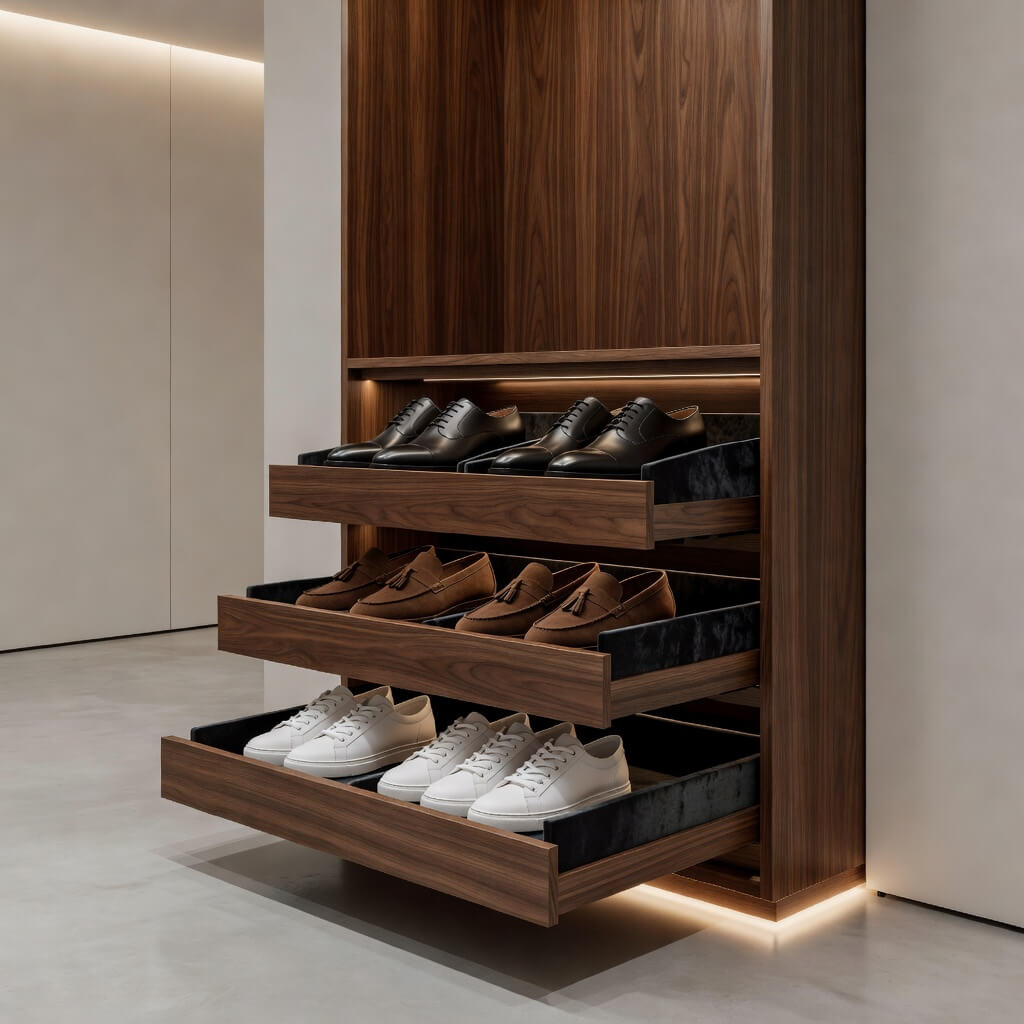
Pull-out drawer systems are absolute genius for keeping shoes organized and hidden. These cabinets look like regular furniture from the outside, but they contain sliding drawers specifically designed for shoe storage.
I helped my parents install one of these in their mudroom, and watching my dad’s face light up when he saw how it worked was honestly adorable. Each drawer pulls out smoothly to reveal a row of shoes, and when you close it, everything disappears. It’s like magic, but with better organization.
What makes pull-out drawers special:
- Complete concealment: Shoes stay completely hidden and dust-free
- Easy access: Pull out the drawer you need instead of digging through everything
- Organized by type: Assign different drawers for different shoes
- Furniture-quality: Looks polished and intentional, not like storage furniture
These cabinets work best in entryways, closets, or bedroom corners. You can find slim versions (around 12 inches deep) that hold shoes heel-to-toe, or deeper versions (18+ inches) that store shoes side by side.
Quality Considerations
Not all drawer mechanisms are created equal. Look for soft-close drawers with ball-bearing slides—they’ll last longer and won’t slam shut on your fingers. Cheaper versions use plastic tracks that break faster than your New Year’s resolutions. Trust me, spend a bit more upfront and save yourself the frustration.
DIY Wooden Crate Shoe Organizer
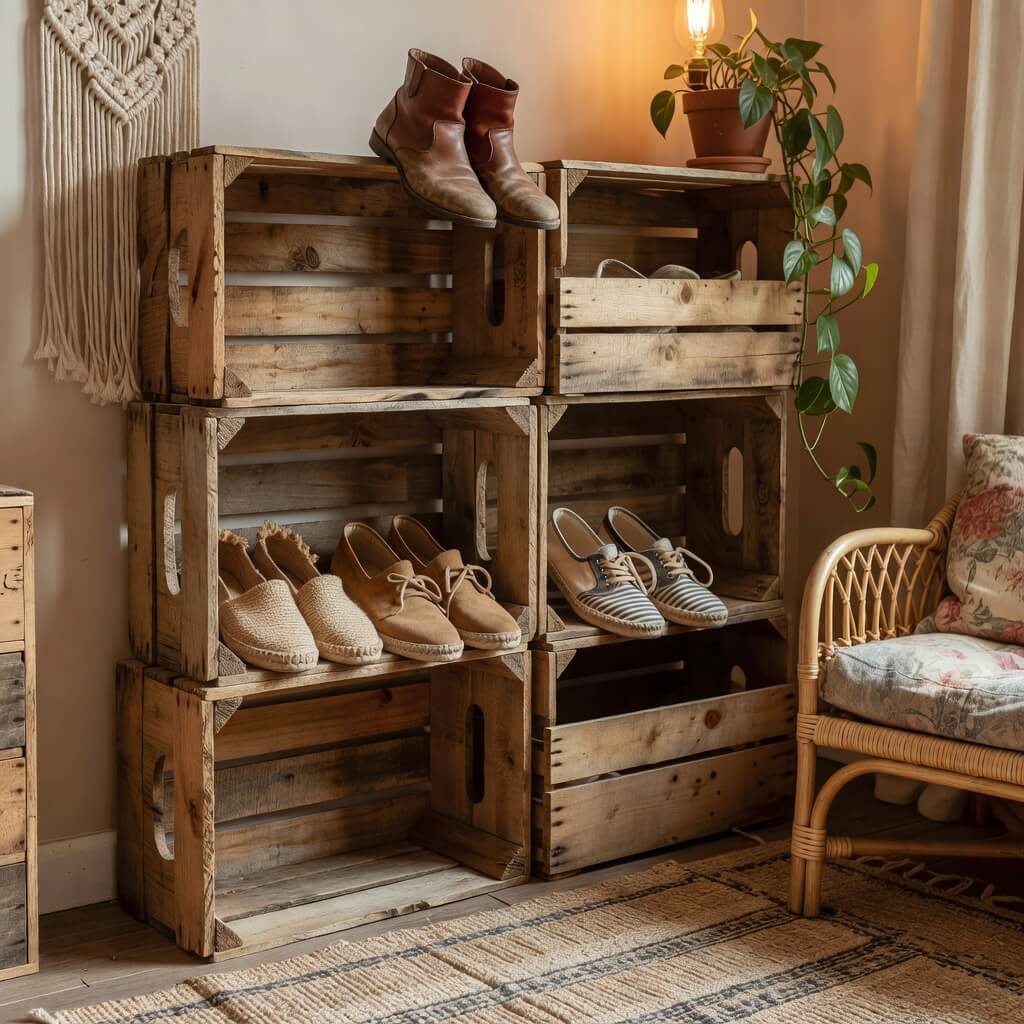
Ready to get a little crafty? Wooden crate shoe organizers are budget-friendly, customizable, and surprisingly stylish when done right. Plus, you get to tell everyone you made it yourself, which is always a humble-brag win 🙂
You can grab wooden crates from craft stores, flea markets, or even online for pretty cheap. Stack them, mount them to walls, or arrange them on the floor—the possibilities are genuinely endless. I made one using six crates arranged in a 2×3 grid, and it cost me about $40 total compared to the $200+ I was seeing for similar pre-made options.
Why DIY wooden crates rock:
- Budget-friendly: Crates cost $5-15 each typically
- Customizable: Stain, paint, or leave them natural
- Easy assembly: Just stack and secure—no advanced carpentry needed
- Rustic charm: Adds character and warmth to any space
You can leave the crates as open cubbies for easy shoe access, or add fabric bins inside for a cleaner look. Some people even add backing boards or line them with pretty paper for a finished appearance.
Assembly and Finishing
Stack your crates in whatever configuration works for your space. Use wood screws or brackets to secure them together and prevent shifting. Sand any rough edges (splinters are not cute), and apply your finish of choice. I used a dark walnut stain on mine, and it looks way more expensive than it actually was.
For stability, attach the top crate to the wall using L-brackets. This prevents the whole thing from toppling if someone (kids, pets, clumsy adults) pulls on it or bumps into it.
Mirror Door Shoe Storage Closet Design
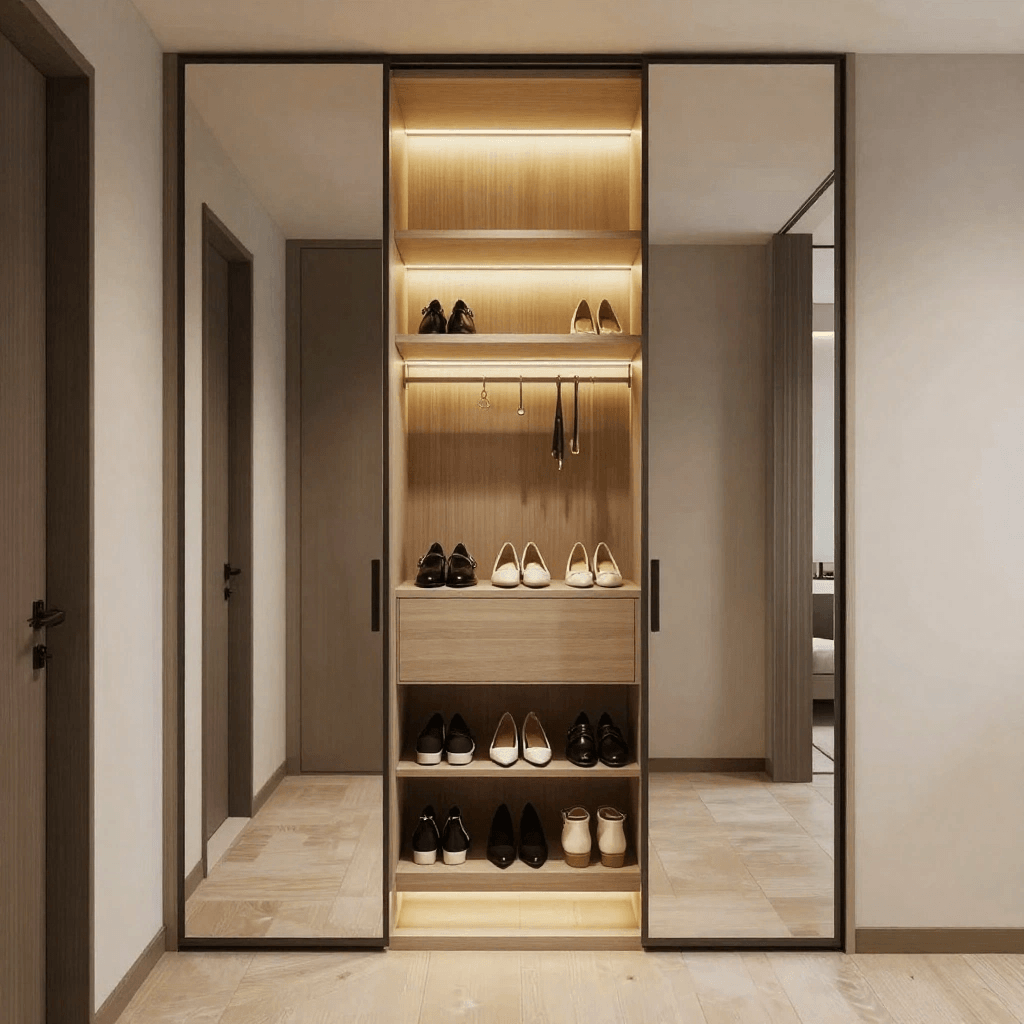
Want to blow your mind with efficiency? Mirror door shoe storage closets hide massive shoe collections while simultaneously making your space feel larger. It’s like getting two upgrades in one purchase.
These clever closets feature a mirrored front that reflects light and creates the illusion of more space—a classic small-space trick. Open the door, and you’ll find rows of shoe storage inside. I’ve seen designs that hold 20-50+ pairs of shoes while looking like a simple full-length mirror from the outside.
I installed one of these in my bedroom, and honestly, it’s one of the best purchases I’ve ever made. Getting ready is easier because I can see my full outfit, and my shoes went from cluttering my closet floor to being neatly organized and hidden.
Benefits of mirror door storage:
- Space illusion: Mirrors make rooms feel larger and brighter
- Dual purpose: Full-length mirror + shoe storage
- High capacity: Stores significantly more shoes than most options
- Sleek appearance: Looks modern and intentional
These usually come as floor-standing cabinets or wall-mounted units. Floor-standing versions are easier to install but take up floor space. Wall-mounted designs require solid installation but keep the floor completely clear.
Placement Strategies
Position your mirror cabinet somewhere you’ll actually use the mirror—like near your closet or by the bedroom door. Avoid placing mirrors directly across from your bed if you’re superstitious or if catching your reflection when you wake up at 3 AM freaks you out (it me).
Also Read: 10 Gorgeous Bar Under Stairs Ideas for Home Upgrade
Open Industrial Metal Frame Shoe Rack
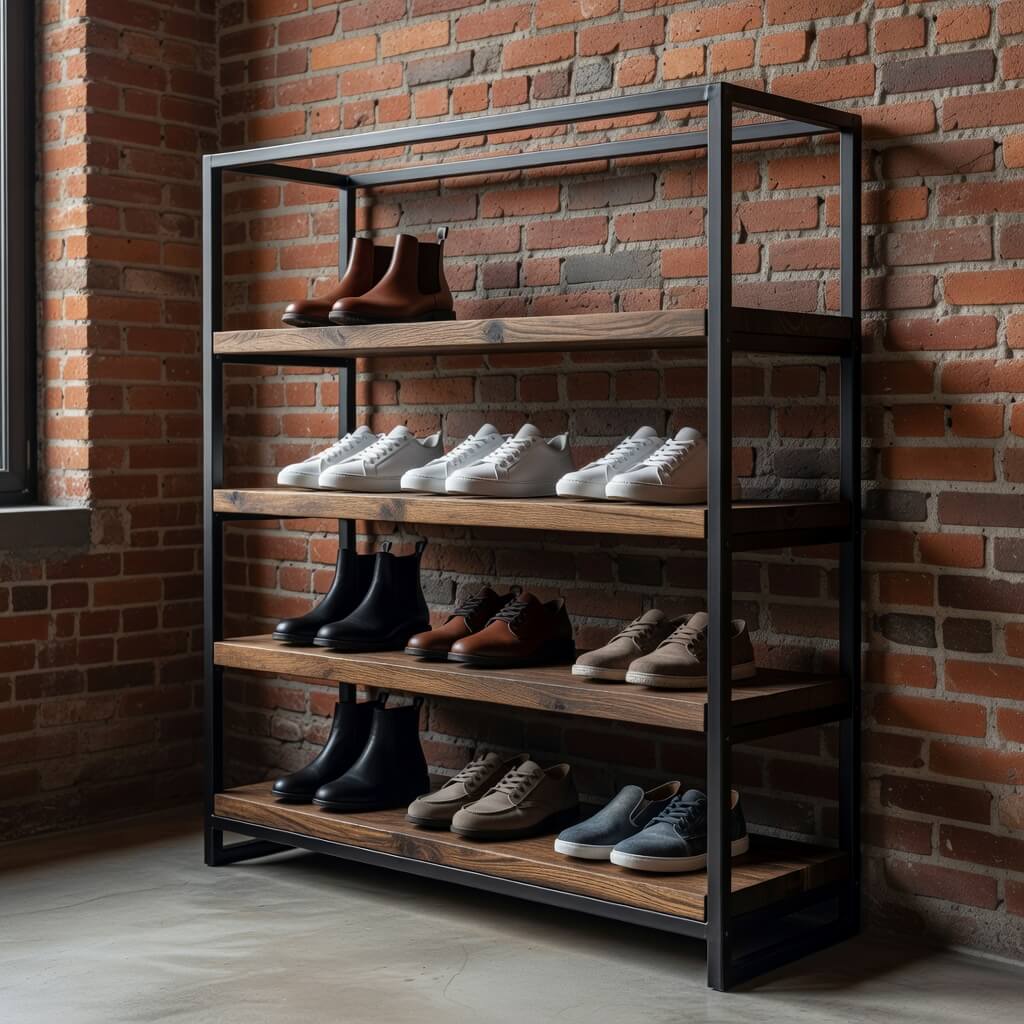
Sometimes you want your shoes on display—especially if you’ve got a collection of sneakers or designer heels that deserve to be seen. Open industrial metal frame racks showcase your footwear while keeping everything organized and accessible.
These racks typically feature metal frames (usually black powder-coated steel or brass finishes) with open shelving. The industrial aesthetic works brilliantly in modern, contemporary, or even eclectic spaces. They add an edgy, intentional vibe that closed cabinets can’t quite achieve.
I’ve got one in my walk-in closet (okay, it’s more like a walk-through closet, but whatever) displaying my favorite sneakers. It’s become a functional decoration that makes me happy every time I see it.
Why industrial metal racks work:
- Style statement: Turns shoe storage into decor
- Airflow: Shoes dry out properly and don’t get musty
- Easy cleaning: Wipe down shelves in seconds
- Affordable: Often cheaper than enclosed cabinets
- Assembly: Most require minimal setup
The downside? Everything’s visible, so you need to keep things tidy. If you’re someone who throws shoes haphazardly and doesn’t care how they land, this isn’t your solution. These racks look best when shoes are neatly arranged and curated.
Choosing Quality Materials
Look for powder-coated steel rather than cheaper painted metal. Powder coating resists scratches and won’t chip as easily. The welds should be smooth and solid—if you see rough, uneven welds, that’s a red flag about the overall quality.
Wrapping This Up
Listen, living in a small space doesn’t mean you have to sacrifice style or organization. These ten shoe rack designs prove you can have both—even when you’re working with limited square footage.
From utilizing forgotten under-stairs spaces to going vertical with stackable towers, there’s genuinely a solution here for every type of small space and every aesthetic preference. The key is choosing something that matches both your space constraints and your lifestyle. If you’re not going to maintain a perfectly arranged open rack, go with hidden storage. If you need multifunctional furniture, grab that bench-style option.
I’ve tried most of these solutions myself over the years (the joys of moving frequently), and each one solved a specific storage headache. Your shoes deserve better than being kicked into a corner or piled by the door. And honestly, so do you—because tripping over shoes when you’re stumbling home exhausted is nobody’s idea of a good time.
Pick a solution, commit to it, and watch your small space transform from chaotic to calm. Your shoes—and your sanity—will thank you.